How Much Does a Concealed Carry Class Cost? Permit Class Prices by State
Published on October 17, 2026
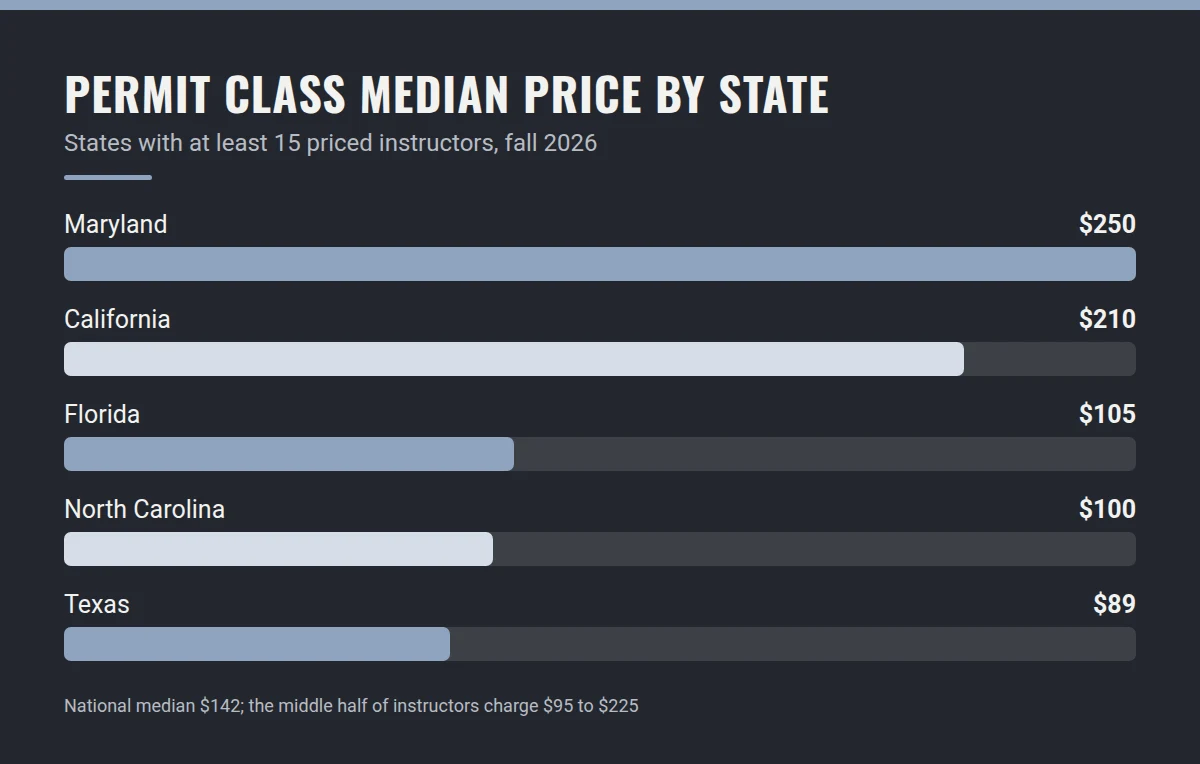
A concealed carry permit class typically costs $142. Half of the instructors and ranges listed in this directory charge less than that and half charge more, and the middle half of them charge between $95 and $225. The state you live in matters more than anything else. The same permit class runs $89 in Texas and $250 in Maryland, because the two states demand very different amounts of training before they will issue a permit, and an instructor who has to deliver sixteen hours of classroom time and a range qualification cannot charge what one delivering four hours can.
This guide covers what the class price includes and what it leaves out, how prices compare across the states, why the gap between them is so wide, the state fees and ongoing costs that come on top of the class, and how to judge whether a cheap class is a bargain or a pricey one is worth the money. At the end you will find class listings for every city on this site and answers to the questions readers ask most often.
What a Concealed Carry Class Costs Nationally
Prices in this guide come from the published price lists of more than 700 concealed carry instructors and ranges listed in this directory, collected in late September and early October 2026. We show the median (the middle price) so one very cheap or very expensive one does not skew it.
Table 1. National prices by service (services with at least 10 priced instructors). A permit class price is for the whole class a state requires for its permit, and the state’s own application and fingerprinting fees are never included.
| Service | Typical price (median) | Middle half of instructors |
|---|---|---|
| Concealed carry permit class | $142 | $95 to $225 |
| Permit renewal class | $125 | $75 to $188 |
| Basic pistol class | $140 | $100 to $180 |
| Advanced or defensive pistol course | $156 | $100 to $250 |
| Private lesson, per session | $142 | $99 to $200 |
| Online course | $85 | $50 to $120 |
| First aid or stop-the-bleed class | $111 | $89 to $150 |
| Range time (lane fee) | $25 | $18 to $39 |
| Gun rental | $22 | $15 to $30 |
The permit class price is for the entire course your state requires, which runs from a few hours in some states to 16 hours or more in others. In most listings that price covers the classroom hours, the range qualification where the state requires one, the targets and the lane time for that qualification, and the certificate you hand to the sheriff or state police with your application. Many classes include the ammunition for the qualification string. Others ask you to bring a box of your own, which is worth checking before you book, because it can add a meaningful amount to a cheap class. The extras to look for are a rental pistol if you do not own one yet, eye and ear protection if you have none, any practice ammunition beyond the qualification itself, and the state’s application and fingerprinting fees, which are a separate payment to the government and are covered later in this guide.
No state sets the price of the class. The Texas Department of Public Safety says plainly that it does not regulate what its certified instructors charge. New York’s concealed carry guidance says training costs and locations are set by the instructor. The Nebraska State Patrol tells applicants that the course cost is not part of the permit fee, varies by instructor, and is paid directly to the instructor. Kentucky is the exception that proves the rule: its statute caps what an instructor may charge for the applicant course at $75, plus no more than $10 for range use, targets and classroom rental, and it allows the instructor to pass on the actual cost of ammunition.
The rest of Table 1 puts the permit class in context. A basic pistol class, which teaches handling and marksmanship without the legal block, costs about the same ($140 against $142), and an advanced or defensive pistol course costs only a little more ($156). A private lesson runs $142 a session and an online course $85. The permit class, in other words, is not the expensive part of carrying a gun responsibly. It is simply the part the state makes you buy, and the training that matters most comes after it.
Permit Class Prices by State
The state figures below are limited to states where enough instructors publish a price to make a median meaningful. Table 2 lists the states with at least 15 priced instructors; Table 3 groups the rest by region, so a thin state’s figure is not swung by two or three listings.
Table 2. Concealed carry permit class prices by state (states with 15 or more priced instructors).
| State | Concealed carry permit class (median) | Middle half |
|---|---|---|
| Maryland | $250 | $185 to $300 |
| California | $210 | $154 to $299 |
| Florida | $105 | $94 to $194 |
| North Carolina | $100 | $94 to $118 |
| Texas | $89 | $69 to $105 |
Table 3. States with fewer than 15 priced instructors, grouped by region, with a combined median for the concealed carry permit class.
| Region | States with fewer than 15 priced instructors | Concealed carry permit class, median (combined) |
|---|---|---|
| Northeast (other states) | Connecticut, Massachusetts, New Jersey, New York, Pennsylvania | $244 |
| Midwest (other states) | Illinois, Michigan, Minnesota, Nebraska, Ohio, Wisconsin | $100 |
| South (other states) | Alabama, District of Columbia, Georgia, Kentucky, Louisiana, Oklahoma, Tennessee, Virginia | $100 |
| West (other states) | Arizona, Colorado, Nevada, New Mexico, Oregon, Utah, Washington | $110 |
No city has at least 10 priced instructors yet, so there is no city table. For a city, use its state or region figure above. The spread is stark. Maryland’s typical class costs nearly three times the typical Texas class, and the middle half of Maryland’s instructors ($185 to $300) does not even overlap with the middle half of Texas instructors ($69 to $105). California sits just below Maryland, the other Northeastern states combined land at $244, and the rest of the country clusters around $100 to $110. Those are not differences in instructor quality. They are differences in how many hours the state makes the instructor deliver.
Why the Same Class Costs $89 in Texas and $250 in Maryland
Every state that issues a permit decides for itself whether to require training, how many hours, and whether the student must fire a gun in front of the instructor. Hours are the cost driver. A sixteen-hour course is two full days of an instructor’s time and often a second day of range time, and the price has to cover that. The groups below are built only from each state’s own statute or licensing agency, so the picture is incomplete for states whose rules we could not confirm from an official page.
The sixteen-hour states. Maryland requires a 16-hour firearms safety training course approved by the state police for a first permit and an 8-hour course for a renewal, taught by a qualified handgun instructor registered with the state police. California’s Penal Code requires a course of no less than 16 hours for a new license, with live-fire exercises on a firing range, a written examination, and a mental health component of at least one hour; renewals need at least eight hours. The Los Angeles County Sheriff’s Department spells out the same 16-hour and 8-hour split and adds that applicants must pass a live-fire course with each gun they want on the license. New York requires 16 hours of in-person classroom instruction plus two hours of live-fire training; the state’s minimum standards also demand an 80 percent score on a written test and a live-fire proficiency assessment, which is why our New York permit guide treats the class as the single biggest step. Illinois requires 16 hours from an instructor approved by the state police. The District of Columbia requires a 16-hour course plus two hours of range training with an instructor certified by the Metropolitan Police Department. New Mexico’s Concealed Handgun Carry Act sets a course of not less than 15 hours that includes live shooting on a range, then a two-hour refresher two years in and a four-hour refresher at renewal. Look back at Table 2 and Table 3 and the pattern is obvious: the two highest state medians and the highest regional median are all sixteen-hour jurisdictions.
The eight-hour states. Michigan’s course must run not less than eight hours, including at least three hours on a firing range and at least 30 rounds fired. Ohio requires at least eight hours, of which at least two must be in-person range time with live fire; a county sheriff’s office notes that the other six hours may be completed online, with a separate certificate for the two hours of in-person handgun training. Colorado’s 2024 law, in force since July 1, 2025, requires at least eight hours of in-person instruction including a live-fire exercise and a written exam, with a two-hour refresher for renewals. North Carolina requires an eight-hour mandated handgun safety course, as the Moore County sheriff’s office puts it, and our SB50 article explains why that requirement still stands. Kentucky’s course may be no more than eight hours and ends with 20 rounds at a full-size silhouette, at least 11 of which must hit. Tennessee’s enhanced permit requires proof of an eight-hour handgun safety course. These states cluster around $100 in Tables 2 and 3, which is what an instructor can charge for one long day.
Shorter or more flexible courses. Texas keeps the classroom portion to four to six hours and lets you take it online, but the range instruction and the shooting proficiency demonstration must be done in person with a Texas Qualified LTC Instructor and take one to two hours. That is the cheapest full permit class in the country at a median of $89, and the shortest. Florida accepts a long menu of courses, from hunter safety to any firearms class open to the public, but the instructor must keep records showing they watched the student safely handle and discharge a firearm with live fire, so even a short Florida class includes range time. Connecticut requires at least the NRA Basic Pistol course and says live fire is required. Massachusetts requires a basic firearms safety course that now includes live firearms training and a written examination, without setting hours. New Jersey requires applicants to qualify on a course of fire under the state’s CCARE protocol, with use of force instruction delivered at the range. Minnesota requires training from a certified instructor that includes an actual shooting qualification exercise, completed within a year of applying. Nebraska requires a course from an instructor certified by the state patrol, with a live-fire exercise at a range, and says online courses do not satisfy the requirement. Louisiana lists the required instruction, from handgun nomenclature to child access prevention, and requires actual live range fire. Nevada sheriffs require a firearm safety course from a certified Nevada instructor. Virginia and Arizona both accept almost any recognized course, including hunter education and NRA classes, though Virginia now insists that competence be demonstrated in person. Oklahoma requires its training class, with a certificate dated within the last three years.
Courses with no live fire, and states with no course. Oregon accepts hunter education or any NRA, law enforcement or certified instructor course as long as handgun safety was part of it, and its statute names no live-fire requirement. Utah requires a course certified by its Bureau of Criminal Identification, taught in person; the bureau’s curriculum recommends a minimum of four hours and treats a live-fire exercise as an optional extra. Wisconsin accepts hunter education or any certified course, sets no minimum hours, and bars its Department of Justice from requiring live fire. Pennsylvania’s licensing statute lists no training requirement at all, and the state police application guidance mentions none. Georgia’s state portal lists no training for its weapons carry license and says you do not need the license to buy or carry a gun in Georgia. Washington requires no training for a concealed pistol license today; that changes on May 1, 2027, when applicants will need a certified course with at least 50 rounds of live fire. Alabama has repealed its permit requirement outright. In these states the class you take is the one you choose, which is why the basic pistol and defensive pistol prices in Table 1 are the relevant ones there.
Permitless states still issue permits, and the class is still worth taking. More than half the states now let an eligible adult carry concealed with no permit and no class, but every one of them keeps issuing permits, for a reason. Nebraska’s state patrol says the state’s permitless carry law lets a person carry with or without a permit and that the permit process continues. Oklahoma’s licensing bureau says a license is not necessary but still available, and lists its benefits as reciprocity with other states and use as an alternative to the federal background check at a gun counter. Georgia says its license exists mainly so that residents can carry in states that recognize it. Alabama’s law enforcement agency warns that permitless carry applies only inside Alabama. A permit travels; your eligibility does not. The training argument is stronger still. Researchers at the Johns Hopkins Center for Gun Violence Solutions found that states which dropped their live-fire training requirement saw a significant rise in gun assaults, while states that loosened permitting but kept the training did not. The class was the protective ingredient, not the paperwork. Our guide to why a course still matters in permitless carry states goes through that evidence and how to pick a course when the state sets no standard.
The Costs on Top of the Class
The class is the first bill, not the last. Three more follow before you are carrying, and the figures below come only from each state’s own licensing agency or statute. Where we could not confirm a figure officially, we say so rather than guess.
The state’s application and fingerprinting fees. These are paid to the government, never to the instructor, and they are not in any price in this guide. In the Table 2 states: Maryland charges $125 for an initial permit and $75 to renew, and says those fees do not include fingerprinting. California’s Department of Justice charges its own fee and each sheriff or police chief sets a local fee on top; Los Angeles County, for example, collects $43 when you apply and $173 when the license issues. Florida’s fee schedule totals $97 for a new resident license, which is a $55 license fee plus $42 for fingerprint processing, and $45 to renew. North Carolina’s sheriffs charge $90 for a new permit and $75 for a renewal, or $85 if fingerprints are needed again. Texas charges $40 for an original license and $40 to renew.
Elsewhere in the Northeast, Connecticut charges $70 for the permit and $70 to renew it. New Jersey’s total comes to $226 for a resident who has already been fingerprinted, of which $200 is the statutory fee, and fingerprints are paid separately to the vendor. Pennsylvania’s statute sets the license fee at $19 plus a $1 charge for the state’s license validation system, and the license runs five years. New York’s fees are set county by county, and Massachusetts sets its fee by statute; check your licensing officer for both.
In the Midwest, Illinois charges $150 for residents and $300 for non-residents. Michigan charges $100 plus $15 for fingerprints. Minnesota lets the sheriff charge up to $100 for a new permit and up to $75 for a renewal. Nebraska charges $100 for a new permit and $50 to renew. Ohio’s five-year license costs $67 for established residents and $77 for people who have lived in the state less than five years, according to one county sheriff. Wisconsin charges $40 for a new license and $22 to renew.
In the South, the District of Columbia charges $75 for the license plus $35 for fingerprinting and the FBI check. Georgia’s license averages about $75 and varies by county. Kentucky’s fee is $60 on a paper application or $70 online. Louisiana charges $125 for a five-year permit and $500 for a lifetime permit, half price at 65 or on active duty, with an extra $50 for anyone who has not lived in the state for the past 15 years; honorably discharged veterans pay nothing. Oklahoma charges $100 for a five-year license or $200 for ten years, plus $25 to the sheriff who takes the application. Tennessee charges $100 for an eight-year enhanced permit, $300 for a lifetime one, and $65 for its concealed-only permit. Virginia caps the whole application at $50.
In the West, Arizona charges $60 for a new permit and $43 to renew. Nevada’s fees are set by each sheriff; Washoe County charges $99 for an original application, including $39 for state fingerprinting, and $64 to renew. New Mexico’s act caps the application fee at $100 and sets the renewal at $75. Oregon charges $100 to the sheriff plus $15 to the state police for the fingerprint check, and $75 to renew. Utah charges $52 for residents and $87 for non-residents. Washington charges $36 plus whatever the FBI charges, and $32 to renew. Colorado’s fees are set by statute and vary with the sheriff’s costs; check your county.
Renewal classes. The typical renewal class costs $125, with the middle half between $75 and $188, which is less than the initial class because most states cut the hours. Maryland’s renewal course is eight hours against sixteen, California’s is eight against sixteen, Colorado’s refresher is two hours against eight, and New Mexico’s is four hours against fifteen. Wisconsin requires no new training to renew, and North Carolina requires no new course as long as the old permit has not expired. New Jersey, by contrast, lets a single qualification serve for two consecutive two-year permits before you must requalify.
Online courses. The typical online course costs $85, with the middle half between $50 and $120, but what it buys depends entirely on the state. Texas accepts the classroom portion online and still requires the one to two hours of range work in person. Ohio accepts up to six hours online with two hours of in-person range training. Nebraska says online courses do not satisfy its requirement. Virginia requires competence to be shown in person, and New York’s sixteen hours must be in-person classroom instruction. Louisiana offers a free online handgun education course and says in the same breath that it is optional and does not count toward the permit. If an online course does not produce the certificate your state accepts, it is a general education purchase, not a permit class, however cheap it is.
Private lessons. A private lesson runs $142 a session, with the middle half between $99 and $200. It is not a route to a permit anywhere, but it is the fastest way to fix a specific problem, such as a weak grip or a flinch, once the class has shown you what your problems are.
Staying Proficient After the Permit: Range Time, Rentals and Ammunition
The permit is a license to practice, not a certificate of competence, and the recurring costs of practice are small next to the class. Range time costs $25 a visit at the median, with the middle half between $18 and $39, and renting a gun costs $22, with the middle half between $15 and $30. Add a box of practice ammunition and a target and a monthly range visit is a modest line in a household budget. If you do not own a pistol yet, renting different models at the range before you buy is money well spent, and our guide to your first trip to the gun range walks through lane fees, rentals, range commands and what to practice on day one.
Some instructors bundle a first aid or stop-the-bleed class, which costs $111 at the median, and it belongs in the same budget, since a tourniquet you know how to use is as much a part of carrying as the holster. Our 12-month training roadmap lays out a first year of dry fire, live-fire benchmarks and trauma care in the order that builds skill fastest. Skills decay. A permit class taken once and never reinforced is the most expensive training of all, because it bought nothing lasting.
Is a Cheaper Class a Bargain or a Pricier One Worth It?
Price alone tells you little, because the hours are fixed by the state. Within a state, what separates a good class from a poor one is what the money buys.
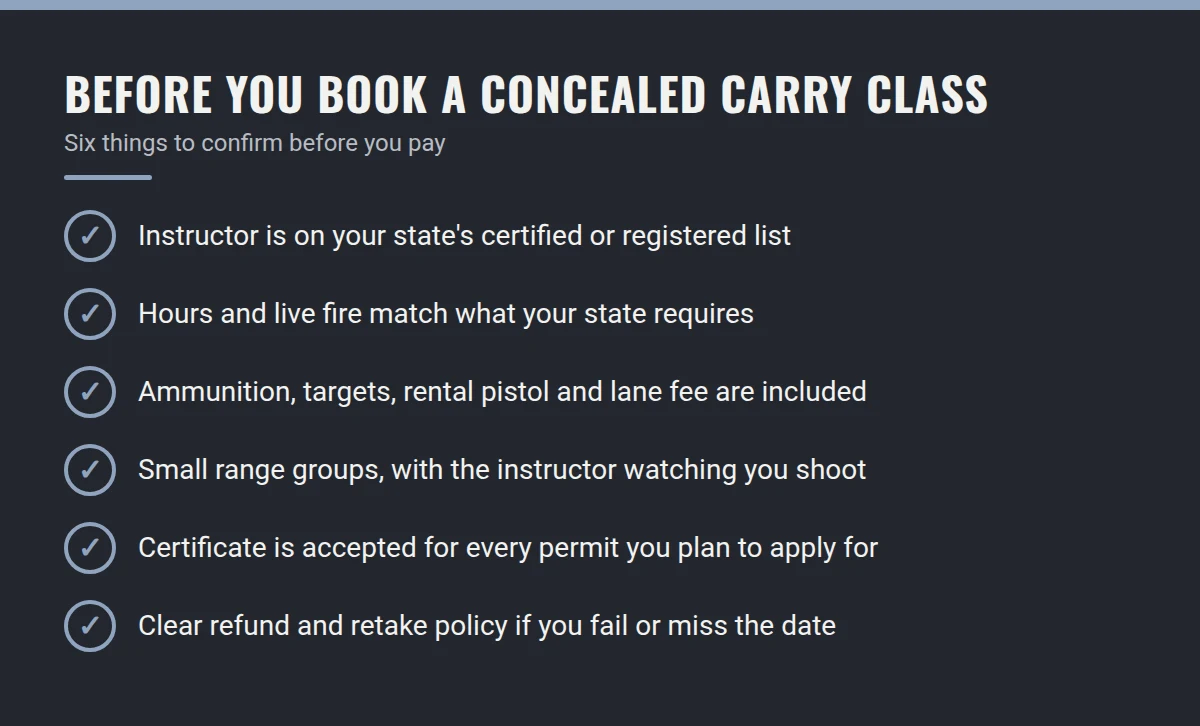
- Instructor certification. Many states register or certify the instructors whose certificates they accept, so an uncertified teacher’s class may be worthless for the permit no matter how good it is. Maryland requires an instructor registered with the state police, New York a duly authorized instructor, Nebraska one certified by the state patrol, the District of Columbia one certified by its police department, and California instructors certified by its Department of Justice. Check the state’s list before you pay.
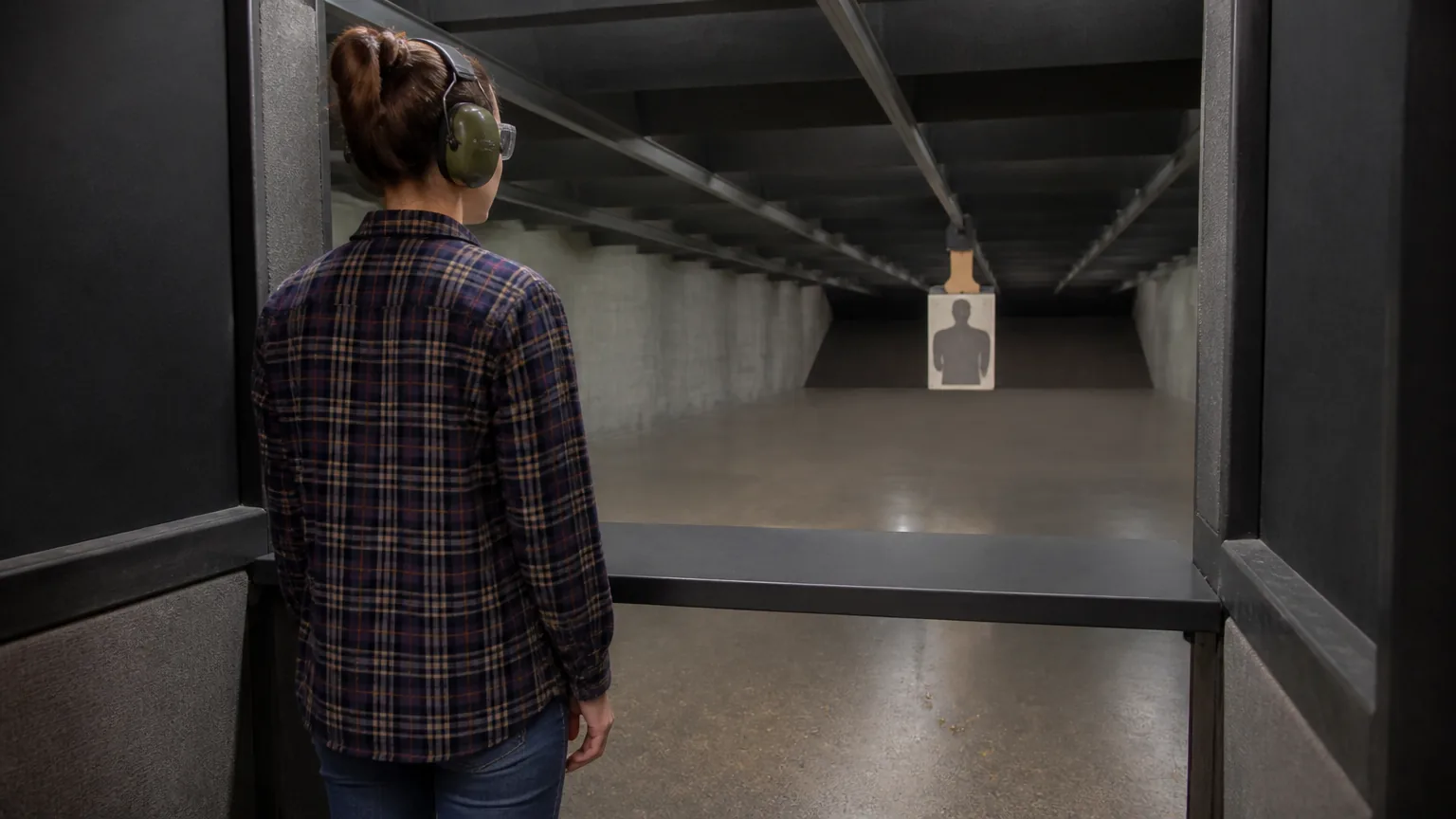
- Class size and live-fire time. A low price often means a full room and a short turn on the line. Ask how many students share the range session, how many rounds you will fire, and whether the instructor watches each student shoot, which several states require.
- What is included. A class that supplies the pistol, the ammunition, targets, eye and ear protection and the lane fee can be the cheaper option even at a higher sticker price. One that charges extra for each of those can double its advertised cost.
- What the certificate is accepted for. Florida accepts a wide range of courses, while New York, Maryland and California accept only their own standard. If you plan to apply for a non-resident permit from Utah, Arizona or Florida, ask whether the class is taught by an instructor those states recognize, because one afternoon can sometimes produce certificates for more than one permit.
- The legal block. The part of the class that keeps you out of court is the hour on your state’s use of force law, carry locations and traffic stops. A class that rushes it to get to the range has the priorities backwards. Our overview of what to expect in a first concealed carry course describes what a complete curriculum covers, and our state laws guide explains how much of that content is specific to where you live.
- Refunds and retakes. Ask what happens if you fail the qualification or miss the date. Kentucky’s statute, for one, says no part of the fee is refunded to a student who fails or does not complete the course.
Find Concealed Carry Classes Near You
Every city below links to the instructors and ranges listed there, with their published prices where they have one. Use the state or region figure from Tables 2 and 3 as your benchmark when you compare them.
- Alabama: Stapleton
- Arizona: Chandler, Gilbert, Glendale, Goodyear, Mesa, Peoria, Phoenix, Scottsdale, Surprise, Tempe, Tucson
- California: Berkeley, Beverly Hills, Burbank, Burlingame, Campbell, Citrus Heights, Clovis, Compton, Corona, Costa Mesa, Eastvale, Elk Grove, Foster City, Fountain Valley, Fresno, Fullerton, Garden Grove, Glendale, Huntington Beach, Inglewood, Lakewood, Lincoln, Long Beach, Los Angeles, Montebello, Norwalk, Oakland, Orange, Redding, Redlands, Redondo Beach, Riverside, Sacramento, San Diego, San Francisco, San Jose, San Leandro, Santa Clara, Simi Valley, Sunnyvale, Thousand Oaks, Torrance, West Covina
- Colorado: Arvada, Aurora, Brighton, Broomfield, Centennial, Colorado Springs, Dacono, Deer Trail, Denver, Lakewood, Littleton, Thornton, Westminster
- Connecticut: Milford, New Haven, North Haven, Stratford
- Delaware: Middletown
- District of Columbia: Washington
- Florida: Boca Raton, Boynton Beach, Bradenton, Brandon, Brooksville, Clearwater, Cutler Bay, Dania Beach, Davie, Deerfield Beach, Delray Beach, Doral, Fort Lauderdale, Hallandale Beach, Haverhill, Hialeah Gardens, Hialeah, Hollywood, Homestead, Jacksonville Beach, Jacksonville, Jupiter, Lake Park, Lake Worth Beach, Largo, Margate, Miami Beach, Miami Gardens, Miami Lakes, Miami, North Miami Beach, Oakland Park, Orange Park, Orlando, Palm Springs, Pembroke Park, Pembroke Pines, Pompano Beach, Port Charlotte, St. Petersburg, Tamarac, Tampa, Trinity, University Park, Wellington, Wesley Chapel, West Palm Beach, Weston
- Georgia: Alpharetta, Atlanta, East Point, Flowery Branch, Marietta, Smyrna, Snellville, Stone Mountain
- Illinois: Alsip, Berwyn, Chicago, Des Plaines, Midlothian, Naperville, Niles, Oak Lawn, Oak Park, Palos Hills, Park Ridge, Plainfield, Schaumburg, Skokie, Tinley Park, Yorkville
- Indiana: Avon, Brownsburg, Carmel, Clarksville, Fishers, Greenwood, Indianapolis, Noblesville, Schererville, Westfield
- Kansas: Kansas City
- Kentucky: Louisville
- Louisiana: West Monroe
- Maryland: Annapolis, Baltimore, Bel Air, Beltsville, Bowie, Brandywine, Calverton, Camp Springs, Catonsville, Centreville, Churchville, Clarksburg, Cockeysville, College Park, Columbia, Crofton, Damascus, District Heights, Dundalk, Edgewater, Edgewood, Eldersburg, Essex, Fallston, Freeland, Gaithersburg, Gambrills, Glen Burnie, Greenbelt, Halethorpe, Hampstead, Hanover, Hyattsville, Jarrettsville, Landover Hills, Lanham, Largo, Laurel, Lutherville, Marriottsville, Middle River, Millersville, Mt Airy, North East, Nottingham, Odenton, Orchard Beach, Owings Mills, Oxon Hill, Parkville, Pasadena, Perryville, Prince Frederick, Pylesville, Queenstown, Randallstown, Reisterstown, Rising Sun, Rockville, Severn, Severna Park, Smithsburg, Sparrows Point, Temple Hills, Timonium, Towson, Upper Marlboro, Waldorf, Westminster, Whiteford
- Massachusetts: Beverly, Boston, Everett, Malden, Medford, Quincy, Woburn
- Michigan: Ann Arbor, Belleville, Brownstown Township, Canton Township, Dearborn, Detroit, Eastpointe, Farmington Hills, Jackson, Lincoln Park, Livonia, Macomb, Madison Heights, Pinckney, Plymouth, Portage, Rochester, Romulus, Royal Oak, South Lyon, Southfield, St. Clair Shores, Sterling Heights, Taylor, Van Buren Township, Westland
- Minnesota: Brooklyn Center, Eagan, Edina, Lakeville, Minneapolis, New Hope, St. Paul, Willmar
- Missouri: Kansas City
- Nebraska: Bellevue, Omaha
- Nevada: Boulder City, Henderson, Las Vegas, North Las Vegas
- New Jersey: Jersey City, Monroe Township, Newark, Secaucus, Union, Woodland Park
- New Mexico: Albuquerque, Clovis, Rio Rancho, Roswell
- New York: Bronx, Brooklyn, Elmont, Long Island City, Middle Village, Mineola, Mount Vernon, New Rochelle, New York, North Tonawanda, Rockville Centre, Staten Island, Woodhaven, Yonkers
- North Carolina: Albemarle, Apex, Broadway, Cary, Charlotte, China Grove, Clayton, Concord, Cornelius, Creedmoor, Durham, Fayetteville, Four Oaks, Fuquay Varina, Garner, Gastonia, Granite Quarry, Harrisburg, Hillsborough, Huntersville, Iron Station, Kannapolis, Lillington, Linwood, Louisburg, Lumber Bridge, Matthews, Middlesex, Mint Hill, Mocksville, Monroe, Mooresville, Oxford, Raleigh, Sanford, Statesville, Wagram, Wake Forest, Warrenton, Waxhaw, Wendell, Wilson, Youngsville, Zebulon
- Ohio: Canton, Columbus, Delaware, Fredericktown, Lithopolis, Nashport, Newark, Pataskala, Waynesville
- Oklahoma: Edmond, Midwest City, Moore, Norman, Oklahoma City, Tulsa, Yukon
- Oregon: Gresham, Hillsboro, Portland, Sherwood, Tigard, West Linn
- Pennsylvania: Philadelphia
- South Carolina: Charleston, Columbia, Fort Mill, Greenville, Indian Land
- Tennessee: Bartlett, Brentwood, Franklin, Gallatin, Memphis, Murfreesboro, Nashville
- Texas: Allen, Arlington, Austin, Benbrook, Boerne, Burleson, Cedar Park, Converse, Crowley, Dallas, Duncanville, El Paso, Ennis, Farmers Branch, Forney, Fort Worth, Friendswood, Garland, Grand Prairie, Grapevine, Houston, Hurst, Irving, Katy, Keller, Kyle, Lancaster, League City, Leander, Lewisville, Mckinney, Mesquite, New Braunfels, North Richland Hills, Northlake, Plano, Round Rock, San Antonio, Sugar Land, The Colony, Watauga, Weatherford
- Utah: Orem
- Virginia: Alexandria, Chesapeake, Falls Church, Hampton, South Boston, Springfield, Virginia Beach
- Washington: Bellevue, Camas, Everett, Lynnwood, Renton, Seattle, Vancouver
- Wisconsin: Brookfield, Greenfield, Kenosha, Menomonee Falls, Mequon, Milwaukee, South Milwaukee, Waukesha, Wauwatosa, West Allis, West Bend
Frequently Asked Questions
How much does a concealed carry class cost? The typical concealed carry permit class costs $142, and the middle half of instructors charge between $95 and $225. The state’s permit fee and fingerprinting are extra.
Which state has the most expensive concealed carry class? Of the states with enough priced instructors to compare, Maryland is highest at a median of $250, with a middle half of $185 to $300. California follows at $210. The other Northeastern states combined (Connecticut, Massachusetts, New Jersey, New York and Pennsylvania) come to $244. All of the expensive jurisdictions require sixteen hours of training.
Which state has the cheapest concealed carry class? Texas, at a median of $89, with a middle half of $69 to $105. Its classroom portion is four to six hours and can be taken online, with one to two hours of range work in person. North Carolina and Florida follow at $100 and $105.
How much is a concealed carry renewal class? The typical renewal class costs $125, with the middle half between $75 and $188. Several states require fewer hours to renew than to qualify the first time, and some require no new class at all.
Are online concealed carry courses cheaper, and do they count? They are cheaper, at a median of $85, but they count only where the state says so. Texas and Ohio accept an online classroom portion with in-person range time; Nebraska, Virginia and New York do not accept online training for their permits. Check your state before paying for one.
Does the class price include the permit? No. The class fee goes to the instructor and the permit fee goes to the state or county, from $40 in Texas to $125 in Maryland, usually with a separate fingerprinting charge. Budget for both.
What does it cost to keep practicing after the class? A range visit costs $25 at the median and a rental gun $22, plus ammunition. Dry fire at home costs nothing and does most of the work between range trips. Our concealed carry class FAQ answers the other common questions about eligibility, what to bring and what happens after the course.
Further reading (sources)
- Maryland State Police on the 16-hour and 8-hour wear and carry courses and the permit fees
- FindLaw publishes California Penal Code 26165, the 16-hour course with live fire and a written exam
- Los Angeles County Sheriff’s Department with its CCW training hours, live-fire rule and fee list
- Florida Legislature for statute 790.06, the accepted courses, the live-fire record and the license fee
- Florida Department of Agriculture and Consumer Services has the license fee schedule with the fingerprint processing fee
- Moore County Sheriff’s Office on North Carolina’s eight-hour course and the $90 permit fee
- Texas Department of Public Safety for the four to six hour classroom, online option and in-person range work and the license to carry fee schedule
- Connecticut Department of Emergency Services and Public Protection on the NRA Basic Pistol minimum, live fire and the $70 permit
- Massachusetts Legislature with chapter 140 section 131P, the safety course with live firearms training
- New Jersey State Police for resident carry permit instructions, the CCARE qualification and the $226 total
- New York State on the 16-hour classroom and 2-hour live-fire course in its concealed carry FAQ
- New York State Police and DCJS with the minimum training standards, written test score and live-fire assessment
- Pennsylvania General Assembly for 18 Pa.C.S. 6109, the license fee and five-year term with no training requirement
- Pennsylvania State Police on applying to the county sheriff for a license to carry
- Illinois State Police with the 16 hours of training and the resident and non-resident fees
- Michigan Legislature for MCL 28.425j, the eight-hour course with three hours of range time and MCL 28.425b, the $100 fee and $15 fingerprint fee
- Minnesota Legislature on statute 624.714, the shooting qualification and the sheriff’s fee caps
- Minnesota Bureau of Criminal Apprehension for the one-year training window and five-year permit
- Nebraska State Patrol with its permit FAQ on in-person training, live fire, fees and permitless carry
- Brown County Sheriff’s Office on Ohio’s eight hours, two in-person range hours and online option
- Wisconsin Department of Justice for the $40 license, $22 renewal and no renewal training
- Wisconsin Legislature with statute 175.60(4), the accepted training and the bar on requiring live fire
- Alabama Law Enforcement Agency on the 2023 permitless carry law applying only inside Alabama
- Metropolitan Police Department for the District’s 16-hour course and two hours of range training and the $75 license and $35 fingerprint fees
- Georgia.gov on the weapons carry license, reciprocity and the average county fee
- Kentucky Legislature with KRS 237.110, the eight-hour maximum, 20-round qualification and $60 fee and KRS 237.122, the $75 cap on the applicant course
- Louisiana State Police for the required instruction and live range fire and the permit fee schedule
- Oklahoma State Bureau of Investigation on license fees and why the optional license is still worth having and the $25 sheriff’s fee in its application instructions
- Tennessee Department of Safety and Homeland Security with the enhanced and concealed permit fees and the eight-hour course
- Virginia Law for 18.2-308.02, in-person proof of competence and 18.2-308.03, the $50 fee cap
- Arizona Department of Public Safety on the $60 permit and $43 renewal
- Arizona Legislature with ARS 13-3112, the accepted proof of competence
- Colorado General Assembly for HB24-1174, the eight-hour in-person class with live fire and a written exam
- Washoe County Sheriff’s Office on Nevada’s certified instructor course and its CCW fee schedule
- New Mexico Department of Public Safety with the Concealed Handgun Carry Act booklet: 15 hours, live fire, refreshers and fees
- Oregon Legislature for ORS chapter 166, the accepted courses and the license fees
- Utah Bureau of Criminal Identification on the certified course and the $52 and $87 fees and its minimum training curriculum, in person with live fire optional
- Washington State Legislature with RCW 9.41.070, the license fees and the training rule arriving in 2027
- Johns Hopkins Center for Gun Violence Solutions on why dropping the training requirement raised gun assaults