Non-Resident Concealed Carry Permits: Should You Stack Utah, Arizona, and Florida?
Published on September 17, 2026

Ask at a gun counter how to carry legally in more states and you will usually hear the same recipe. Get a Utah permit, add Arizona, throw in Florida, and your wallet covers most of the country. Each of those non-resident permits really is honored in about thirty states. The count is accurate. What it counts is the problem.
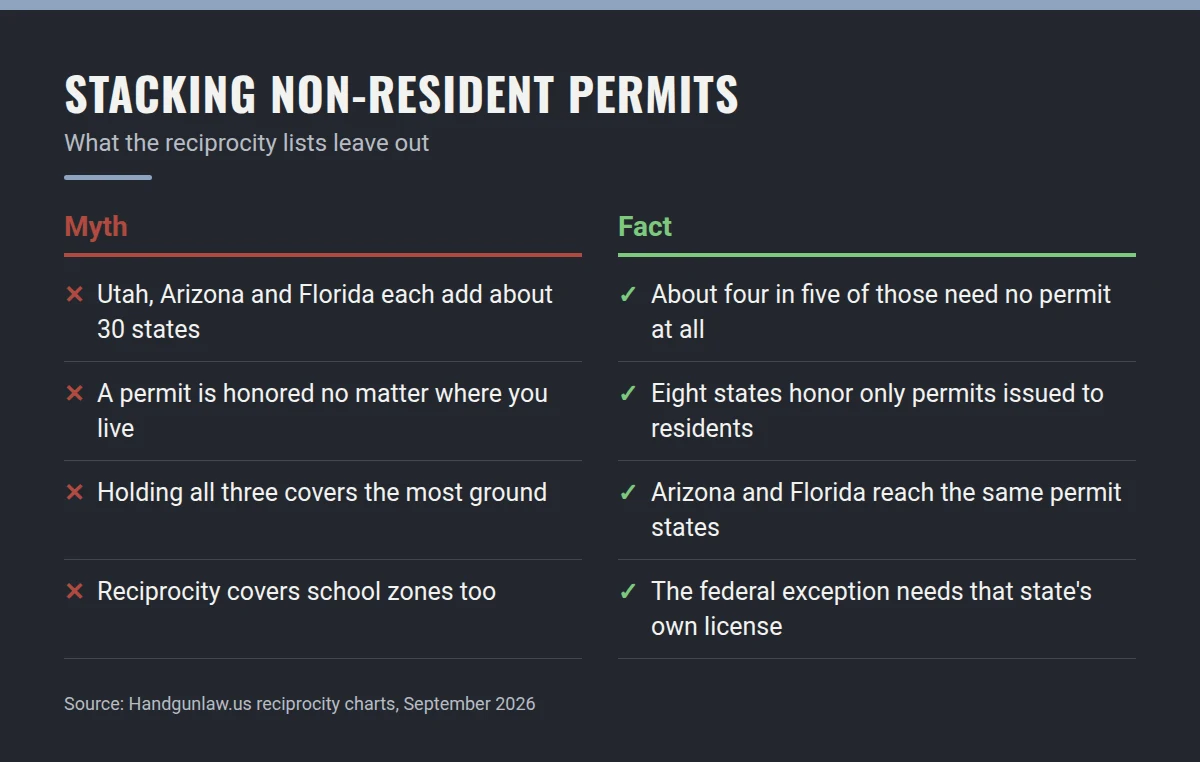
Most of the states on those lists no longer require a permit at all. Eight states refuse to honor a permit issued to someone who lives elsewhere. And two of the three permits reach exactly the same places. Handgunlaw.us, the reference site that has tracked state carry laws for two decades, keeps a dedicated Non-Resident Permits document and revised it repeatedly through 2026. This guide does the subtraction those lists leave to you: what each permit actually adds, what the applications involve, and when the extra fees buy nothing at all.
What a Non-Resident Permit Is
A non-resident permit is a carry license issued by a state you do not live in. It is valid in the issuing state and in the states that honor that state’s permits, minus one important group covered below. It does not replace your home permit, and some states will not issue one until you hold a home permit.
States issue them on very different terms. Arizona issues the same permit to residents and non-residents alike. Utah and Florida take applications by mail from anywhere in the country. Other states open the door only partway: South Carolina issues to non-residents who own property there, Oregon mostly to residents of neighboring states, Kentucky only to military members stationed in the state, and Illinois only to residents of a short list of states. Handgunlaw.us warns that a few states that technically issue to non-residents are next to impossible to get one from.
The picture keeps moving. In 2026 alone, Handgunlaw.us logged New York dropping its rule that non-resident applicants show a job or other tie to the state, Wisconsin starting to honor New Hampshire’s non-resident permit, and Florida opening its license to adults aged 18 to 20 after a state appeals court struck down the age limit in Eubanks v. Florida.
Eight States Quietly Void the Stack
Colorado, Florida, Maine, Michigan, New Hampshire, North Dakota, Pennsylvania, and South Carolina honor an out-of-state permit only when the holder lives in the state that issued it. In those states, a Utah permit carried by a Georgia resident simply does not count. Utah’s own Bureau of Criminal Identification cautions its permit holders that some states accept the Utah permit only from Utah residents.
For five of the eight, the damage is smaller than it looks. Florida, Maine, New Hampshire, North Dakota, and South Carolina allow permitless carry, so a visiting adult who can legally possess a handgun can generally carry there without any permit, within each state’s age limits and location rules. The three that really bite are Colorado, Michigan, and Pennsylvania, which still require a permit and ignore non-resident ones.
Your options in those three are thin. Pennsylvania issues its own non-resident license, but you apply in person at a county sheriff’s office and generally need a permit from your home state first. Colorado and Michigan license only their own residents, apart from military members stationed there. If they do not honor your home state’s resident permit, no stack of out-of-state paper will change that.
The quirks cut the other way too. Wisconsin honors Florida and Virginia licenses only when they were issued to non-residents, so a Virginian with a Virginia resident permit is not covered in Wisconsin while a Marylander holding a Virginia non-resident permit is.
Subtract the Permitless States Before You Count
Handgunlaw.us lists 29 other states where a Utah non-resident permit is valid, 29 for Arizona’s, and 30 for Florida’s. But 29 states now allow permitless carry, and about four in five of the states on each list are in that group. There, the permit is not what makes carrying legal. A permit can still matter at the margins, such as age thresholds, certain locations, and the federal school zone exception, which is why we argue a permit is worth holding even in permitless states.
Strip out the permitless states and each permit reaches exactly six states that still require a license:
- Utah: Delaware, Nevada, North Carolina, Virginia, Washington, and Wisconsin.
- Arizona: Delaware, Nevada, New Mexico, North Carolina, Virginia, and Wisconsin.
- Florida: Delaware, Nevada, New Mexico, North Carolina, Virginia, and Wisconsin.
The states’ own lists back this up. Washington’s attorney general recognizes Utah’s standard permit but not Arizona’s or Florida’s. New Mexico’s Department of Public Safety accepts Arizona and Florida licenses but not Utah’s. Nevada’s recognition list, effective July 1, 2026, includes all three, and Delaware’s Department of Justice says it honors both resident and non-resident licenses from the states it recognizes.
What none of the three reaches matters just as much: Minnesota, plus the ten states and the District of Columbia that honor no outside permit at all, including California, New York, New Jersey, Illinois, and Massachusetts. Our state travel atlas explains how reciprocity works across the whole map.
When a Second Permit Buys Nothing
Look at those lists again. Arizona and Florida reach the identical set of permit-required states, so holding both adds nothing that either one does not already cover. Utah plus one of the other two reaches all seven permit-required states that any of them can, and a third permit on top pays twice for the same map.

Your home permit shrinks the gap further, because it already covers many of those seven states on its own. Using the Handgunlaw.us charts as they stood in September 2026:
- Ohio, Kansas, North Carolina, and North Dakota (Class 1) resident permits already reach every permit-required state that Utah, Arizona, or Florida could add. For these holders a non-resident permit buys nothing on the map.
- Texas, Arkansas, and Oklahoma permit holders gain exactly one state, Washington, and only from Utah.
- Michigan permit holders gain only Nevada, which any of the three provides.
- Georgia and Pennsylvania permit holders are missing Delaware, Minnesota, Nevada, New Mexico, and Washington. Utah covers Delaware, Nevada, and Washington, Arizona or Florida covers Delaware, Nevada, and New Mexico, and a pair closes four. Minnesota stays shut; its own non-resident permit, available through any Minnesota county sheriff, is the only paper that opens it.
- New York and California permit holders are missing Delaware, Nevada, New Mexico, and Washington, and a Utah and Arizona pair closes all four. It does nothing for a drive into New Jersey or Connecticut.
The whole exercise takes ten minutes. Pull up the Handgunlaw.us chart for your home permit, write down the states you actually pass through in a normal year, cross out the permitless states and the states that honor nobody, and compare what is left against the three lists above. If nothing is left, keep your money.
What Each Application Involves
Utah charges non-residents $87, compared with $52 for residents. Before you apply, you must complete a firearms familiarity course taught in person by an instructor certified by Utah’s Bureau of Criminal Identification (BCI), and BCI must receive your application within a year of the class. Certified instructors teach all over the country. BCI recommends at least four hours of instruction, and live fire is optional, left to the instructor. You send one fingerprint card, a passport-quality photo, and a copy of your driver license. The catch is the home-permit rule: if you live in a state that honors the Utah permit, you must hold your own state’s permit and include a copy, both when you apply and every time you renew. Utah decides where you live from your state-issued ID. The permit lasts five years, and non-residents pay $50 to renew.
A classroom certificate satisfies the paperwork, not the skill. If your permit class never put you on a firing line, book a range session before you carry on it.
Arizona is the cheapest, at $60 for a new permit and $43 to renew. Non-residents must be U.S. citizens and at least 21, or 19 with military service or an honorable discharge. Arizona’s statute accepts a wide range of existing training as proof of competence, including any NRA firearms course, a hunter education course approved by any state, military service, or a current or expired out-of-state permit that required training. You submit two fingerprint cards with a paper application, or book electronic prints if you apply online. The Department of Public Safety asks applicants to allow 75 days, and the statute directs it to prioritize Arizona residents. The permit lasts five years, and renewals need no new fingerprints.

Florida costs $97 for a new license, which includes a $42 fingerprint processing fee. Accepted training includes a hunter safety course, military service, organized shooting competition, or a class from an NRA or state-certified instructor, who must keep records showing you fired live rounds in their presence. You can apply online, by mail with fingerprints taken at a local sheriff’s office or police department, or in person in Florida, and the Department of Agriculture and Consumer Services has 90 days to decide once your application is complete. Florida takes applicants who live in the United States and are citizens or permanent residents, and since this summer it issues to adults 18 and older, though some states that honor Florida’s license require the holder to be 21. The license lasts seven years, but non-residents pay $87 to renew because every out-of-state renewal needs a fresh fingerprint card rolled by a law enforcement agency.
Some instructors teach one combined class aimed at several states’ requirements. Before you pay, confirm the certificate satisfies each state you plan to apply to, especially Utah’s certified instructor rule and Florida’s live-fire records.
Three Renewal Clocks That Never Line Up
The real cost of a stack is not the application. It is keeping every license alive on its own schedule for years.
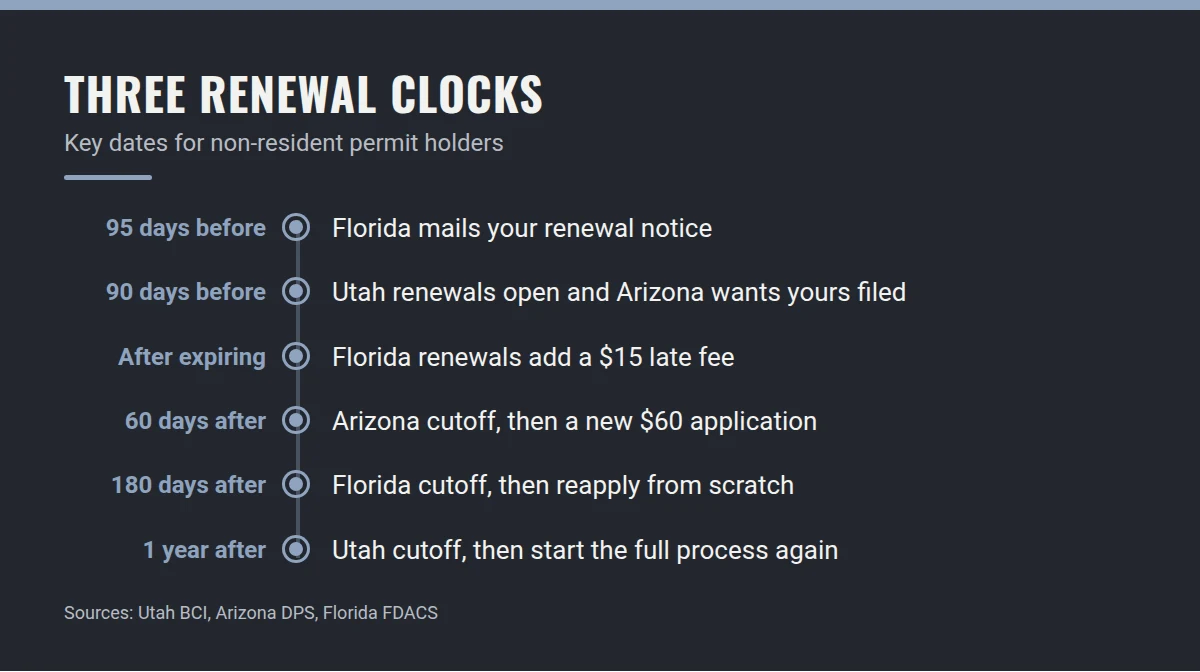
- Utah: renew no earlier than 90 days before expiration and no later than one year after. Non-residents from states that honor Utah must include a current copy of their home permit, so a lapsed home permit stalls the Utah renewal too.
- Arizona: file the renewal at least 90 days before expiration. One that arrives more than 60 days after expiration is returned, and you start over with a new $60 application.
- Florida: the state mails a renewal notice about 95 days before expiration. You can still renew up to 180 days after it expires, with a $15 late fee; after that you reapply from scratch.
Over a five-year cycle, a Utah and Arizona pair runs $147 in state fees to start and $93 to renew, before the class, fingerprinting, photos, and postage. Put every expiration date, home permit included, on one calendar with a reminder about four months out. Keep your training certificates, since Arizona accepts an expired permit in good standing as proof of competence. And remember that moving resets the math: Nevada, for one, stops honoring an out-of-state permit once its holder becomes a Nevada resident and goes 60 days without getting a Nevada permit.
Where No Stack Can Help
The eleven jurisdictions that honor no outside permit are closed to every stack. The only license that works there is their own, and several now issue to non-residents, New York among them since it stopped requiring a local job or other tie. Those applications are slower and pricier, and they come with long lists of places you still cannot carry, but for anyone who works in or regularly visits one of those states, a license from that state is the only lawful path to carrying there.
School zones are the other blind spot. The exception in the federal Gun-Free School Zones Act only credits a license issued by the state where the school sits, so a Utah permit does nothing for you on a Nevada school route, reciprocity or not. If you commute into one state every day, that state’s own non-resident license, where one is offered, protects you in a way no stack can. Our guide to the 1,000-foot federal rule explains the trap in detail.
The Bottom Line
A non-resident permit is a tool for a particular route, not a badge that adds thirty states to your map. For most carriers the honest answer is one permit or none: Utah if Washington is the gap, Arizona if New Mexico is, and nothing at all if your home permit already reaches every permit-required state you drive through. Florida mainly earns its place as the substitute for applicants Arizona turns away, such as permanent residents who are not U.S. citizens.
Whatever you carry, check the destination before every trip, because the charts change constantly; Handgunlaw.us logged Maine dropping recognition of four states’ permits on September 16. The state you are standing in sets the rules on where you may carry and when you may use force, and a permit class is a legal minimum rather than real training. Until a national reciprocity law actually passes, this patchwork is the system, and a question about a regular commute across a state line belongs with a firearms attorney licensed in that state.
Further reading (sources)
- Handgunlaw.us on which states issue non-resident permits and where each one is valid
- Handgunlaw.us for the states that honor only resident permits, among other reciprocity quirks
- Utah Bureau of Criminal Identification with its permit course curriculum, fees, and home permit rule
- Utah BCI on states that accept the Utah permit only from Utah residents
- Arizona Department of Public Safety for permit fees, fingerprints, processing time, and renewals
- Arizona Legislature with the statute listing accepted proof of firearm competence
- Florida Department of Agriculture and Consumer Services on ways to apply and the new minimum age of 18
- FDACS publishes the fee schedule for out-of-state applicants and renewals
- Florida Legislature for the license statute covering live-fire training and out-of-state renewals
- Washington Attorney General on which out-of-state permits Washington recognizes
- New Mexico Department of Public Safety with its recognition and reciprocity table
- Nevada Department of Public Safety for the 2026 list of permits Nevada recognizes
- Delaware Department of Justice on recognizing resident and non-resident licenses