Permitless Carry States: Why a Concealed Carry Course Still Matters When the Law Doesn't Require One
Published on August 31, 2026

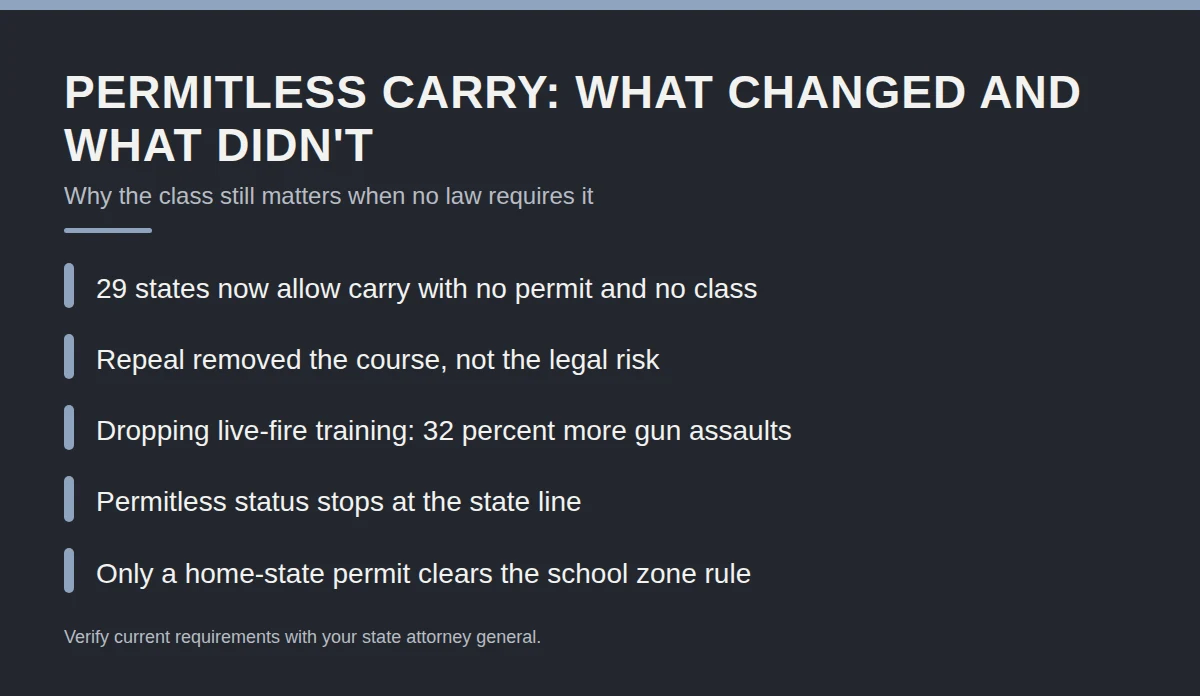
Twenty-nine states now allow a legally eligible adult to carry a concealed handgun with no permit, no application, and no class. That is a majority of the country, and it happened fast: before 2015, only four states allowed it. The permit requirement is what got repealed in each of those states, but the mandatory training course is what quietly disappeared along with it, because in most states the course only ever existed as a condition of the permit. Remove the permit and the class becomes optional overnight. If you carry in a permitless state, the legal floor for your competence is now zero, and the only person who can raise it is you.
What Permitless Carry Actually Took Away
It helps to be precise about what changed, because the political framing on both sides tends to blur it.
Permitless carry removed three things: the application to your sheriff or state police, the fee, and the state-mandated course with its classroom hours and, in many states, a live-fire qualification. That is the entire list.
It removed nothing else. You still cannot carry if you are a prohibited person under federal law. The deadly force statutes in your state read exactly as they did before, and a jury will apply them to you the same way. Gun-free zones, private property rules, and duty-to-inform requirements during a traffic stop all survived the repeal untouched. Civil liability for negligence never depended on a permit at all. What permitless carry changed was who decides whether you are ready, and the answer is now you.
Worth knowing: almost every permitless state still issues permits. The permit did not get abolished, it got made optional, which means everything below is a choice available to you today without waiting for the legislature.
The Research Points at Training, Not Paperwork
The most careful study on this question is worth reading closely, because it does not say what either side usually claims it says.
Researchers at the Johns Hopkins Center for Gun Violence Solutions analyzed state violent crime data from 1981 through 2019 and published the results in Criminology & Public Policy (Doucette et al., 2024). Their headline finding on the broad question was null: moving from a shall-issue permit system to permitless carry showed no statistically significant effect on violent crime rates when all the states were pooled together. If you have seen permitless carry described as an automatic crime wave, that is not what the data showed.
The significant finding was narrower and far more interesting. When the researchers separated out the states that had required live-fire firearms training and then dropped it, those states saw 21 additional gun assaults per 100,000 residents, a 32 percent increase. States that went permissive but kept a live-fire training requirement in their permitting system did not show that jump. As Cassandra Crifasi, co-director of the center, put it: “When states made it easier for potentially untrained gun owners to carry their weapons in public, assaults with guns increased.”
Read that as a carrier rather than as a voter and the takeaway is not about legislation. The permit was never the protective ingredient. The training inside it was. That is a variable you still control completely, for the price of a Saturday and a box of ammunition.
There is supporting evidence from a very different angle. In a firearms simulator experiment, participants with lower levels of training and experience performed measurably worse than trained participants under stress, and a number of them fired on innocent bystanders and unarmed people (Vince, Wolfe, and Field, 2015). Daniel Webster of the Hopkins center framed the practical gap this way: millions of Americans are now legally carrying “with no training about how to make clear decisions about whether one should reach for a firearm, whether one shouldn’t point it at somebody, or even fire at someone.”
That is the real risk profile for an untrained carrier, and it is not marksmanship. It is judgment.
The Permit Still Buys Things Nothing Else Can
Even if you never intend to use it at home, applying for the optional permit in your permitless state is usually the highest-return $50 to $100 a carrier can spend. Three reasons stand out.

Your permitless status stops at the state line. Reciprocity agreements recognize permits, not eligibility. Drive from a permitless state into a permit-required one carrying on nothing but your residency and you are committing a crime the moment your tires cross. A resident permit is the document that travels, and it is honored by a long list of states. Our state travel atlas maps out which states honor what.
The federal school zone problem only has one solution, and it is a permit. Under 18 USC 922(q), possessing a firearm within 1,000 feet of a K-12 school is a federal crime, and that radius covers sidewalks, parking lots, and public streets you drive down without thinking. The statute contains an exemption, and it is written narrowly: it applies to people holding a carry license issued by the state where the school sits. Permitless carriers are not covered by it. This is the single most underappreciated exposure in constitutional carry states, and our federal firearms law reference covers how the exemption works in detail.
Purchase friction goes away. In many states, a valid carry permit is recognized by ATF as a qualifying alternative to the point-of-sale NICS check, which means no delays at the counter. Verify whether your state’s permit qualifies before you count on it, since the list changes.
What a Good Course Teaches That YouTube Cannot
New carriers tend to assume a concealed carry class is a shooting class. The shooting is the smallest part of it.
The section that actually changes outcomes is the legal block: when deadly force is justified under your state’s statute, what “reasonable belief” means, whether your state imposes a duty to retreat, and what the first ten minutes after a defensive incident look like when police arrive. Getting that wrong does not produce a bad target. It produces a prosecution. Our use of force primer is a good self-study companion, but a live instructor who teaches your specific state’s law and takes questions is worth more than any article.
The rest of a competent curriculum covers the mechanical skills nobody develops by accident: drawing from concealment without sweeping your own hand, reholstering slowly and deliberately, clearing a malfunction, loading and unloading safely, and storing the gun where a child or a guest cannot reach it. Add awareness and avoidance, which is the only skill on this list that works before anything goes wrong. If you want a preview of the format, we walk through what to expect in a first concealed carry course hour by hour.
Vetting an Instructor When the State Sets No Standard
In a permit state, the curriculum has a legal floor. In a permitless state it has none, so quality control falls to you. Ask before you pay:
- Does the class include live fire with your own carry gun and holster, not a loaner on a bench?
- Does the instructor hold a recognized credential (NRA, USCCA, state certification, or a documented professional background)?
- Does the class teach your state’s use of force statute by name, or does it hand out a generic national handout?
- How many students per instructor on the firing line? Eight to ten is workable, thirty is a liability.
- Will they let you shoot from concealment, or is the drawing done from a bench because the range prohibits holster work?
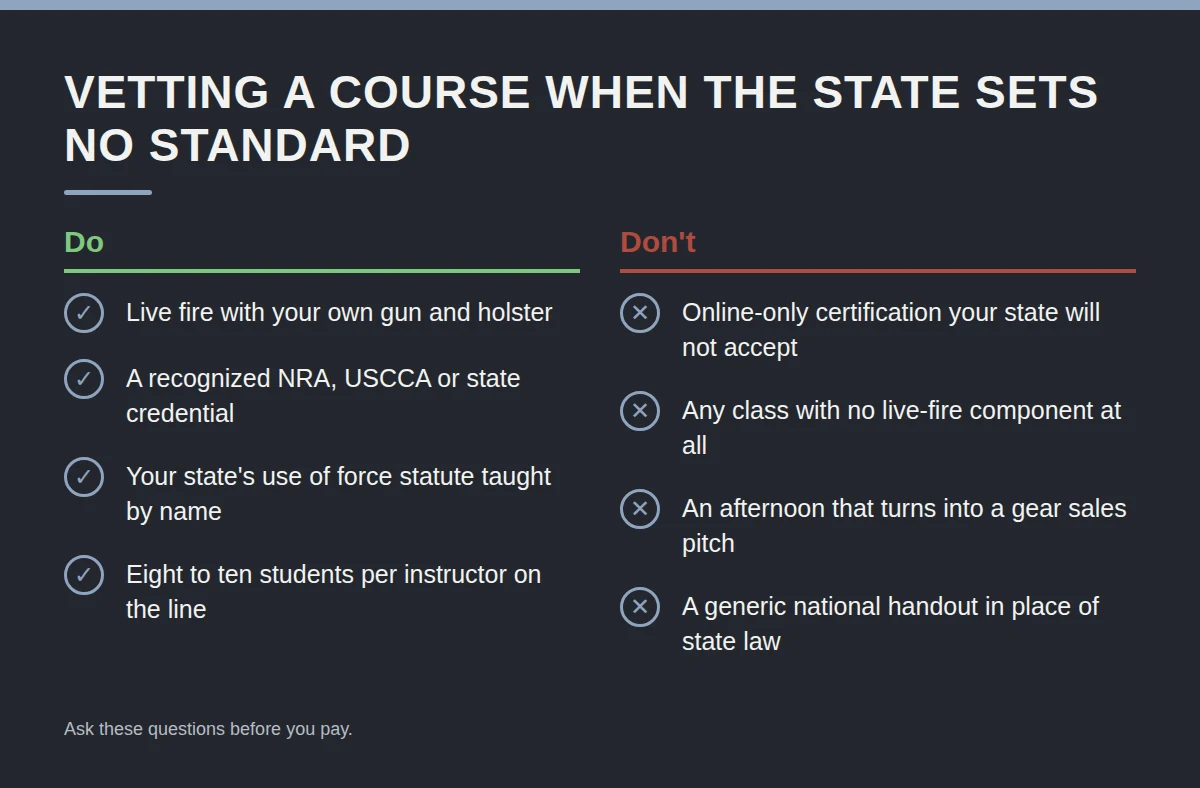
Walk away from online-only “certification” in a state that would not accept it anyway, from any class with no live-fire component, and from an instructor who spends the afternoon selling gear. Scenario-based and simulator training, which several commercial ranges now offer with immersive projected environments, is a genuinely useful supplement once the fundamentals are in place, because it drills the decision rather than the shot.
One more piece belongs in the same budget conversation: know how you would pay for a defense attorney before you need one. We compare the self-defense legal coverage plans that exist for exactly that purpose.
Training Is a Habit, Not an Event
A single class is a starting line. Skills built in eight hours decay within weeks if nothing reinforces them, and the draw stroke is the first thing to go. Ten minutes of dry fire three times a week, a range trip once or twice a month, and one honest annual standard you hold yourself to will put you ahead of the overwhelming majority of people carrying around you, permit or not. Our 12-month training roadmap lays out a full first-year plan if you want the structure.
The Bottom Line
Permitless carry did not lower the bar for carrying a gun responsibly. It moved the bar out of the statute book and into your hands, which is either a burden or a freedom depending on what you do next. The research says the training was doing the work all along. Take the class, get the optional permit if you ever cross a state line or drive past a school, and treat the absence of a legal requirement as exactly what it is: an absence, not a verdict on whether you need it.
Laws change frequently and vary by jurisdiction, so verify current requirements with your state attorney general’s office before you carry or travel, and consult a firearms attorney about any situation specific to you.
Further reading (sources)
- Criminology & Public Policy on the deregulation of public gun carrying and violent crime, 1981 to 2019
- Johns Hopkins Center for Gun Violence Solutions for why dropping the training requirement drove gun assaults up
- Everytown Research & Policy with a survey of what permitless carry laws remove from the permitting process
- WKRC Local 12 reporting on the training gap left behind as more states go permitless
- Interlochen Public Radio for how a longtime instructor views the constitutional carry trend
- Everytown Research & Policy on the case against a national concealed carry mandate