Buying a Handgun Out of State: What the Fifth Circuit's Ruling Really Changes at the Counter
Published on November 16, 2026

On September 18, 2026, a divided federal appeals court held that the federal ban on buying a handgun directly from a dealer in another state violates the Second Amendment. Read quickly, the headlines sounded like an open road: drive to Texas, pick out a pistol, take it home.
If you travel with a carry gun, split the year between two homes, or live a short drive from a state line, this ruling is aimed at people like you. For most readers, though, the honest answer is that the gun counter works exactly as it did before the ruling. This explainer covers what the ban required, what the court decided, whom the ruling actually reaches, the state laws it never touched, and what to watch while the government decides its next move.
What the Ban Actually Required
Three provisions of federal law work together, and the court called them, collectively, the Nonresident Handgun Purchase Ban. A licensed dealer may not sell or deliver a firearm to someone who lives in another state. Anyone who is not a dealer may not bring a firearm bought in another state into the state where they live, or receive it there. And two private individuals who live in different states may not sell to each other directly. ATF enforces the dealer rule through a matching regulation.
The way around the ban is a second dealer. As ATF explains it, the sale can go through if the gun is shipped to a licensed dealer in the buyer’s home state and the buyer takes delivery there, which means filling out the federal form and passing the background check at that counter. Nothing obliges the second dealer to take part, and those that do usually charge a fee. One plaintiff in this case said his home-state dealer typically charges him $30 to $40 and that the process delays his taking possession of the gun. In an earlier challenge to the same ban, a Washington, D.C., couple who picked out two handguns at a dealer in Arlington, Texas, learned that a D.C. dealer would have charged them $125 per handgun to complete the transfer.
Rifles and shotguns never worked this way. Since the Firearm Owners’ Protection Act of 1986, a dealer may sell a long gun to a resident of any state, as long as the buyer meets the dealer in person and the sale complies with the laws of both states. Two other exceptions also cover handguns: borrowing or renting a gun for temporary use for lawful sporting purposes, and inheriting one through a will or an estate in another state, as long as you may lawfully own it where you live.
Why single out handguns? Congress explained itself in 1968. In the findings of the Omnibus Crime Control and Safe Streets Act, it declared that sales of “concealable weapons” by licensed dealers to residents of other states had “tended to make ineffective the laws, regulations, and ordinances” of the states and localities. The home-state dealer was meant to be the checkpoint where your own state’s rules get applied.
What the Fifth Circuit Decided
The case, Elite Precision Customs v. ATF, was brought by a Texas gun maker and dealer that wants to sell handguns to customers from other states, two would-be customers from Arizona and New Mexico, and the Firearms Policy Coalition, a gun-rights group all three belong to. A federal district judge in Texas dismissed the suit, treating the rules as ordinary commercial regulations outside the Second Amendment’s text. On appeal, Judge Jerry Smith, joined by Judge Kurt Engelhardt, reversed. The majority’s reasoning runs in three steps.
Buying is covered. The right to keep firearms “logically entails the right to purchase them as well,” the court wrote, leaning on its own 2025 Reese decision, which struck down the federal ban on dealer handgun sales to adults aged 18 to 20. A law that forbids a whole class of purchases is presumptively unconstitutional, which puts the burden of justifying it on the government. (Our piece on who has to prove what in a Second Amendment case explains why that shift decides so many of these fights.)
The workaround does not save it. A waiting period ends; this ban does not. “There is no amount of time an individual can wait to be able to purchase a handgun directly from a licensed firearms dealer in another state, because such purchases are flatly illegal,” the court wrote. It added that the second-dealer route hands a veto to third parties and always costs a fee: “We must pause before endorsing a cost attached to the exercise of a fundamental constitutional right.”
History does not support it. The government offered 18 colonial and early American laws. The court sorted them into wartime defense measures, rules on trade with other colonies and with tribes that were treated as foreign sovereigns, and early product inspection laws, and concluded that the record is “devoid of laws meaningfully restricting the trade of firearms between states” in the early republic.
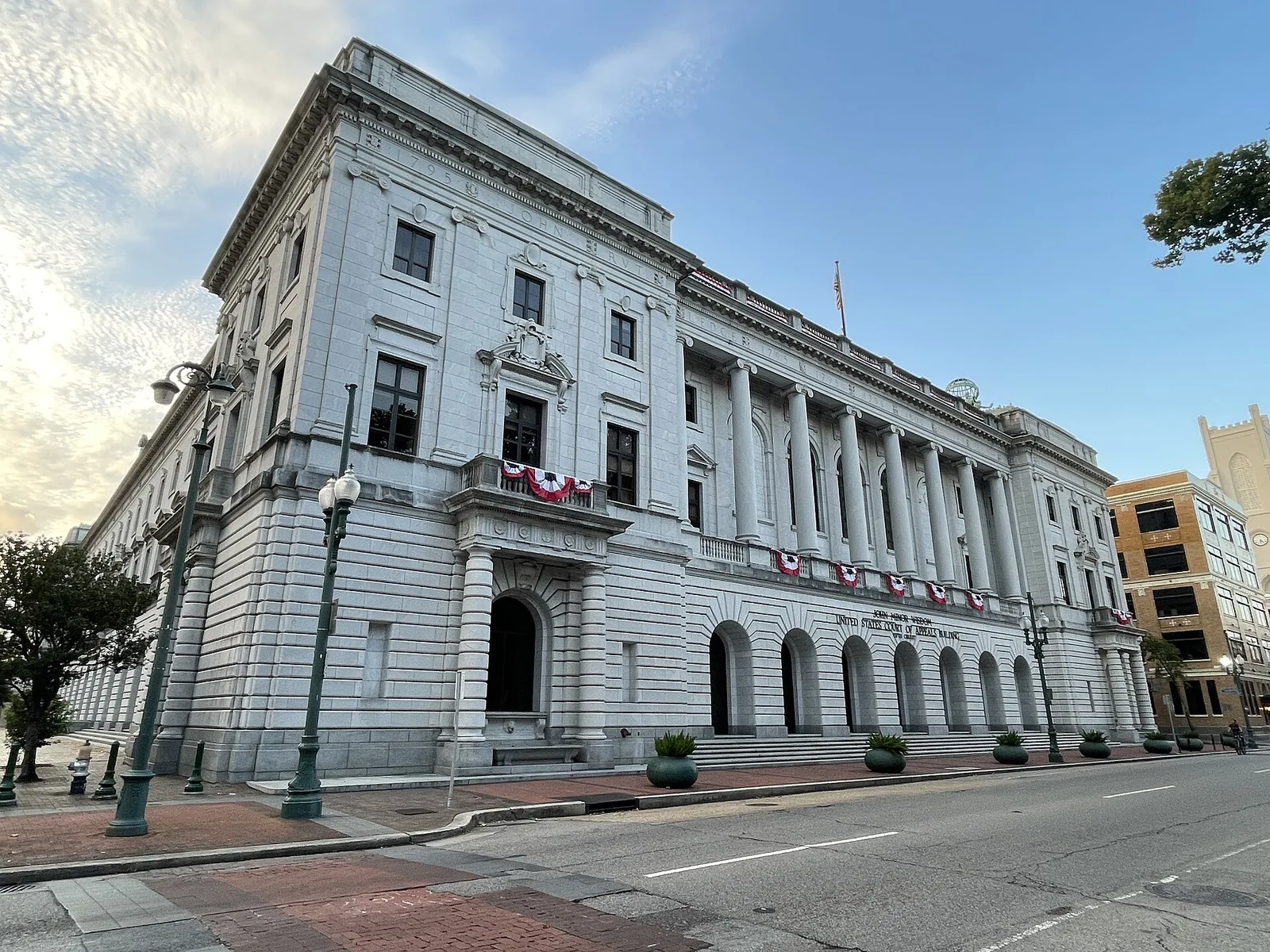
Judge Catharina Haynes dissented briefly, agreeing with the trial judge that the provisions are constitutional. The majority also took direct aim at the Second Circuit, which upheld the buyer’s side of the ban in a 2025 criminal case, United States v. Vereen: “We reject the Second Circuit’s approach.” Two federal appeals courts now disagree about the same statute, the classic setup for a Supreme Court case.
Who the Ruling Actually Covers
Three different things are easy to blur together here.
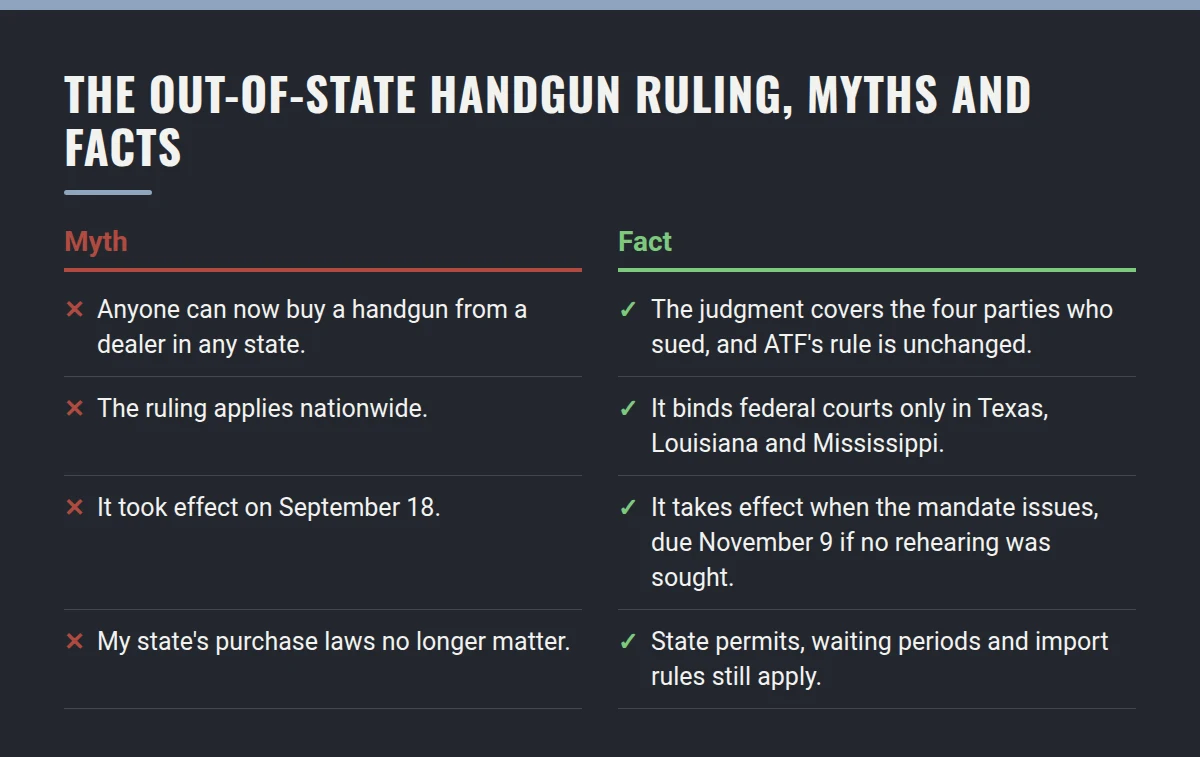
The judgment. The court reversed and rendered “judgment for plaintiffs,” meaning the four parties who sued. The opinion does not spell out the terms of an injunction, and since the Supreme Court’s 2025 decision in Trump v. CASA, federal courts generally may not order relief broader than the parties before them need. Whether the judgment reaches the coalition’s wider membership is a question the opinion does not answer.
The precedent. As a published decision, the ruling binds every federal judge in Texas, Louisiana and Mississippi, which matters if the government ever tries to prosecute a dealer or a buyer there under these provisions. It binds no federal court anywhere else. In New York, Connecticut and Vermont, the Second Circuit’s ruling upholding the buyer’s side of the ban still governs.
The law on the books. Nothing has been repealed. The statute is still in the U.S. Code, and ATF’s regulation still forbids the sale; the court declined to rule on that regulation separately because it adds nothing to the statute. We found no new ATF guidance on the ruling as of November 4.
And as this was written in early November, the ruling had not yet taken effect. An appeals court ruling takes effect when the court issues its mandate. The government had until November 2 to ask the panel or the full court to rehear the case, and if it did not, the mandate is due November 9. We could not confirm a rehearing petition either way when this was written. As New Jersey gun owners learned when a court struck down their magazine ban and the ban stayed in force anyway, a ruling on paper and the law on the street can stay apart for a long time.
Why the Map Matters More Than the Headline
The ban has two halves. The dealer’s half is the sale, which happens at the dealer’s counter. The buyer’s half is bringing the gun into, or receiving it in, the state where the buyer lives. A precedent that binds only federal courts in Texas, Louisiana and Mississippi protects each half only where it happens.
| You live in | You buy in | Where the ruling leaves you |
|---|---|---|
| Texas, Louisiana or Mississippi | Another of those three states | Best case: both halves fall inside the Fifth Circuit. Many dealers may still wait for ATF. |
| Any other state | Texas, Louisiana or Mississippi | The sale is in the Fifth Circuit, but taking the gun home is not. Not covered. |
| Texas, Louisiana or Mississippi | Any other state | The selling dealer is outside the Fifth Circuit. Expect a refusal. |
| New York, Connecticut or Vermont | Anywhere | Your federal appeals court upheld the rule on bringing guns home. |
So the person the ruling helps most clearly lives in one of the three states and shops in another: a Shreveport resident at a dealer in East Texas, say, or someone from the Mississippi Gulf Coast buying across the Pearl River in Louisiana. An Oklahoma trucker or a Florida family on vacation in Houston gains nothing at the counter yet, and every dealer keeps the right to decline any sale.
The State Laws This Case Never Touched
Even a complete win against the federal ban would leave every state’s own purchase law in place. Rosters of approved handguns, permits to purchase, waiting periods, registration and import rules are all state law, and a ruling about a federal statute does not reach them.
Some states regulate purchases their residents make elsewhere. California bars a resident from bringing in a firearm obtained outside the state since 2015 unless it is first delivered to a California dealer, who then hands it over under the state’s own delivery rules, including the 10-day wait. Illinois says no one may “acquire or possess any firearm” in the state without a Firearm Owner’s Identification card. New York, New Jersey, Maryland and Hawaii also require a state license or permit before you acquire a handgun, as our guide to how a dealer purchase works lays out.
The seller’s state matters as well. Federal law bars a dealer from selling any firearm to someone whose purchase or possession would break a state law or published ordinance that applies where the sale takes place.
What You Can Already Do Legally
None of these depends on the ruling.
- Snowbirds can buy where they are living. ATF’s definition of residence says a person with homes in two states is a resident of whichever one they are actually living in at the time. While you are wintering at your Arizona house, you can buy from an Arizona dealer like any other Arizonan, provided you can show government-issued proof of that address, since your driver’s license probably shows the other one. Your other state’s laws still apply once the gun goes there.
- Service members are residents of the state where their permanent duty station is.
- Renting a handgun at a range for an afternoon is allowed under federal law, even in a state where you could not buy one.
- An inherited handgun can come home with you when it passes to you through a will or an estate, as long as you could lawfully own it in your state.
- Everyone else uses the home-dealer route. Before you buy anything out of state, call your local dealer: confirm it accepts transfers, ask the fee, and ask how it wants the selling dealer to reach it.

Whichever way the gun gets home, the drive is its own legal question. If your route crosses states with strict transport laws, our state travel atlas covers the federal safe passage rule and how to pack for it.
What Happens Next
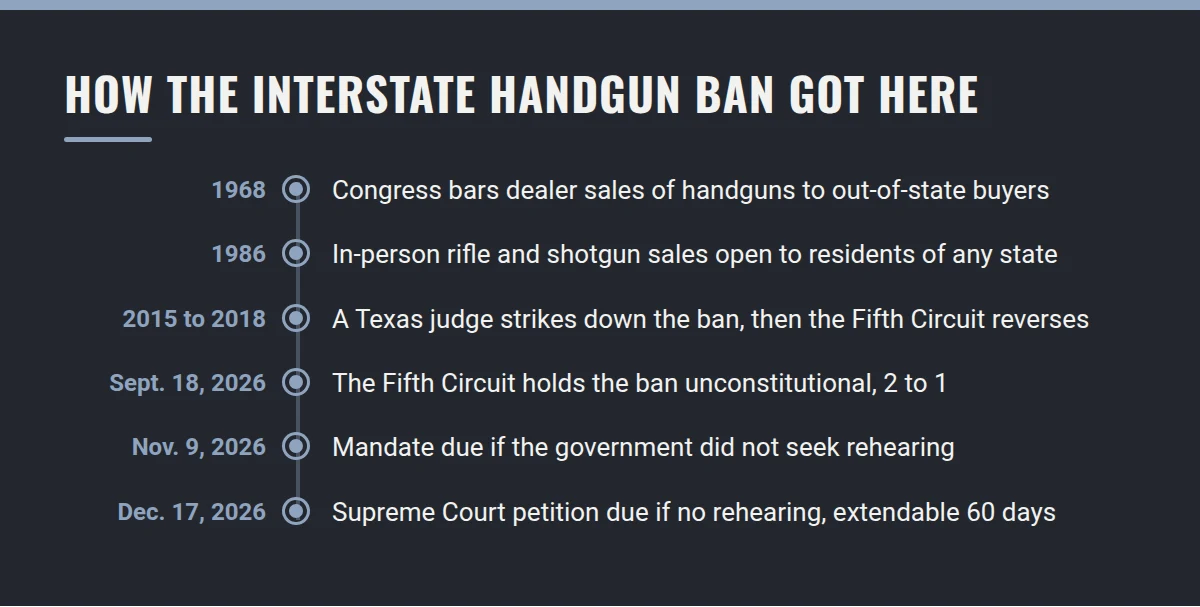
The government’s choices narrow over the coming weeks. If it did not seek rehearing, its deadline to ask the Supreme Court to take the case falls on December 17, 90 days after the judgment, and a justice can extend that by up to 60 days. Whether it will is genuinely uncertain. A post on the Duke Center for Firearms Law’s blog noted that, given the administration’s positions in other Second Amendment cases, it is unclear whether the government will seek further review at all. The day before this ruling, the Justice Department concluded that the federal ban on dealer handgun sales to adults under 21 is unconstitutional and may not be criminally enforced, which we covered in our explainer on the DOJ’s under-21 opinion.
Three paths look realistic from here:
- The government lets the ruling stand. It becomes settled law in the three states, the split with the Second Circuit remains, and the question can still reach the Supreme Court through another case.
- The government asks the Supreme Court to hear it. A split between two circuits is one of the main things the Court looks for when it chooses cases, and the government could also ask to keep the ruling on hold while the Court decides.
- ATF or Congress acts. ATF could rewrite its regulation and guidance, or Congress could amend the statute. Either would do more for buyers nationwide than this one case can.
A caution from history: this ban has been struck down before. In 2015 a federal judge in Texas held it unconstitutional and blocked its enforcement, and in 2018 the Fifth Circuit reversed and threw out the injunction. The legal test has changed since then, but the lesson has not. A ruling that is not final is no reason to change how you buy.
The Bottom Line
The Fifth Circuit has declared the federal ban on buying a handgun from an out-of-state dealer unconstitutional, and for now that is mostly a statement about the future. The judgment covers four parties, the precedent covers three states, the statute and ATF’s rule remain on the books, and your own state’s purchase laws never depended on any of it. Until the mandate issues and ATF or the Supreme Court weighs in, plan on buying at home or having the gun shipped to a dealer near you.
Firearm purchase laws vary widely by state and are changing quickly. Verify the current rules in your state and the seller’s state before you buy, take questions about your own situation to a firearms attorney, and if this is your first handgun, book in-person training with a certified instructor before you carry it.
Further reading (sources)
- U.S. Court of Appeals for the Fifth Circuit in Elite Precision Customs v. ATF, the September 18 opinion and dissent, and on the same ban in Mance v. Sessions, which reversed the 2015 injunction
- Duke Center for Firearms Law with an analysis of the ruling, the circuit split and the mandate dates
- ATF on how a sale to an out-of-state buyer goes through a home-state dealer
- Legal Information Institute for the text of 18 U.S.C. 922, the 90-day certiorari deadline in 28 U.S.C. 2101 and the Supreme Court’s opinion in Trump v. CASA
- Electronic Code of Federal Regulations on ATF’s nonresident sale rule in 27 CFR 478.99 and the definition of state of residence in 27 CFR 478.11
- U.S. Statutes at Large with Congress’s 1968 findings on handgun sales to nonresidents and the 1986 Firearm Owners’ Protection Act
- FindLaw reproduces California’s out-of-state import rule, Penal Code 27585, and its 10-day dealer delivery rule, Penal Code 27540
- Illinois General Assembly for the FOID card requirement in 430 ILCS 65/2