How Buying a Handgun Actually Works in 2026: Form 4473, NICS, Waiting Periods, Age Limits, and Interstate Rules
Published on October 29, 2026

Most first-time buyers picture a handgun purchase as an ordinary retail sale: pick the gun, pay, walk out. What actually happens is a federal form you sign under penalty of a felony, a background check that can stall for days, and a layer of state law that decides whether the gun goes home today, next week, or only after you get a license you may not have known you needed.
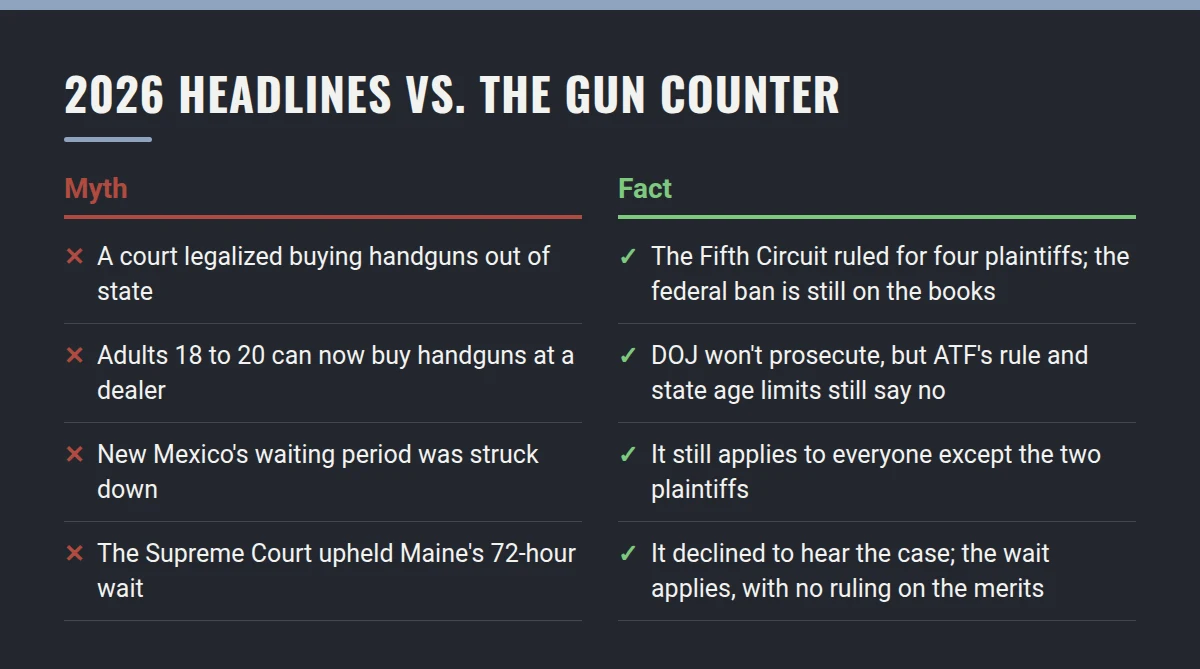
This fall’s headlines made it murkier. In September a federal appeals court struck down the ban on buying a handgun directly from an out-of-state dealer, and the Justice Department said it would stop prosecuting dealers who sell handguns to adults aged 18 to 20. In October the Supreme Court declined to hear a challenge to Maine’s 72-hour waiting period. Read quickly, those stories suggest the rules just changed. At most gun counters, they did not.
This guide walks through the purchase itself, start to finish: the form, the check, the waits and limits states add, where a carry permit lets you skip steps, and what the 2026 rulings really did. Choosing the gun is a separate job, and our first carry pistol buyer’s guide covers it.
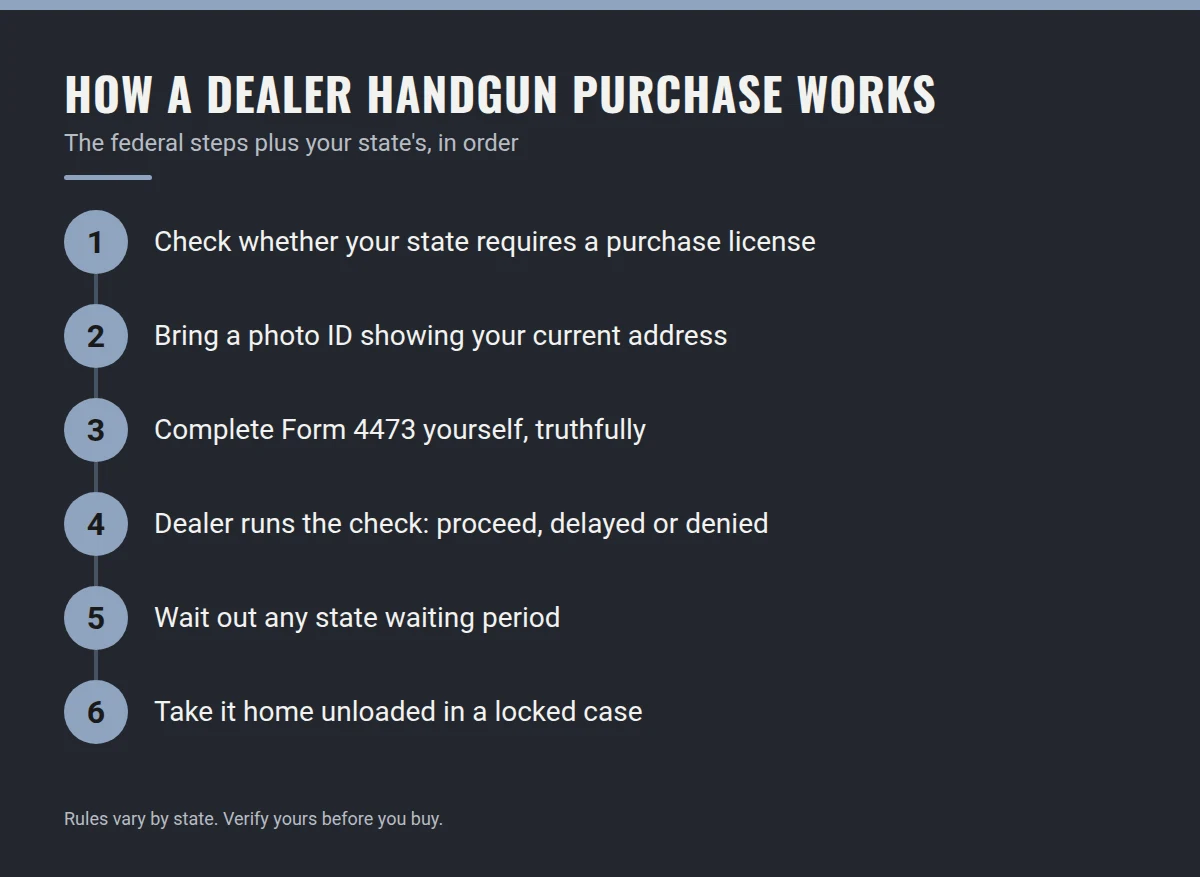
Step Zero: Find Out Whether Your State Wants a License First
In most states you can walk into a gun shop with nothing more than a driver’s license. In a handful, the dealer cannot start the sale until you hold state paperwork, and getting it can take weeks.
- Illinois requires a Firearm Owner’s Identification (FOID) card to acquire or possess any firearm.
- Maryland requires a Handgun Qualification License, which calls for an approved safety course and fingerprints and lasts ten years.
- New Jersey requires a permit to purchase a handgun. Each permit covers one handgun and expires 90 days after it is issued.
- Hawaii requires a permit to acquire, which cannot be issued until 14 days after you apply and must be used within 30 days.
- New York requires a pistol license before you can buy or possess a handgun.
If you live in one of these states, your first stop is the licensing office, not the gun counter. Everywhere else, the process starts at the dealer.
At the Counter: What Form 4473 Asks
Every sale by a licensed dealer runs through ATF Form 4473, the Firearms Transaction Record. The version in use is the one revised in August 2023. The dealer records the gun first, and then you complete your own section.
Identification. You need a valid government-issued photo ID showing your name, date of birth and current home address. If your license still shows an old address, the dealer can accept a second government document that shows where you live now, including a valid electronic one from a government website. Active-duty service members can use their permanent change of station orders. Your Social Security number is optional, though the form notes it helps prevent a mistaken match.
The actual buyer question. Question 21.a asks whether you are the actual buyer. If someone hands you money to buy a gun for them, you are not, and the dealer cannot complete the sale. Buying a genuine gift with your own money is fine, as long as the person receiving it is not prohibited from owning a gun.
The eligibility questions. The rest of question 21 runs through the federal prohibitions, from felony charges and convictions to domestic violence orders, certain mental health adjudications, immigration status and unlawful drug use. That last one catches many buyers off guard, because the form warns that marijuana remains unlawful under federal law even where a state has legalized it. In June 2026 the Supreme Court held in United States v. Hemani that the government’s prosecution of one marijuana user under that law violated the Second Amendment. The ruling addressed his case, not the statute as a whole: the law is still on the books, the question is still on the form, and a “yes” still stops the sale. Our guide to marijuana and the federal unlawful user ban covers where that leaves cardholders.
Telling the truth. A false answer on the form is a federal felony in its own right, even when the purchase itself would have been legal.
Picking up on a later day. If the gun changes hands on a different day from the day you filled out the form, which is routine in waiting period states and after a delayed check, you certify at pickup that your answers are still true.
Changes proposed, not in effect. In May 2026 ATF proposed rewriting the form: simpler rules for proving identity and residence, electronic forms, and two months instead of 30 days for a sale to close after the background check. The comment period ended August 6. Until a final rule takes effect, the 2023 form is the one on the counter.
The Background Check: Proceed, Delayed, or Denied
Once your section is complete, the dealer runs your information through the National Instant Criminal Background Check System (NICS). In 31 states, plus the District of Columbia and five territories, the FBI does the check. Fifteen states run every check themselves, and four run their own handgun checks while leaving long guns to the FBI. Whoever runs it, the dealer gets one of three answers.
Proceed. Nothing disqualifying turned up. Unless your state adds a waiting period, the sale can close that day.
Delayed. Your details matched a record that might be disqualifying, either someone else’s with a similar name and birth date or an old case of your own with no recorded outcome, and examiners need time to sort it out. Federal law gives them three business days, counting only days when state offices are open. If no answer arrives by then, the dealer may complete the sale unless state law forbids it, but the dealer is not required to, and some will not. For a buyer under 21, a possible juvenile record can stretch the window to 10 business days. A check is only good for 30 days, so if a delay drags past that, the dealer has to run a new one.
Denied. The check found a prohibiting record. If the denial is wrong, you can challenge it with the agency that ran the check. If you keep getting delayed because your name matches someone else’s record, you can apply to the FBI’s Voluntary Appeal File; approved applicants get a Unique Personal Identification Number to enter on future forms. If the denial is correct, perhaps because of an old conviction, the real question is whether your rights can be restored, which our guide to getting your gun rights back walks through.
As for the records, the completed 4473 stays in the dealer’s files, where ATF can inspect it. The FBI says it destroys the record of a check that ends in a completed sale, since NICS may not be used as a gun registry.
Waiting Periods: The Clock That Runs Even After You Pass
A clean check does not always mean you leave with the gun. Federal law has no waiting period beyond the delayed-check window, but several states add their own, and passing the check does not cut it short.
Selected state waiting periods for a handgun bought from a dealer, as written in each state’s law in late October 2026. Check your own state before you shop.
| State | How long you wait | Worth knowing |
|---|---|---|
| California | At least 10 days after you apply | Applies to every firearm |
| Colorado | 3 days after the dealer starts the check, or until approval if that is later | Applies to every firearm |
| Florida | 3 days, not counting weekends and holidays, or until the check is done if that is later | Florida license holders are exempt |
| Hawaii | No permit to acquire until 14 days after you apply | A separate permit for each handgun |
| Illinois | 72 hours after you agree to buy | A FOID card is also required |
| Maine | 72 hours after you agree to buy | Runs at the same time as the check |
| Maryland | 7 days after the application is filed | Handguns and other regulated firearms |
| Minnesota | 30 days after the transfer report, unless the sheriff or police chief waives it | Skipped with a permit to carry |
| New Mexico | 7 days under a 2024 law | Struck down for two plaintiffs only |
| Rhode Island | 7 days after the application | Pistols and revolvers |
| Vermont | 72 hours after the check clears, or 7 business days after it starts if sooner | Any sale that needs a check |
| Washington | 10 business days after the dealer requests the check | Applies to every firearm |
Maine’s wait survived. A federal judge blocked Maine’s 72-hour law in February 2025. In April 2026 the First Circuit vacated that order, concluding that the law “does not regulate conduct protected by the plain text of the Second Amendment,” so the state never had to defend it with historical analogues. The challengers asked the Supreme Court to take the case, backed by gun-rights groups and 25 states, and on October 19 it declined without comment. A denial is not a ruling on the merits, but the practical result is plain: the wait applies.
New Mexico’s lost, mostly on paper. In August 2025 the Tenth Circuit sided with two buyers challenging New Mexico’s seven-day wait, and on August 27, 2026, a federal judge entered final judgment barring the state from making those two people wait. Only those two. The governor’s office told Source NM it would almost certainly appeal and was blunt about everyone else: “The law remains in effect otherwise.” Two federal appeals courts have now reached opposite answers on short waiting periods, and the Supreme Court has so far declined to settle it.
Why states keep them. Supporters argue that a pause between deciding to buy and taking possession saves lives in a crisis, and the research partly backs them: RAND’s ongoing review of gun policy studies, updated in January 2026, rates the evidence as moderate that waiting periods reduce firearm suicides and total homicides. Whatever you make of the policy, plan around it. In a waiting period state, buy well before you need the gun.
One Gun a Month
A few states also limit how often you can buy. Maryland allows one handgun or other regulated firearm in any 30-day period. New Jersey allows one handgun per purchase permit and no more than one in 30 days; gun-rights groups asked a federal judge in September to strike the limit, the state filed its own motion for summary judgment on October 26, and the case is pending. Virginia limits buyers to one handgun in 30 days, with exceptions for trading in a handgun as part of the same purchase, replacing a lost or stolen one, and holding a valid Virginia concealed handgun permit.
California’s version is gone: in June 2025 the Ninth Circuit struck down its one-gun-a-month law, finding that it “meaningfully constrains the right to purchase and possess firearms.”
Where a Carry Permit Lets You Skip Steps
This is where a carry permit can pay for itself at the gun counter, though by less than many holders assume.
Skipping the NICS call. Federal law lets a dealer skip the background check when you show a qualifying permit issued within the past five years by the state where you are buying, as long as that state checked your eligibility before issuing it. The FBI says 29 states issue permits that ATF accepts in place of a NICS check, and ATF keeps the list in its Permanent Brady Permit Chart. Many are concealed carry licenses, but not every carry license qualifies. Even when yours does, you still fill out Form 4473; the dealer records your permit on the form in place of the background check.
Skipping state steps. Some states give permit holders more:
- Florida exempts its concealed weapons license holders from the three-day wait.
- Minnesota lets a permit to carry stand in for the transfer report, which removes the 30-day wait.
- Virginia exempts its own concealed handgun permit holders from the one-handgun-a-month limit.
Other states give nothing. Illinois and Maine apply their 72-hour waits to permit holders like everyone else. Every shortcut above is also tied to a permit from the state where you are buying, so an out-of-state permit that is honored for carry under reciprocity does not count at the register. If these shortcuts tip you toward getting a permit, our breakdown of what a concealed carry class costs by state shows what the training runs before the state’s own fees.
Buying Across State Lines
Federal law lets a dealer sell you a rifle or shotgun in person in another state, as long as the sale is legal in both states. Handguns are different. A dealer may sell a handgun only to a resident of the dealer’s own state, and two private individuals who live in different states cannot trade one directly either. If you find the right handgun out of state, the selling dealer ships it to a dealer in your home state, who handles the 4473 and the background check and hands it over, usually for a transfer fee. One plaintiff in the case below said the home-state dealer he uses typically charges $30 to $40.

Where you live is the state where you are present with the intention of making a home. If you split the year between two houses, federal rules treat you as a resident of whichever state you are actually living in at the time. Active-duty service members are residents of the state where their permanent duty station is located.
The Fifth Circuit ruling. On September 18, 2026, a divided Fifth Circuit panel held in Elite Precision Customs v. ATF that the federal ban on interstate handgun sales violates the Second Amendment, finding the historical record “devoid of laws meaningfully restricting the trade of firearms between states” in the early republic. It reversed the lower court and entered judgment for the plaintiffs: a Texas dealer, two would-be buyers from Arizona and New Mexico, and the Firearms Policy Coalition.
Before you plan a road trip, three cautions. The statute is still in the U.S. Code, and ATF’s matching regulation has not changed. The Second Circuit upheld the same provisions in 2025 and the Supreme Court declined to review that case, so the federal appeals courts now disagree. And the government’s deadlines to seek rehearing or Supreme Court review had not yet passed when this was written. Until ATF, Congress or the Supreme Court acts, expect dealers everywhere, Texas included, to keep requiring a transfer through your home state.
Under 21: A Federal Shift That Has Not Reached Most Counters
Since 1968 federal law has barred licensed dealers from selling handguns to anyone under 21. On September 17, 2026, the Justice Department’s Office of Legal Counsel concluded that the rule is unconstitutional and may not be criminally enforced against dealers who sell to law-abiding adults aged 18 to 20. That is a real change, but a narrow one. The statute is still law, ATF’s regulation still forbids the sale, and states with their own under-21 rules, such as Florida’s ban on dealer sales of any firearm to buyers under 21, are untouched. Buyers under 21 also get the enhanced background check that can run up to 10 business days.

Our explainer on the DOJ under-21 opinion covers what changed, what did not, and why the age to buy and the age to carry are separate questions.
Buying From a Private Seller
Federal law does not require a background check when two residents of the same state sell a gun privately, but many states do. Washington subjects nearly every private sale to a background check through a licensed dealer, Vermont requires most private transfers to go through a dealer, and Virginia requires a private seller to get a background check result through a dealer before selling. Wherever you live, no one may sell a gun to a person they know or have reasonable cause to believe is prohibited, and a handgun sale between residents of different states still has to go through a dealer in the buyer’s state. A private sale skips the dealer’s paperwork, not the law.
Before the Gun Comes Home
The transaction is only half of the job. Follow your state’s rules for transporting the gun home (unloaded and in a locked case is the safest default), have a lockbox or safe ready before it arrives, and book time with a certified instructor for in-person training. Owning a handgun and carrying one are separate legal questions, and a receipt is not a permit.
The Bottom Line
In 2026, the rules for buying a handgun are moving faster in the courts than at the counter. On the day you buy, expect the 4473, a background check, and every step your own state adds: licenses, waiting periods and purchase limits. If you hold a permit from the state where you are buying, check whether it lets you skip the NICS call or a state step. And treat any headline about a court ruling as a reason to call your dealer, not to drive across a state line.
Laws on firearm purchases vary widely by state and are changing month to month. Verify current rules with your state’s agency before you buy, and take questions about your own eligibility to a firearms attorney.
Further reading (sources)
- ATF for the current Form 4473 and its instructions
- Federal Register on ATF’s May 2026 proposal to revise Form 4473
- FBI with how NICS checks, delays and alternate permits work
- Cornell Legal Information Institute for the federal statute behind the check and the residency rules, 18 U.S.C. 922 and the Supreme Court’s opinion in United States v. Hemani
- Electronic Code of Federal Regulations on the 30-day check limit and the permit exception, the definition of state of residence and ATF’s rule on nonresident and underage sales
- U.S. Court of Appeals for the Fifth Circuit in Elite Precision Customs v. ATF
- U.S. Court of Appeals for the First Circuit on Maine’s waiting period, as filed with the Supreme Court, and the Supreme Court docket showing the October 19 denial in Beckwith v. Frey
- Source NM on the New Mexico judgment and the governor’s response
- RAND with its review of research on waiting periods
- Duke Center for Firearms Law on the Ninth Circuit ruling against California’s one-gun-a-month law
- Firearms Policy Coalition, a plaintiff, lists the filings in the New Jersey one-gun-a-month case
- U.S. Department of Justice, Office of Legal Counsel on why the under-21 dealer rule may not be enforced
- State legislatures for the waiting periods and purchase limits above: Florida 790.0655, Maine 25 M.R.S. 2016, Minnesota 624.7132, Rhode Island 11-47-35, Colorado’s 2023 waiting period act, Virginia’s one-handgun rule and its permit exemption and Virginia’s private sale check
- Illinois General Assembly on the 72-hour wait and the FOID card requirement
- Maryland General Assembly with the seven-day wait and the one-per-30-days limit
- Washington State Legislature for the 10-business-day dealer wait and the private sale rule
- Vermont General Assembly on the 72-hour wait and private transfers through a dealer
- FindLaw reproduces New Jersey’s handgun purchase permit law and California’s 10-day wait