Marijuana, Prescriptions, and the Federal 'Unlawful User' Gun Ban
Published on June 24, 2026
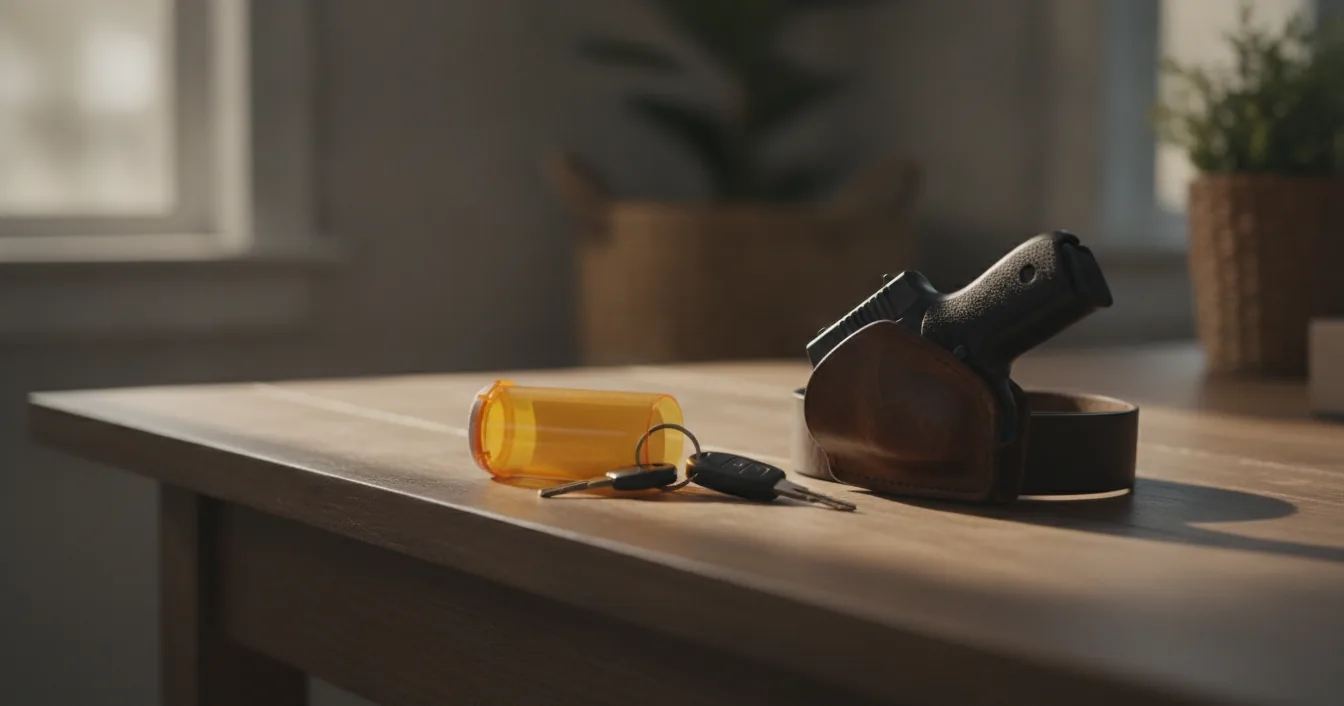
In May 2026, police in Sterling, Illinois stopped a man walking down a residential street and found a pistol, eleven rounds of ammunition, and 3.6 grams of fentanyl in the bag he was carrying (Shaw Local, 2026). The charges stacked up fast, and because he already had felony convictions, prosecutors had several prohibitions to choose from. But strip away the prior record and one element of that arrest still describes a federal crime almost nobody talks about in concealed carry classes: possessing a firearm while using an illegal drug. The statute is 18 USC 922(g)(3), the “unlawful user of any controlled substance” ban, and it disqualifies far more otherwise law-abiding people than they realize. Most never see it coming, because the thing that trips them is legal where they live.
What 18 USC 922(g)(3) Actually Says
Federal law makes it unlawful for any person “who is an unlawful user of or addicted to any controlled substance” to possess a firearm or ammunition. The phrase “controlled substance” points back to the federal Controlled Substances Act, and that is the detail that catches people: the question is whether a drug is controlled under federal scheduling, not whether it is legal in your state. A violation is a federal felony. Thanks to the Bipartisan Safer Communities Act of 2022, the maximum sentence for a 922(g) offense climbed from ten years to fifteen (Congressional Research Service, 2023).
Courts have read a timing requirement into the word “user.” A single experiment years ago does not make you an unlawful user; the government generally has to show drug use regular and recent enough to overlap with the period you possessed the gun. That nuance matters, but it is thin protection. Ongoing use of a federally controlled substance plus a firearm in the home is enough, and you do not have to be high at the moment police find the gun.
Marijuana Is the Big One
The single most common way an ordinary person lands in this category is marijuana. As of 2026, cannabis remains a Schedule I controlled substance under federal law. A 2024 Justice Department proposal to move it to Schedule III is still unfinished, and even if it eventually clears, marijuana would stay a controlled substance that cannot be casually prescribed, so the firearm problem would not simply disappear.
The ATF has been blunt about what this means. In long-standing guidance to licensed dealers, the agency states that anyone who uses marijuana is an unlawful user under federal law, regardless of whether their state has legalized it for medical or recreational use, and regardless of whether they hold a state-issued medical card (ATF, 2024). Form 4473, the document you sign to buy a gun from a dealer, spells it out in a warning printed right on the page: marijuana use and possession remain unlawful under federal law even where a state has legalized them. Answering that question dishonestly is a separate felony, so a regular cannabis user faces a real bind. Answer truthfully and the sale is denied. Answer falsely and you have put a federal crime in writing.

A state medical marijuana card makes the problem worse, not better. The card is documentary proof of exactly the status the statute prohibits. Hawaii offered an early preview of where this can lead: in 2017, Honolulu police mailed letters ordering registered medical cannabis patients to surrender their firearms, then backed off after the public reaction. The registries exist, and they can be cross-referenced.
The Courts Are Reshaping the Ban
This is one of the most actively litigated corners of federal gun law right now. After the Supreme Court’s 2022 Bruen decision required gun rules to fit the nation’s historical tradition, defendants began arguing that disarming drug users has no founding-era analogue. The Fifth Circuit agreed in United States v. Daniels, throwing out the conviction of a marijuana user in 2023. The Supreme Court sent the case back for another look following its 2024 decision in United States v. Rahimi (the ruling that upheld disarming people under domestic violence restraining orders), and on remand the Fifth Circuit again found 922(g)(3) unconstitutional as applied to a sober marijuana user. The government had petitioned the case to the Supreme Court as Garland v. Daniels.

Here is the trap buried in that good news: the rulings are “as applied,” the federal circuits disagree with one another, and the statute is still on the books and still enforced everywhere. A favorable opinion in one circuit does not legalize your conduct in another, and it will not stop a prosecution, an arrest, or a denied purchase in the meantime. Until the Supreme Court settles the question for the whole country, treat 922(g)(3) as live law, because it is.
Where Prescriptions Fit In
Here the news is better than most carriers fear, with a few sharp exceptions. The statute bars unlawful users. Taking a controlled-substance medication exactly as a doctor prescribed it is lawful use, so a person with a valid prescription for an opioid painkiller, an ADHD stimulant such as Adderall, or a Schedule IV anxiety or sleep medication is not, by that fact alone, a prohibited person.

The danger starts when the use stops being lawful. Taking more than prescribed, using a medication written for someone else, or buying a controlled drug off the books all convert lawful use into unlawful use. And there is a separate, common-sense line that has nothing to do with scheduling: never carry a firearm while actually impaired by any substance, prescription or not. Many states stack their own offenses on top of the federal rule for handling a gun while intoxicated.
The reason medical marijuana gets no prescription safe harbor is technical but decisive. Because cannabis sits on Schedule I, it has no accepted federal medical use and cannot be prescribed at all. A doctor “recommends” it under a state program; no federal prescription exists. So unlike a Schedule II opioid taken as directed, medical marijuana use is never lawful use in federal eyes.
What This Means If You Carry
A handful of practical takeaways follow from all of this.
- You cannot lawfully use marijuana and own a gun at the same time under current federal law, even where both are legal in your state. There is no version of this where a medical card protects you federally.
- Do not lie on Form 4473. The false-statement charge is often easier to prove than the underlying possession, and it carries its own felony exposure.
- If you use cannabis and want to carry lawfully, the only clean path today is to stop and be able to show the use is genuinely in the past before you buy or carry. How much distance is enough remains unsettled, which is exactly why this is a question for a lawyer.
- Prescription patients should keep their medications properly documented, take them only as directed, and never carry while impaired.
- Because marijuana legality and carry rules both shift at the state line, a single road trip can stack two problems at once. Our concealed carry travel atlas walks through how carry law changes as you cross state borders.
This is genuinely unsettled, fact-specific territory, and it is the kind of question where a firearms attorney earns the fee. For the wider set of federal rules that sit on top of your permit, see our complete reference guide to federal firearms law, and for how permitting works where you live, our guide to state concealed carry laws and training requirements. If you are still deciding whether to pursue a permit at all, the concealed carry class FAQ is a good place to start.
The uncomfortable part is that this prohibition feels victimless and is easy to stumble into, which is precisely what makes it dangerous. Knowing the rule is the first step toward staying on the right side of it.
Further reading (sources)
- Shaw Local on the Sterling arrest that paired a pistol with a controlled substance
- Cornell Legal Information Institute for the full text of 18 USC 922 and its prohibited-person categories
- ATF with its guidance on federal firearms law and prohibited persons
- Congressional Research Service on the unlawful-user prohibition and the Bipartisan Safer Communities Act penalty increase
- Congressional Research Service for its legal analysis of marijuana use and the right to possess firearms after Bruen
- SCOTUSblog with the case file on United States v. Rahimi
- Federal Register documenting the DEA proposal to reschedule marijuana to Schedule III