The DOJ Says Dealers Can Sell Handguns to 18-to-20-Year-Olds: What Actually Changes at the Counter
Published on October 1, 2026

On September 18, 2026, the Justice Department released a legal opinion concluding that the federal ban on licensed dealers selling handguns to 18-to-20-year-olds is unconstitutional and may not be criminally enforced. Nearly two weeks of headlines along the lines of “DOJ drops federal handgun sale ban” has left plenty of young adults, and more than a few parents, believing a 19-year-old can walk into a gun store this weekend and walk out with a pistol.
For most of them the honest answer is not yet, and in a large part of the country it will stay no whatever happens in Washington, D.C. This is the buying-side explainer for young adults and their families: what the opinion does, what it cannot do, why the counter is probably still closed this month, and how your own state’s law decides the rest. Carrying is a separate question with a separate age, and we come back to it near the end.
What the Justice Department Actually Said
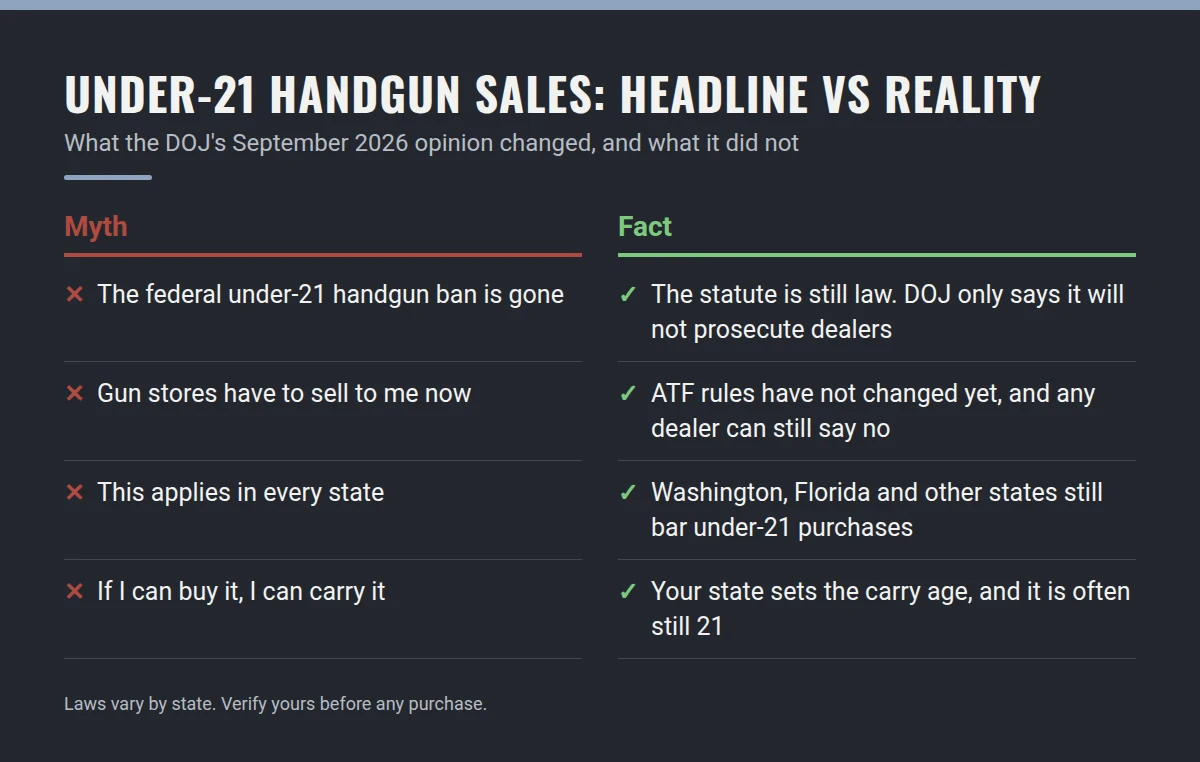
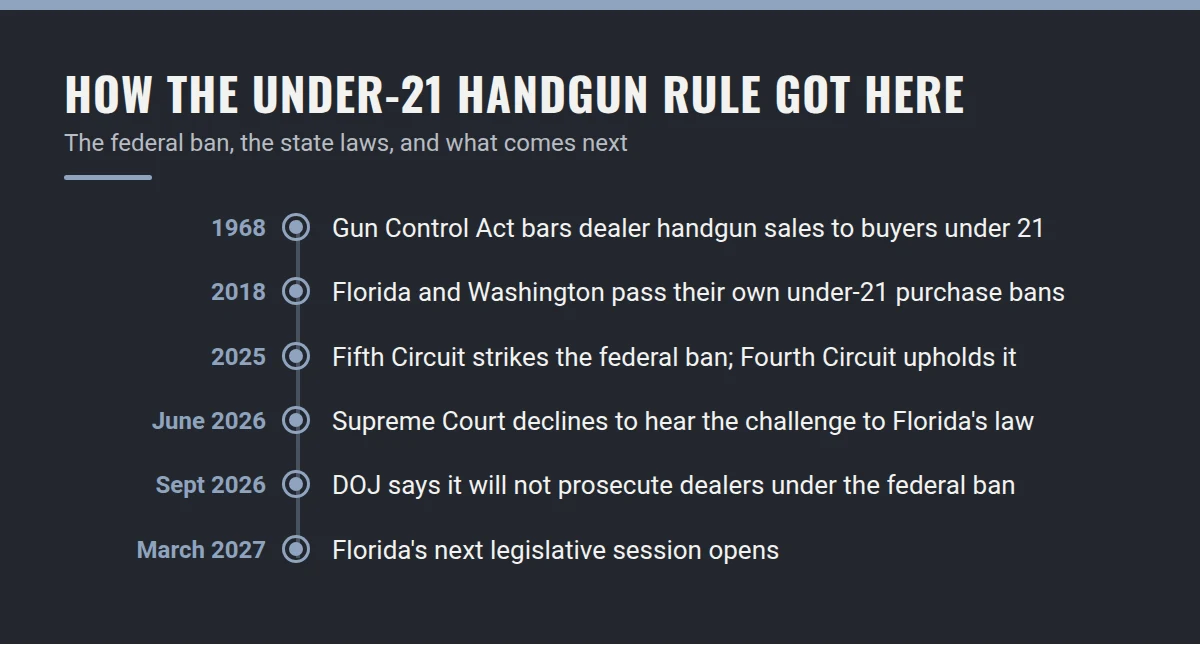
Since the Gun Control Act of 1968, federal law has made it a crime for a licensed dealer to sell a handgun, or handgun ammunition, to anyone the dealer knows or has reasonable cause to believe is under 21. That rule is 18 U.S.C. 922(b)(1). A companion provision, 922(c)(1), closes the same door for buyers who do not appear in person. Rifles and shotguns have been available from dealers at 18 the whole time.
Notice who the rule is aimed at. It restricts the dealer, not the buyer. Federal law has never made it a crime for an 18-year-old to possess a handgun, because the federal juvenile handgun ban stops at 18. What the statute did was make the dealer the gatekeeper, with real stakes attached: a willful sale to a 19-year-old carries up to five years in federal prison and puts the dealer’s license at risk.
The new opinion comes from the Office of Legal Counsel, the part of the Justice Department that advises the rest of the executive branch on what the law means. Dated September 17 and signed by Assistant Attorney General T. Elliot Gaiser, it concludes that 922(b)(1) and (c)(1) “may not be enforced to impose criminal penalties on dealers who sell handguns” to law-abiding adults aged 18 to 20. Its first line makes the whole argument in miniature: “Our laws deem an eighteen-year-old ‘mature enough to be drafted, vote, serve as a juror, and be sentenced to death.’”
The reasoning runs through the Supreme Court’s recent Second Amendment cases, including the June 2026 Hawaii decision, Wolford v. Lopez, which we broke down when it was decided. Young adults belong to “the people” the Amendment protects, the opinion says, handguns are arms in common use for self-defense, and Founding-era militia laws enrolled men at 18 and expected them to show up with their own guns.
Just as important is what the opinion leaves alone. It does not touch the ban on handgun possession by anyone under 18, the prohibited-person categories that disqualify buyers of any age, or the enhanced background check Congress requires for buyers under 21. All of those still apply.
What an OLC Opinion Is, and What It Is Not
An OLC opinion steers the executive branch. It is why federal prosecutors are expected to stop charging dealers under this statute. It is not a court ruling, and three practical limits follow from that.
The statute is still on the books. Section 922(b)(1) remains in the U.S. Code. Only Congress can repeal it, and only a court can strike it down. A future administration could withdraw the opinion as easily as this one issued it, and the old enforcement posture would come back with it.
The courts are still split. The Fifth Circuit, which covers Texas, Louisiana, and Mississippi, held the federal ban unconstitutional in 2025. The Fourth Circuit, which covers Maryland, Virginia, West Virginia, and the Carolinas, upheld it the same year. And in July 2026, a month after Wolford, a federal judge in Connecticut upheld both the state’s and the federal under-21 handgun restrictions after a two-day bench trial. The opinion concedes that the question “has deeply divided members of the federal bench,” then explains why it sides with the judges who struck the law down. No court is bound by that choice.
It does not bind the states. The opinion says so itself: “numerous states, which are not bound by our opinions, have similar age restrictions.” A footnote then lists 17 states and the District of Columbia. Those laws are untouched, and state prosecutors still enforce them.
Why the Counter Is Probably Still Closed This Month
Even in a state with no age law of its own, a dealer who would happily make the sale has good reasons to wait.
ATF has not changed its rules. The opinion speaks to prosecutors. ATF’s regulations implementing the age limit remain in effect, and days after the opinion came out, the agency’s public guidance still told licensees they may not transfer handguns to anyone under 21. An ATF spokesperson told the Daily Caller News Foundation that the agency’s counsel was still reviewing questions about the memo. Even Aidan Johnston, director of federal affairs at Gun Owners of America, who called the opinion “a huge deal,” expects the rulemaking that has to follow to be “probably a six-to-twelve-month process.”
The license is a separate risk. The opinion’s conclusion is limited, in its own words, to “criminal penalties.” It does not resolve ATF’s separate power to revoke the license of a dealer who willfully breaks the statute, and for a gun shop the license is the business.
The paperwork has not caught up. Every dealer sale is recorded on Form 4473, and buyers under 21 get an enhanced background check that looks for disqualifying juvenile records. If the system flags a record for further investigation, the dealer must hold the transfer for up to 10 business days. The opinion does not say how a handgun sale to a 19-year-old should be recorded or checked, which leaves that question with ATF.
Any dealer can say no. A dealer can decline any sale it is not comfortable making, and some stores set their own age policies. The same statute also covers handgun ammunition, so the ammo shelf sits in the same limbo.
Where State Law Overrides It Outright
Federal non-enforcement removes a federal crime. It does nothing to a state crime. Where a state has its own under-21 purchase law, the opinion changes nothing at the counter, because state and local prosecutors enforce state law whatever the Justice Department thinks of the federal version.
Washington. Initiative 1639, which voters approved in 2018, rewrote RCW 9.41.240 to say that “a person under twenty-one years of age may not purchase a pistol or semiautomatic assault rifle,” and the state’s definition of that rifle is broad enough to reach most semiautomatic rifles. Adults aged 18 to 20 may possess a pistol only at home, at a fixed place of business, or on real property they control, with a short list of other exceptions. The purchase ban is not limited to dealers, and most private transfers in Washington have to go through a dealer and a background check anyway. Family gifts can skip the dealer, but they do not lift the age limits. As the Lynnwood Times put it, a Spokane or Tacoma dealer who sold a pistol to a 19-year-old would no longer face a federal felony for it, but would still face prosecution under Washington law. A federal lawsuit challenging the initiative’s age limits on semiautomatic rifles, Mitchell v. Atkins, is still in the courts, and nothing in the opinion decides it.
Florida. After the 2018 shooting at Marjory Stoneman Douglas High School in Parkland, the Legislature added a flat rule to section 790.065: “A person younger than 21 years of age may not purchase a firearm,” and no licensed dealer may make or facilitate such a sale. That covers rifles and shotguns as well as handguns, with narrow exceptions for law enforcement officers, correctional officers, and service members buying long guns, and a violation is a third-degree felony. The federal appeals court covering Florida upheld the law, and on June 30, 2026, the Supreme Court declined to hear the NRA’s challenge. “An eighteen-year-old cannot buy a firearm of any kind in the state of Florida from a licensed dealer,” the firearms manager at a Jacksonville sporting goods store told Action News Jax.
Everywhere else on the list. Washington and Florida are the clearest examples, not the only ones. The states in the opinion’s footnote include California, Colorado, Illinois, New Jersey, New York, and Ohio. New York’s governor answered the next day. “Not in New York,” Kathy Hochul posted. “No teenager should be able to walk into a gun store and buy a handgun. Our laws don’t allow it and that’s not changing.” If you live in one of these states, read your own statute before you read another headline.

Where the Florida Repeal Push Stands
Florida is where the opinion landed hardest politically. Attorney General James Uthmeier has refused to defend the state’s age law, which he considers unconstitutional, and after the opinion he wrote that he looks forward to working with the Legislature to “right this wrong.”
The votes have never been there in the Senate. The Florida House has passed a rollback in four consecutive sessions, and every one of them died in the Senate. The version the House passed in January 2026 would have lowered the age only for rifles and shotguns; handguns were not part of it. Senate President Ben Albritton summed up his chamber’s view at the time: “This last year, they were not supportive of it. I have not heard anything different this year.” His successor, incoming Senate President Jim Boyd, did not respond when the Florida Phoenix asked where he stands.
The governor’s race matters too, since the next governor will decide whether to sign or veto any repeal. Republican candidate Byron Donalds has said of the age limit, “It’s gotta go,” while Democratic candidate David Jolly has said the law “should stay in place.” The next real chance is the 2027 regular session, which convenes March 2 and must end by April 30. Until a bill passes both chambers and becomes law, the 21-and-over rule stands for every kind of firearm.
Not everyone on the retail side is pushing for change, either. “I understand the handgun, why it’s 21, and I think that should stay the same,” the same Jacksonville manager said, though he could see long guns going back to 18 if buyers first had to complete a hunter or firearms safety course.
Buying at 18, Carrying at 21: Two Different Ages
The opinion is about buying. Carrying is a different legal question, set by state law with its own minimum age, and in many states that age is still 21. Washington’s concealed pistol license requires 21. Florida’s concealed weapon license requires 21, and its permitless carry law borrows the same eligibility criteria, age included. Other states have moved the other way: Kentucky opened a provisional carry license for 18-to-20-year-olds this summer, and federal appeals courts have struck down under-21 carry limits in Minnesota and Pennsylvania.
So a gap opens. Where a 19-year-old can eventually buy a handgun, that gun can go home, but in many states it cannot lawfully go on a belt. A receipt is not a permit, and carrying concealed without one where a license is required is a crime, exactly as it was before September 18.
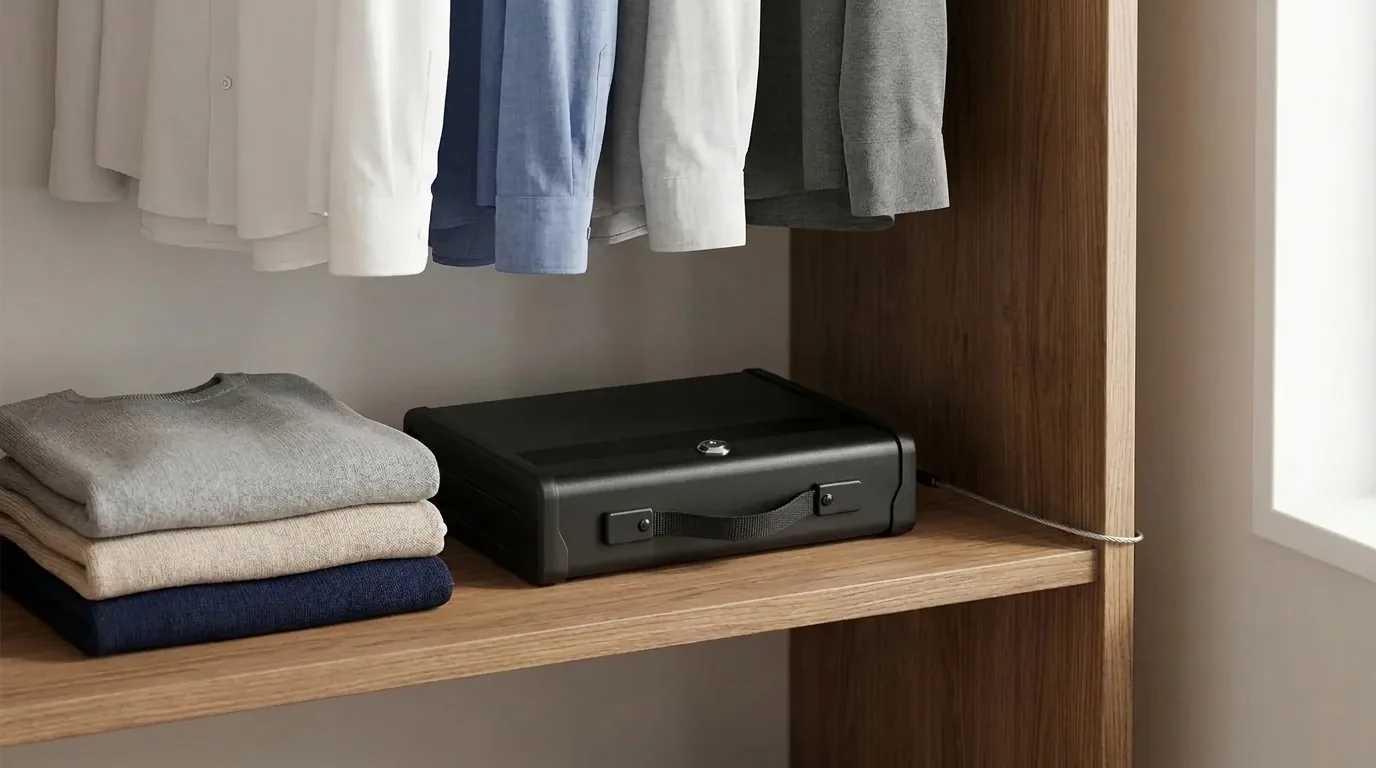
A gun at home brings its own responsibilities. If younger siblings live in the house, or you share an apartment, a locked quick-access safe is part of the purchase, not an accessory for later; our guide to raising kids around guns covers storage and safety talks for every age in the household. If you live in campus housing or rent, read the housing contract or lease, which may ban firearms outright.
If You Are 18 to 20, or the Parent of One
- Check your state first. In Washington, Florida, New York, or any other state with its own under-21 rule, nothing changed for you this month.
- Call before you drive. In states without their own rule, ask whether the store is selling handguns to buyers under 21 yet. Until ATF issues written guidance, expect careful answers.
- Buy only for yourself, and tell the truth on the form. Lying on Form 4473, including about who the actual buyer is, is a federal felony. A parent who buys a handgun as a genuine gift with their own money is the actual buyer. A parent who takes their child’s cash and fills out the form as a stand-in is making a straw purchase, however lawful the child’s own ownership would be. ATF has proposed a rule that would formally let parents buy firearms for children under 21, but a proposal is not a rule. If a parent will be standing at the counter, talk to a firearms attorney first, and see our federal firearms law reference for how Form 4473 and straw purchases work.
- Expect a longer wait. The under-21 background check can hold a sale for up to 10 business days.
- Train before you buy. Take an in-person course from a certified instructor before the gun comes home, not after, and choose a handgun for fit and purpose rather than for the headline. Our first-pistol buyer’s guide walks through those decisions.
- Keep buying and carrying separate. Your state’s carry age, permit rules, and off-limits places apply no matter how you came to own the gun.
The Bottom Line
The Justice Department has stopped threatening licensed dealers with prison for selling handguns to adults aged 18 to 20. That is a real change, and so far it is the only one. The statute is still law, ATF’s rules have not moved, the courts remain split, any dealer can still refuse, and in Washington, Florida, and the other states with age limits of their own, state law keeps the counter closed. Watch for written ATF guidance, the cases still working through the courts, and Florida’s 2027 session. Until your state and your dealer both say yes, the answer at the counter is still no, and even when it changes, carrying what you bought is a separate question with its own age.
Laws in this area are moving month to month. Verify your state’s current rules before any purchase, and take questions about your own situation to a firearms attorney.
Further reading (sources)
- U.S. Department of Justice, Office of Legal Counsel on why 922(b)(1) and (c)(1) may not be enforced against dealers
- Legal Information Institute for the text of 18 U.S.C. 922, including the under-21 background check
- CBS News with what the opinion binds and the circuit split behind it
- The Firearm Blog on why ATF guidance and the DOJ position now conflict
- Daily Caller News Foundation for ATF’s review of the memo and the rulemaking timeline
- Inside Investigator on the Connecticut ruling upholding state and federal age limits
- Washington State Legislature for RCW 9.41.240 as rewritten by Initiative 1639
- Lynnwood Times with why Washington dealers still cannot sell pistols under 21
- Florida Statutes on the under-21 purchase rule in section 790.065 and the license age in section 790.06
- Action News Jax for Florida reaction, from the attorney general to a gun counter
- SCOTUSblog on the denied petition in NRA v. Glass
- WFLX with the House’s long-gun bill and the Senate’s resistance
- Florida Phoenix on where the repeal push stands after the opinion
- The Florida Senate for the 2027 regular session calendar