Does the Gun Actually Fit You? Hand Size, Trigger Reach, and Grip Circumference
Published on September 8, 2026
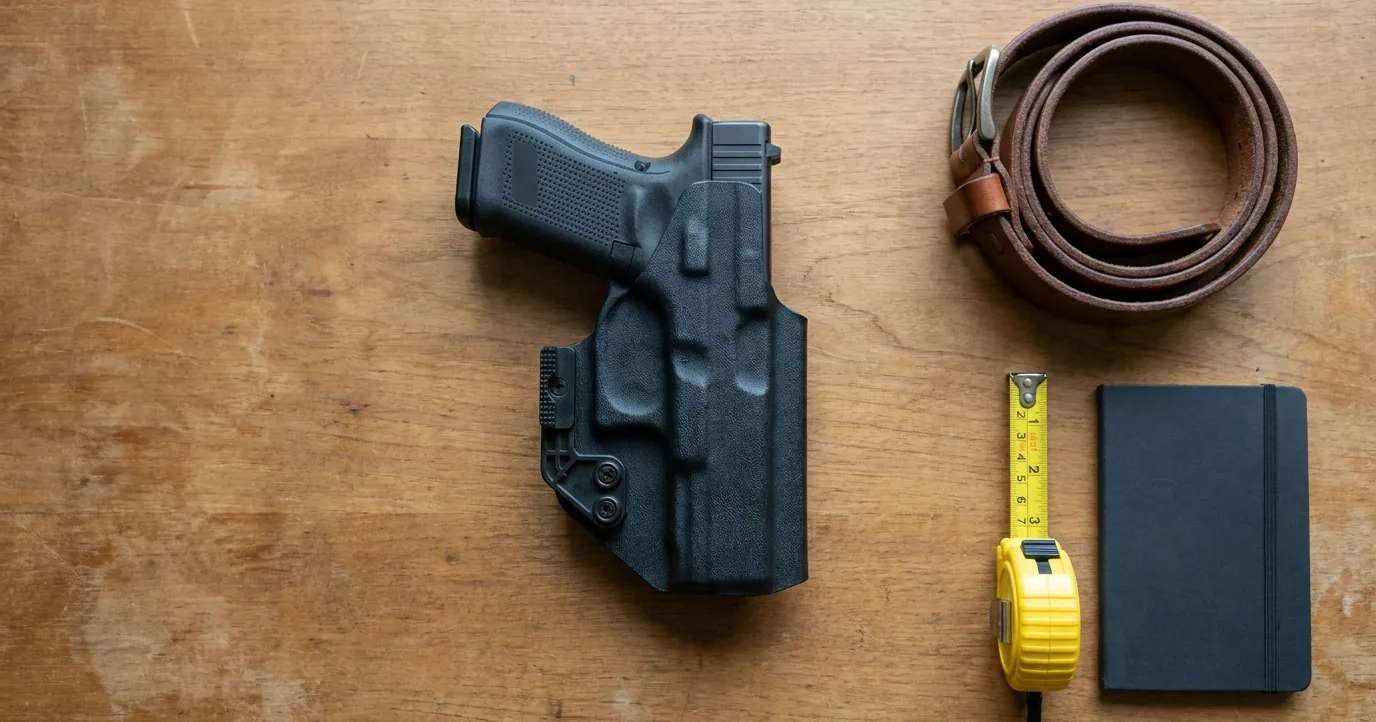
Most people buy a carry pistol the way they buy a phone. They read what is popular, hold it at the counter for thirty seconds, and take it home. Then they shoot it badly and conclude they need more practice. Sometimes that is true. Often the real problem is simpler and a lot less flattering to the way guns get sold: the pistol does not fit the hand that has to run it. Trigger reach, grip circumference, and grip length are measurable, physical things, and when they are wrong for you, range time only partly compensates. This is the part of the gun counter conversation that usually gets skipped.
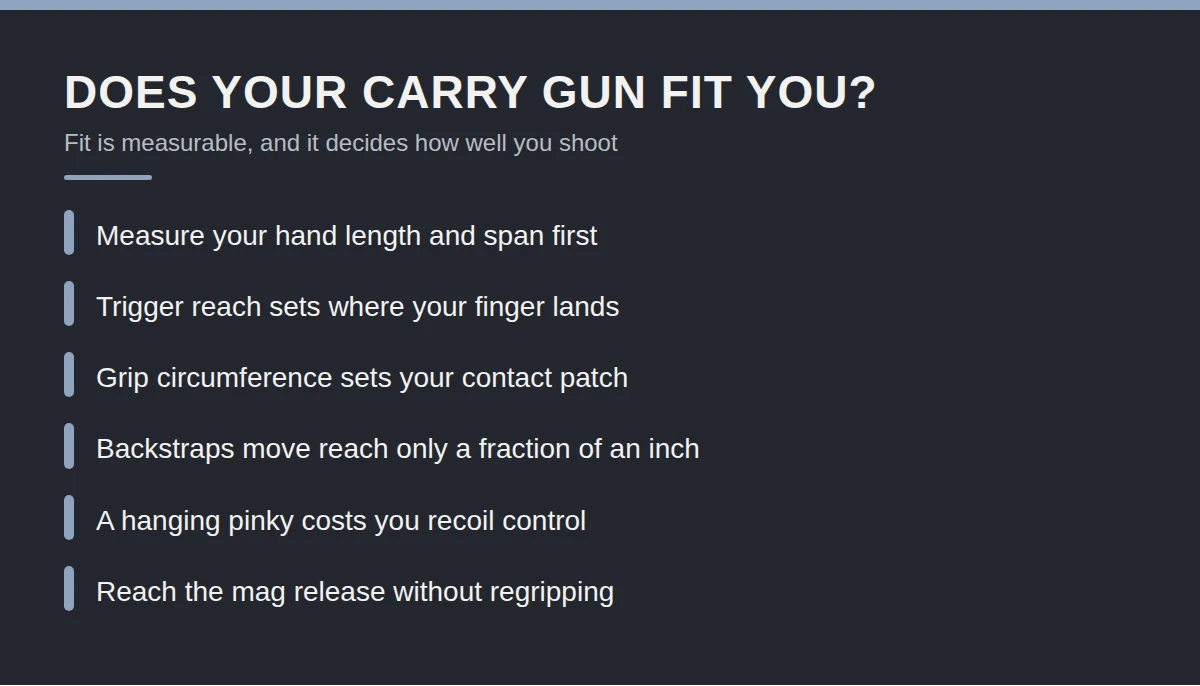
Measure Your Hand Before You Shop
Two numbers describe your hand well enough to start.
Hand length is the distance from the crease at the base of your palm, where your wrist bends, to the tip of your middle finger. Most adult hands land somewhere between about 6.5 and 8 inches. Hand span is thumb tip to little fingertip with your hand spread flat on a table. Span tells you how far you can wrap around something; length tells you how far your trigger finger can travel.
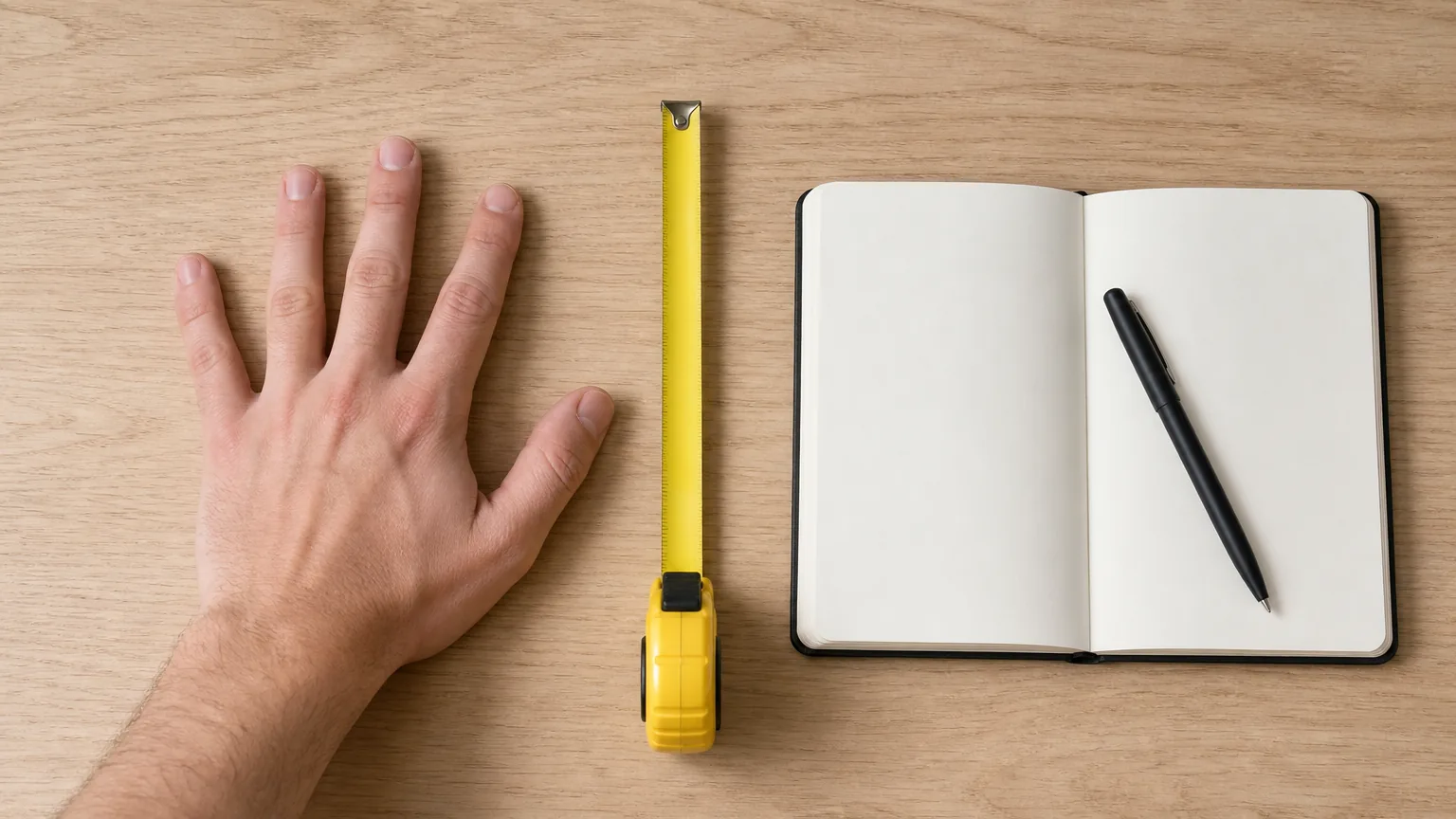
Write both down. Neither number maps to a model on a shelf, and no manufacturer publishes a compatibility chart. What they do is turn a vague feeling (“this one feels big”) into two specific questions you can answer at the counter, which is the whole point.
Trigger Reach Is the Number That Matters Most
Trigger reach is the distance from the backstrap, where the web of your hand sits, to the face of the trigger at rest. It is the single most important fit dimension on a semi-auto, because it determines where your finger lands, and where your finger lands determines whether the gun stays still while you press.
Build a proper firing grip first: web of the hand as high on the beavertail as it will go, barrel in line with your forearm. Now look at your trigger finger. On a light striker-fired trigger, you want the center of the pad, roughly between the fingertip and the first joint, sitting on the trigger face. On a heavy double-action pull, a small revolver or the first shot on a DA/SA pistol, you want more finger, out to the first joint crease, because you need the leverage.
When reach is too long, you rotate the gun in your hand to get your finger onto the trigger, and the press then pushes the muzzle toward your support side. For a right-handed shooter, that is the classic low-left group. When reach is too short, you end up pressing with the joint rather than the pad and shove the gun the other way. Either way you are steering the pistol with the same finger that is supposed to be firing it.
One caution: do not diagnose your fit from a target alone. Group offset has several possible causes, including trigger anticipation, and they look identical on paper. The fastest way to separate them is an instructor standing behind you watching your hands, which is one of the underrated benefits of a live course with a certified instructor.
Grip Circumference Is the Other Half
Circumference is the distance around the grip, measured at about the height of your middle finger. Slimline single-stacks are the narrow end of the range, compact double-stacks the wide end, and a double-stack with a thick backstrap installed is wider still.
The test is not whether your fingers meet. It is whether you can get the web of your hand high, wrap your fingers so the pads (not just the tips) are in contact, and still have the meat of your palm on the side of the frame. When circumference is too large, your hand stretches out and you end up holding the gun with your fingertips. That shrinks the contact patch right when recoil is trying to rotate the pistol, and it also leaves your support hand nowhere to sit, because the strong hand is already spread across the real estate the support palm needs.
Circumference and reach are related but not the same. A gun can be thin and still out of reach for you, and a chunky grip can have a short reach. Check them separately.
Backstraps and Grip Modules: What They Actually Change
Interchangeable backstraps are the standard fix, and they are genuinely useful, but be realistic about the size of the adjustment. Swapping from a large to a small backstrap typically changes trigger reach by a couple tenths of an inch and shaves a little circumference at the same time. That is often enough to move your finger from the joint to the pad. It is not enough to turn a gun that does not fit into one that does. Recent designs lean on this heavily: Rost Martin’s RM1F, for example, is built around interchangeable backstraps plus fully ambidextrous slide and magazine releases, which is a lot of fit adjustment at an entry price point.
Grip modules go further. On a chassis pistol, the serialized part is the internal frame, so the entire grip housing is an ordinary component you can buy in a different size, and sometimes a different length. That is real modularity, and it is the reason chassis guns fit a wider range of hands than any one polymer frame can. Read the fine print, though. Wilson Combat’s Bulwark uses a serialized steel chassis with a swappable aluminum grip module, but reviewers note that reassembling the fire control correctly is a gunsmith-level job rather than a coffee-table swap. “Modular” on the box does not always mean modular on a Tuesday night.
Revolvers deserve a mention here because they are the easiest of all to refit. Grips on a small-frame revolver come off with one screw, and a set of aftermarket boot grips or a larger rubber grip can transform both reach to a heavy double-action trigger and how the recoil feels. It is frequently the cheapest meaningful upgrade in the whole gun.
The Controls You Have to Reach Without Regripping
Fit is not only about the grip. It is about whether you can operate the gun without taking your hand off it.
Magazine release. With a full firing grip, can you press it with your strong-hand thumb? If you have to rotate the pistol to reach the button, every reload includes rebuilding your grip afterward, under stress, with a gun that is temporarily empty. Many pistols have a reversible release, which helps left-handed shooters and sometimes helps short thumbs too.
Slide stop. Can you reach it, and can you get enough leverage on it to release the slide? Plenty of shooters cannot, and that is fine. The overhand rack is faster and more reliable for most people anyway, and it works the same on every pistol. Just decide which method you use and drill that one.
Manual safety, if the gun has one. On a frame-mounted safety in the CZ 75 pattern, the question is whether your thumb can sweep it down and then ride it comfortably. Worth noting if you were planning on one of the classics: CZ concluded production of the CZ 75 B, CZ 75 BD, and CZ 75 Compact in 2026, though the SP-01, P-01, and PCR carry the platform forward.
Grip Length, the Pinky, and Recoil Control
Grip length is a third dimension, separate from reach and circumference, and it is the one that most affects how the gun behaves when it goes off. If your pinky hangs off the bottom of the frame, you have given up the lowest point of leverage on the pistol, and it will rotate more in recoil no matter how strong you are.
The fixes are cheap and effective: a pinky extension floorplate, an extended magazine, or the slightly longer variant of the same model. That last option is why so many people shoot the longer-gripped versions of micro-compacts noticeably better than the standard size.
Here is the trade nobody gets to repeal. Grip length is what prints under a shirt, far more than barrel length. Every inch of frame you add for control is an inch working against concealment, which is the same tension running through our roundup of carry handguns by size class. Fit does not exempt you from that trade. It just tells you which side of it you are actually paying on.
What Bad Fit Looks Like on the Range
Four symptoms show up over and over:
- Groups consistently offset to one side, in the same direction, across sessions.
- The gun shifting in your hand during a string, so you re-seat your grip between shots.
- Slow, clumsy reloads, because the magazine release forces a grip change.
- A large gap between your two-handed and one-handed shooting.
That last one is the most diagnostic. A support hand hides a multitude of fit problems by clamping everything together. Strong-hand-only and support-hand-only shooting strips that away, which is why both belong in a regular practice rotation like the one in our first-year training roadmap. If your one-handed performance collapses relative to your two-handed performance, look hard at the frame before you blame yourself.
Fit Is Not Permanent
Your hands change. Grip strength declines with age, arthritis and injuries change what you can do, cold weather stiffens everything, and winter gloves add thickness to a grip that fit fine in July. A gun that fits you now is worth rechecking every few years, and worth checking in gloves if you live somewhere cold.
Racking the slide deserves its own note, because it is where a lot of people quietly give up on carrying at all. If slide manipulation is the barrier, the answer is not to muscle through with a gun you cannot load. It is to look at designs built around the problem: easier-racking slides, tip-up barrel designs like Beretta’s 80X in .32 ACP, or a revolver, which sidesteps the slide entirely. Never buy a defensive handgun you cannot load, unload, and clear by yourself.
The Ten-Minute Gun Counter Test
Ask the clerk to verify the gun is unloaded, follow the shop’s rules on dry-firing, and keep it pointed somewhere safe throughout. Then, on every candidate:
- Build a full firing grip, web high on the beavertail. Look at where your trigger finger lands on its own, before you correct it.
- Press the trigger and watch the front sight. Does the muzzle twitch toward your support side?
- Without changing your grip at all, press the magazine release.
- Without changing your grip, try the slide stop.
- Rack the slide and lock it back.
- Check your pinky against the bottom of the grip.
- Ask for the other backstraps or grip modules and repeat steps 1 through 3.
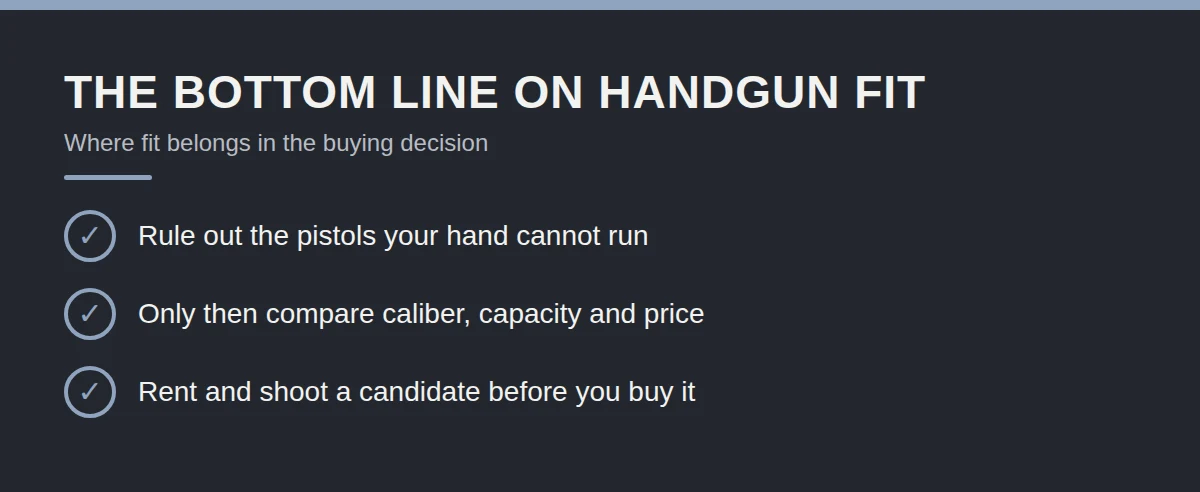
Then rent it if you possibly can. Fifty rounds tells you things thirty seconds at a counter never will, and it is a great deal cheaper than discovering the mismatch after the purchase. Once you have a gun that fits, the rest of the system still has to fit too, which means a holster and belt chosen just as carefully.
Fit belongs at the front of the decision, not the end. Work out which pistols your hand can genuinely run, and only then argue about caliber, capacity, and price within that set. Our complete first-pistol buyer’s guide walks through those remaining decisions in order. The gun that fits you is the one you can operate one-handed, tired, without looking at it, and that is a much better standard than whatever the internet is recommending this month.
Further reading (sources)
- All4Shooters on an American striker-fired pistol built around ergonomics
- Handguns Magazine for a serialized chassis with swappable grip modules
- Guns.com with the news that three classic CZ 75 models are ending production
- CZ-USA, via Outdoor Wire, on which CZ 75 variants continue the platform
- NRA Women about a tip-up barrel design for shooters who struggle to rack a slide