Who Has to Prove 'Common Use'? The Calce Stun Gun Case and the Burden That Decides Which Arms You Can Carry
Published on October 21, 2026
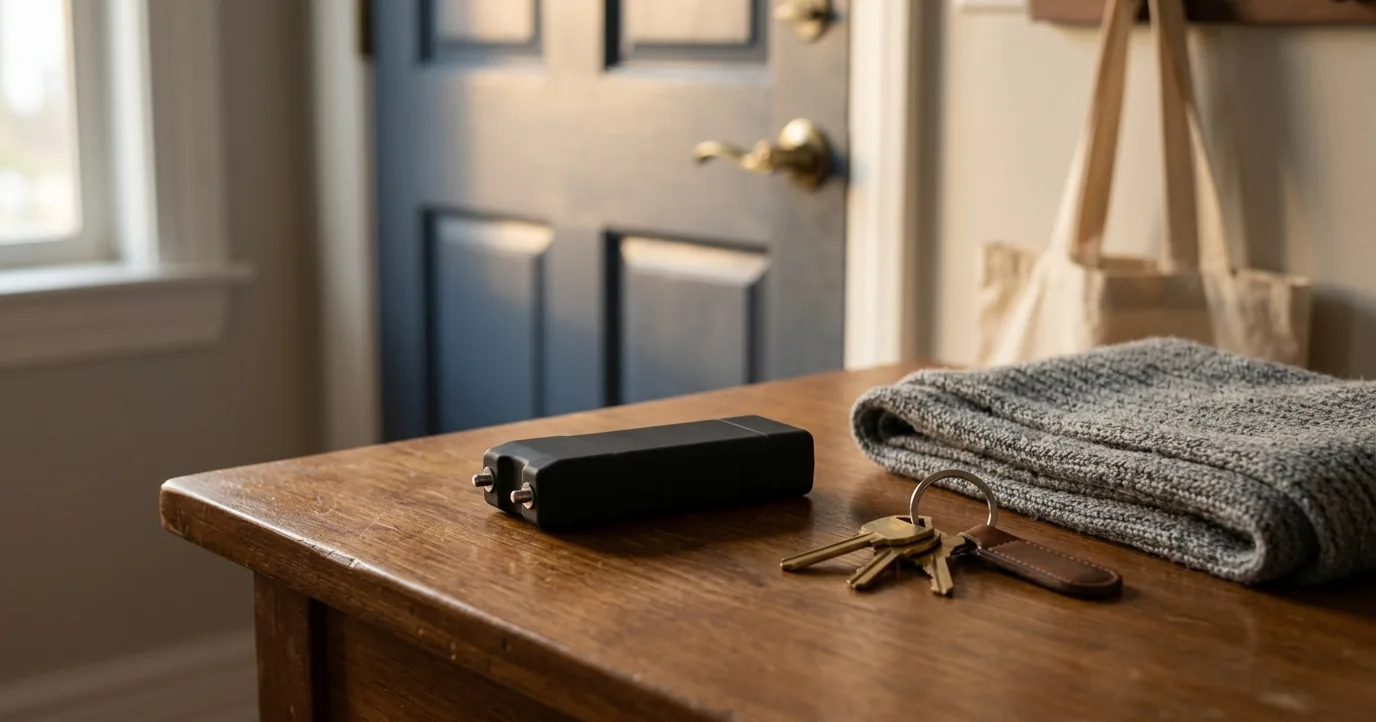
Amanda Kennedy was driving in New York City when a woman on foot began striking her car, hit Kennedy in the face through the window, and tried to open the door. Kennedy showed her attacker a stun gun, and the assault stopped. Then the police who responded learned about the stun gun, and in November 2021 they charged Kennedy with possessing it, a crime under a city law on the books since 1985. The charge ended in an adjournment in contemplation of dismissal, a New York disposition that drops a case if the defendant stays out of trouble for a set period. Kennedy is now one of seven petitioners asking the Supreme Court to strike the ban down, and on September 8 the justices asked the city to respond.
The case is Calce v. City of New York, and the petition opens with the line “This case essentially is Caetano 2.0,” a nod to the 2016 decision in which the Court threw out a Massachusetts ruling that had upheld a stun gun ban. The question sounds procedural, and it is: when someone challenges a ban on a type of weapon, must the challenger first prove the weapon is “in common use,” or does the government have to justify the ban from the start? It matters far beyond stun guns, because the side that carries a burden of proof loses whenever the evidence runs out. Here is what Caetano settled, how the burden drifted onto challengers in the lower courts, and why the answer will govern future fights over carry pistols, magazines and less-lethal tools alike. This is general information, not legal advice, and in New York City the ban is fully enforceable today.
What New York City Bans, and Who Is Challenging It
Two laws do the work. New York Penal Law § 265.01(1) makes it a misdemeanor to possess an “electronic dart gun,” the Taser-style device that fires wired darts, or an “electronic stun gun,” the kind that has to touch the target. New York City Administrative Code § 10-135, adopted in 1985, separately bans selling or possessing stun guns anywhere in the city. Neither law has an exception for ordinary civilians, and the petition says that includes people licensed to carry a handgun. If you are working through New York’s carry permit process, know that the license covers the pistol, not the stun gun.
According to the petition, the state ban now effectively applies only in New York City. In 2019, in Avitabile v. Beach, a federal court in the Northern District of New York held it unconstitutional as applied to stun guns and Tasers. The state did not appeal, and state officials have been barred from enforcing it ever since. The city still enforces both laws. The challengers, five individuals plus the Second Amendment Foundation and Firearms Policy Coalition, sued in the Southern District of New York on October 5, 2021. Four of the individuals live in the city. Kennedy has since moved to Connecticut but still visits regularly for work, a reminder that the city’s weapons laws bind a visitor exactly as they bind a resident.
What Heller and Caetano Already Settled
The phrase “common use” comes from District of Columbia v. Heller in 2008, and where it sits in that opinion is the whole fight. Heller’s reading of the text is broad: the Second Amendment “extends, prima facie, to all instruments that constitute bearable arms, even those that were not in existence at the time of the founding.” The limits arrive in historical terms. Heller read the 1939 case United States v. Miller to mean the Amendment does not protect “those weapons not typically possessed by law-abiding citizens for lawful purposes,” and said that reading “accords with the historical understanding of the scope of the right.” Protecting the sorts of weapons “in common use at the time,” it added, is a limitation “fairly supported by the historical tradition of prohibiting the carrying of ‘dangerous and unusual weapons.’”
Caetano v. Massachusetts tested that language against a stun gun. Jaime Caetano had been put in the hospital by an abusive ex-boyfriend, and her restraining orders had not stopped him. When he confronted her outside her job one night, she showed him a stun gun a friend had given her, and he left. Police later found the stun gun, and Massachusetts convicted her of possessing it. The state’s highest court upheld the conviction on three grounds: stun guns were not in common use when the Second Amendment was adopted, they were “unusual” because they are “a thoroughly modern invention,” and nothing suggested they were readily adaptable to military use.
In a short unsigned opinion on March 21, 2016, the Supreme Court vacated that decision without a single dissent, holding that all three reasons contradicted Heller. What it did not do matters just as much to Calce: it never said stun guns are in common use or that the ban was unconstitutional. It sent the case back.
Only a two-justice concurrence went further. Justice Samuel Alito, joined by Justice Clarence Thomas, wrote that “the pertinent Second Amendment inquiry is whether stun guns are commonly possessed by law-abiding citizens for lawful purposes today,” pointed to “[h]undreds of thousands of Tasers and stun guns” sold to private citizens, and concluded that stun guns “are widely owned and accepted as a legitimate means of self-defense across the country.” He also warned that her conviction “likely bars her from ever bearing arms for self-defense,” a reminder of how long a weapons conviction can follow someone, as our guide to getting gun rights back explains.
Six years later, New York State Rifle & Pistol Association v. Bruen cited Caetano, with the parenthetical “(stun guns),” for the point that the Amendment’s definition of arms “covers modern instruments that facilitate armed self-defense.” To the Calce challengers, that settles whether stun guns are arms. To the courts below, a concurrence and a citation were not proof that stun guns are common.
Step One or Step Two: Why the Answer Moves the Burden
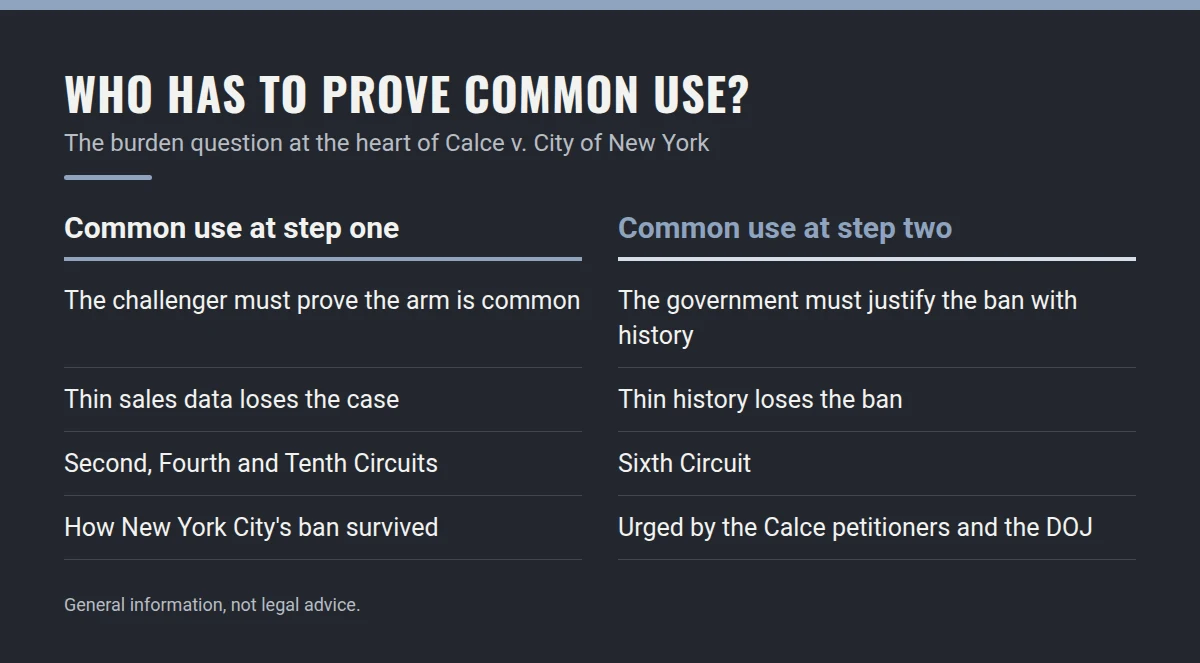
Bruen set the test every court now applies, and its two steps carry different burdens. At step one, the court asks whether the Second Amendment’s plain text covers what the person wants to do. If it does, the Constitution “presumptively protects that conduct,” and at step two “the government must demonstrate that the regulation is consistent with this Nation’s historical tradition of firearm regulation.” A burden of proof decides who loses when the evidence is thin, missing or evenly split, so the placement of “common use” decides who has to go find the numbers.
Bruen mentioned common use in two places, and each side of the current fight builds on one of them. Just before turning to the plain text, the Court noted that no party disputed “that handguns are weapons ‘in common use’ today for self-defense.” Many lower courts read that placement as making common use part of step one, which makes it the challenger’s job. Later, in its historical analysis, the Court said handguns “are indisputably in ‘common use’ for self-defense today,” so colonial laws against “dangerous and unusual weapons” could not justify the modern restriction. Challengers read that passage as proof that common use belongs at step two, where the government carries the load.
The Seventh Circuit put it plainly in 2023: “There is no consensus on whether the common-use issue belongs at Bruen step one or Bruen step two.” By the petition’s count, the Second, Fourth and Tenth Circuits treat common use as part of the plain text, the Seventh gets to a similar place by narrowing what counts as a “bearable” arm, and the Sixth treats it as a question of history.
Moving the burden is not the same as winning. In United States v. Bridges, decided in August 2025, the Sixth Circuit held that a machine gun is plainly an arm, weighed common use at step two, and still upheld the federal machine gun ban as consistent with the tradition of prohibiting dangerous and unusual weapons. Even carrying the burden, the government can win when history is on its side. What changes is who loses when the record is empty.
How the Burden Landed on the Calce Challengers
Judge Edgardo Ramos of the Southern District of New York decided the case on March 24, 2025. Following what he called “the weight of authority,” he placed common use at step one, put the burden on the plaintiffs, and described the question as “an objective and largely statistical inquiry.” They had not, he found, “provided any studies, reports, or data.” He declined to adopt the stun gun findings of other courts, noted that the Alito concurrence is not binding precedent, and never reached step two, so the city was never asked to show a historical tradition at all.
On April 13, 2026, a Second Circuit panel affirmed in a short unpublished order. Relying on the circuit’s own recent precedent, it held that “Plaintiffs bear the burden of proof” on whether the weapons are “in common use today for self-defense,” and said the appeal “really concerns Rule 56,” the federal rule on summary judgment. It refused to consider newspaper articles and a Congressional Research Service report the plaintiffs first cited on appeal, and it called what they did cite “miscellaneous bits and pieces.”
That report is worth a look. The Congressional Research Service’s December 2024 brief says stun guns and Tasers are legal, “subject to varying levels of regulation, in every state,” that the maker of the Taser reported civilian stun gun purchases up 300 percent in 2020 over 2019, and that the Second Amendment’s application to these devices “remains an unresolved legal question.” Because most of them fall outside federal firearms law, there is no federal record of who owns them, and the numbers come from sales data that companies are not required to publish. In the 2019 Avitabile case, the challenger asked several makers for figures and many would not provide them. The parties there agreed, on what the court called limited data, to at least 300,000 Tasers and 4,478,330 stun guns in private hands. A burden built on numbers nobody has to disclose is a hard burden to carry.
Why the Supreme Court Asked New York to Respond
The petition, filed July 7, 2026, asks whether a challenger must show an arm is in common use before a ban even implicates the plain text, and whether New York’s bans implicate the text and violate the Second and Fourteenth Amendments. The city filed a waiver on August 6, signaling it would not respond unless asked. On September 8 the Court asked anyway, and after an extension the city’s brief is due November 23, 2026. A request for a response is not a grant. The Court calls for one when a justice wants to see the other side before voting, which improves the odds of review without guaranteeing them.
The petitioners lean hardest on a decision that came after both lower rulings. In Wolford v. Lopez, decided June 25, the Court struck down Hawaii’s rule against carrying a handgun onto private property open to the public without the owner’s express permission, which we covered in our breakdown of the Hawaii ruling. The majority restated step one as three questions, one of them whether the law concerns “any form of ‘Arms,’ i.e., any weapon customarily used for offensive or defensive purposes,” and said Hawaii’s historical arguments “are out of place at Bruen’s first step.” Justice Amy Coney Barrett’s concurrence was blunter: “The disagreement is instead whether courts can smuggle additional limits, drawn from our regulatory tradition, into the plain-text stage of the inquiry. The answer is and always has been no.” Justice Ketanji Brown Jackson’s dissent read the majority the same way, objecting that it removes “any real burden of proof on gun owners at step one.”
Wolford even built a hypothetical around a Hawaii woman “whose situation is like that of Jaime Caetano.” The caution is that Wolford was about where you may carry, not which arms you may own, and the majority never mentions common use. The petition argues its framework settles the question anyway. New York City has not yet said what it thinks.
The AR-15 Case May Answer It First
On December 2, the Court hears Viramontes v. Cook County together with Grant v. Higgins, challenges to the Cook County, Illinois and Connecticut bans on AR-15-style rifles, on whether the Second and Fourteenth Amendments “guarantee the right to possess AR-15 platform and similar semiautomatic rifles.” The Justice Department filed a brief supporting the challengers, has asked for ten minutes of the argument, and on the burden question lines up with the Calce petitioners. AR-15s are arms, its brief says: “The plain-text inquiry here is as simple as that.” Pulling historical limits into step one, it argues, “wrongly relieves the government of its burden of proving that the challenged law is consistent with our regulatory tradition.”
An opinion that says where common use belongs would answer Calce’s first question for every court in the country, which is why the petitioners asked, as a fallback, that their case be held until the rifle decision. The justices could also decide the rifle case on narrower grounds and leave the burden question for another day. Our guide to Heller, Bruen and the circuit splits tracks what else is pending.
Why It Matters Even If You Never Carry a Stun Gun
Every challenge to a ban on a type of arm has to pass through this gate.
- Carry pistols. A newer design, or a model left off a state’s approved handgun roster, may not have years of sales figures behind it. If the owner must prove common use first, thin data ends the case before the state defends anything.
- Magazines. Capacity limits are fought over the same doctrine, and the Third Circuit’s July ruling against New Jersey’s ban is stayed while the state seeks Supreme Court review, as we explained in how stays and appeals trap carriers.
- Less-lethal tools. Stun guns, Tasers and launchers are often chosen precisely because they are not firearms, and they tend to have the least public data behind them. A rule that demands statistics before protection falls hardest on them.
For now, nothing has changed on the street. Possessing a stun gun or Taser in New York City is still a crime, a pending petition is not a ruling, and even a win would have to become final before it protects anyone. If you carry one lawfully at home, leave it there when you travel into the city, and check the rules for less-lethal tools in every state on your route. Anything specific to your situation belongs with a firearms attorney.
What to Watch
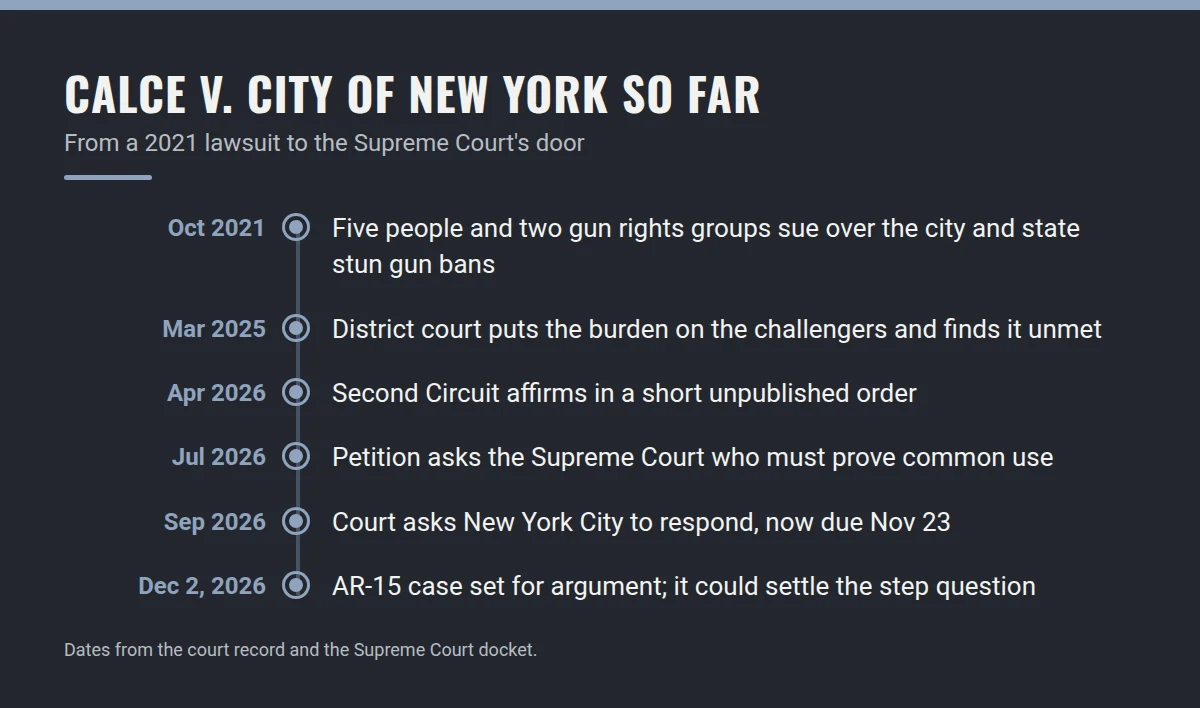
- November 23: New York City’s response is due. The petitioners can reply, and the petition then returns to a conference list.
- December 2: argument in Viramontes and Grant. Listen for whether any justice asks who has to prove common use.
- After that: the Court can grant Calce, deny it, summarily reverse as it did in Caetano, send it back for another look in light of Wolford, or hold it until the AR-15 decision, which like most argued cases should come by the end of the term next summer.
The Bottom Line
Caetano told courts they could not dismiss stun guns as too modern or too unmilitary to count. It did not say who has to prove a stun gun is common, and the lower courts answered by handing that job to the person challenging the ban. Calce asks the Supreme Court to hand it back to the government. However the justices answer, the rule will reach far past one city’s stun gun law, to every fight over which arms an ordinary person may keep and carry. Until then, follow the law where you stand.
Further reading (sources)
- Calce v. City of New York for the cert petition, with the Second Circuit order and district court opinion in its appendix
- SCOTUSblog on the Calce docket, the call for a response, and the November 23 deadline
- District of Columbia v. Heller with the bearable arms definition and the common use limit
- Caetano v. Massachusetts for the stun gun per curiam and Justice Alito’s concurrence
- New York State Rifle & Pistol Association v. Bruen on the two-step test and both of its common use passages
- Wolford v. Lopez with the three plain-text questions and the Barrett concurrence
- U.S. Court of Appeals for the Sixth Circuit for the Bridges opinion weighing common use at step two
- Congressional Research Service on stun guns, Tasers, and their legal status in every state
- Office of the Solicitor General in the federal amicus brief backing the AR-15 challengers
- SCOTUSblog with the Viramontes case page and its December 2 argument date
- The Volokh Conspiracy on the district court ruling that upheld the city and state bans