Getting Your Gun Rights Back: The Reopened Federal Path, Pardons, and State Relief
Published on October 15, 2026

For more than three decades, the federal law that lets a prohibited person ask for gun rights back existed mostly on paper. Section 925(c) of the Gun Control Act lets the Attorney General lift a federal firearms disability, but since 1992 Congress has barred ATF, the agency that ran the program, from spending money to act on applications from individuals. In 2002 the Supreme Court held in United States v. Bean that courts could not step in without an actual denial, and ATF’s practice was to return applications unprocessed rather than deny them.
That began to change in March 2025, when the Justice Department pulled the authority back from ATF. Since then it has granted relief in small batches to people who had asked for a pardon or for relief, naming each one in the Federal Register; the first ten included the actor Mel Gibson. What is new this fall is a process anyone can use. A final rule published August 20, 2026 moves the program to the Office of the Pardon Attorney, it took effect September 21, and DOJ’s program page lists the application opening to the public on November 4.
Pardons are in the news too. On September 3, President Trump pardoned Patrick Tate Adamiak, a former Navy master-at-arms serving 20 years for unregistered machine guns and destructive devices, and an AmmoLand column is now urging the same for Kyle Myers, the YouTube personality known as FPSRussia, who lost his gun rights over a nonviolent marijuana felony.
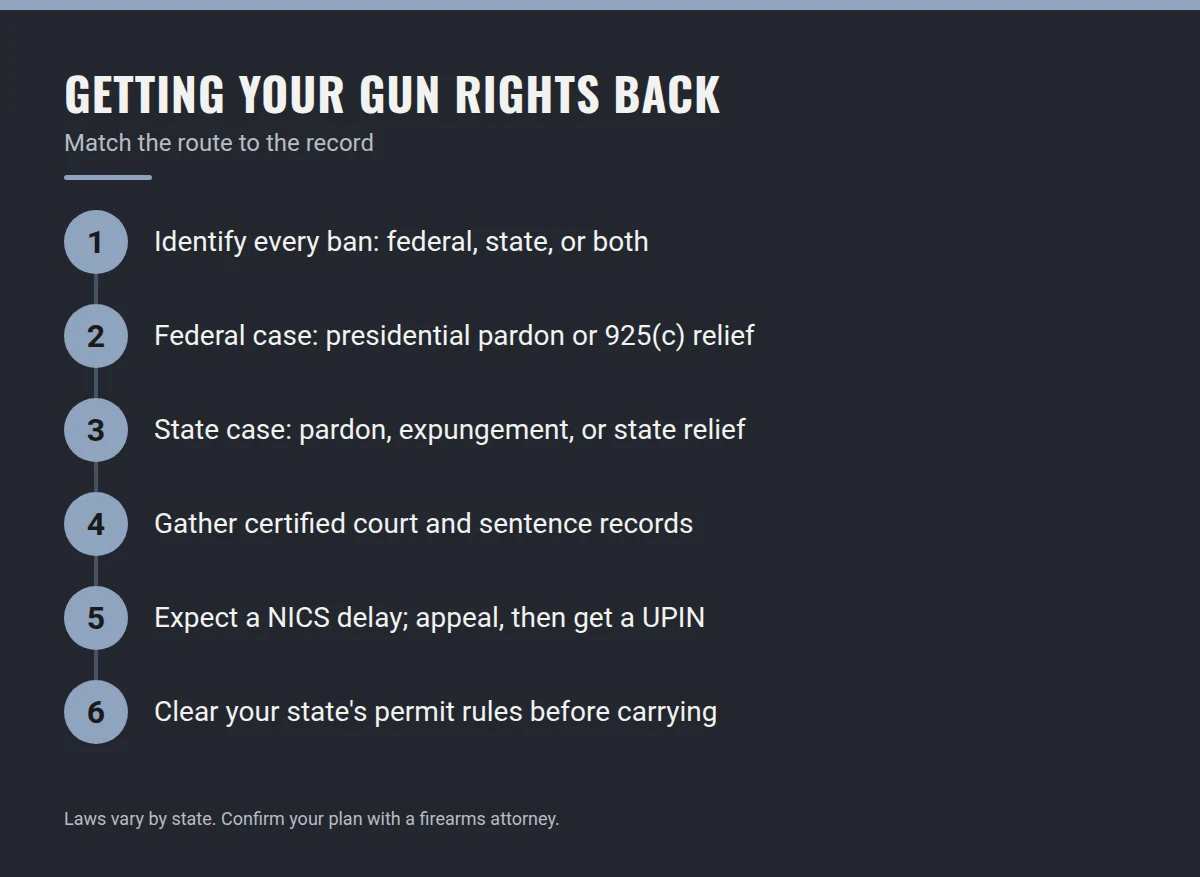
If you have an old conviction on your record, the question underneath all of this is personal: can you ever lawfully carry again? Often the answer is yes. But each route back reaches only certain records and lifts only certain bans, and the most common mistake is using a fix that clears one prohibition while another stays in force.
Start With the Court That Convicted You
Federal law bars anyone convicted of a crime punishable by more than a year in prison from possessing a gun or ammunition, along with people convicted of a misdemeanor crime of domestic violence and several other groups. Our federal firearms law reference lists every category. Whether an old case still counts is answered by one sentence of the statute, 18 U.S.C. 921(a)(20): a conviction that was expunged or set aside, or for which you were pardoned or had your civil rights restored, no longer counts, unless the pardon, expungement or restoration “expressly provides” that you may not possess firearms. The law of the place that convicted you decides what counts, not the law where you live now.
Two consequences follow, and they shape everything below.
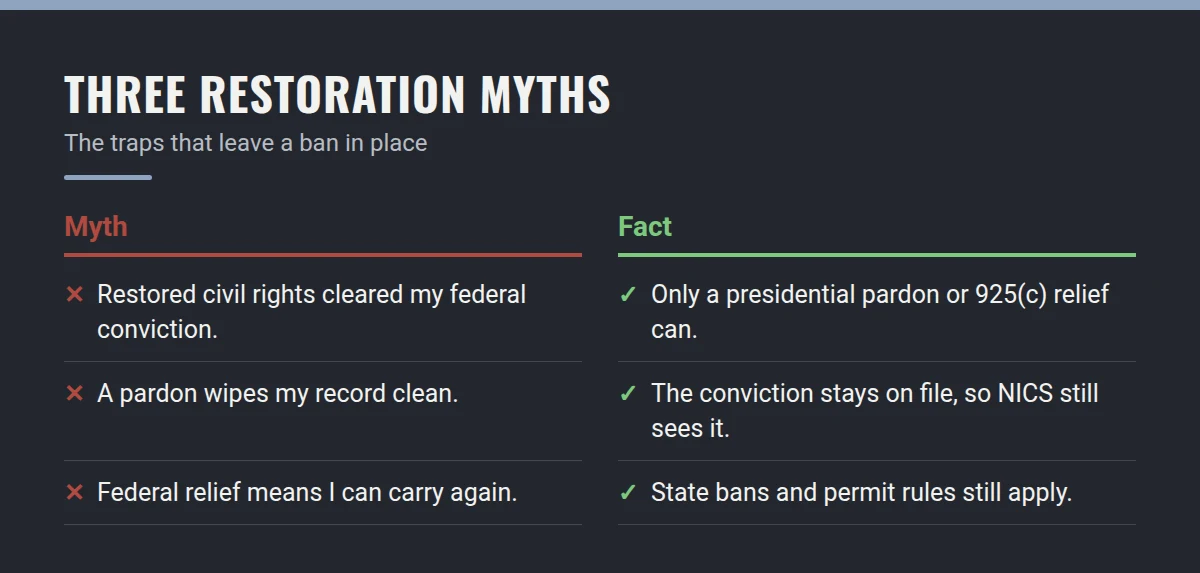
First, a federal conviction can only be cleared by federal action. In Beecham v. United States (1994), the Supreme Court held that a state’s restoration of civil rights does nothing for a federal conviction. For a federal case, that leaves two doors: a presidential pardon, or relief from the Attorney General under 925(c).
Second, a state conviction usually carries two bans, one federal and one under state law, and they come down separately. States are often stricter than federal law. The Collateral Consequences Resource Center found that in more than two-thirds of states, any felony costs you gun rights indefinitely, and only 13 states limit the loss to violent crimes. A felony from another state, or a federal one, is harder still, because many states give no effect to relief granted somewhere else.
The Reopened Federal Path: 925(c) Relief
The statute lets the Attorney General grant relief when an applicant shows they “will not be likely to act in a manner dangerous to public safety” and that relief “would not be contrary to the public interest.” The funding bar was written into ATF’s budget, so DOJ’s answer was to take the program away from ATF. The final rule, codified at 28 C.F.R. Part 107, sends every application to the Pardon Attorney instead.
Anyone federally prohibited may apply, whether the record is a state felony, a federal one, a domestic violence misdemeanor, a dishonorable discharge or a mental health commitment. The application is heavy on paper:
- Certified court records: the charging document, any plea agreement, the presentence report and the judgment, plus a certificate showing the date your sentence and supervision ended.
- Criminal record checks from every state you have lived in or been arrested in since turning 18, or for the last 25 years if that is shorter.
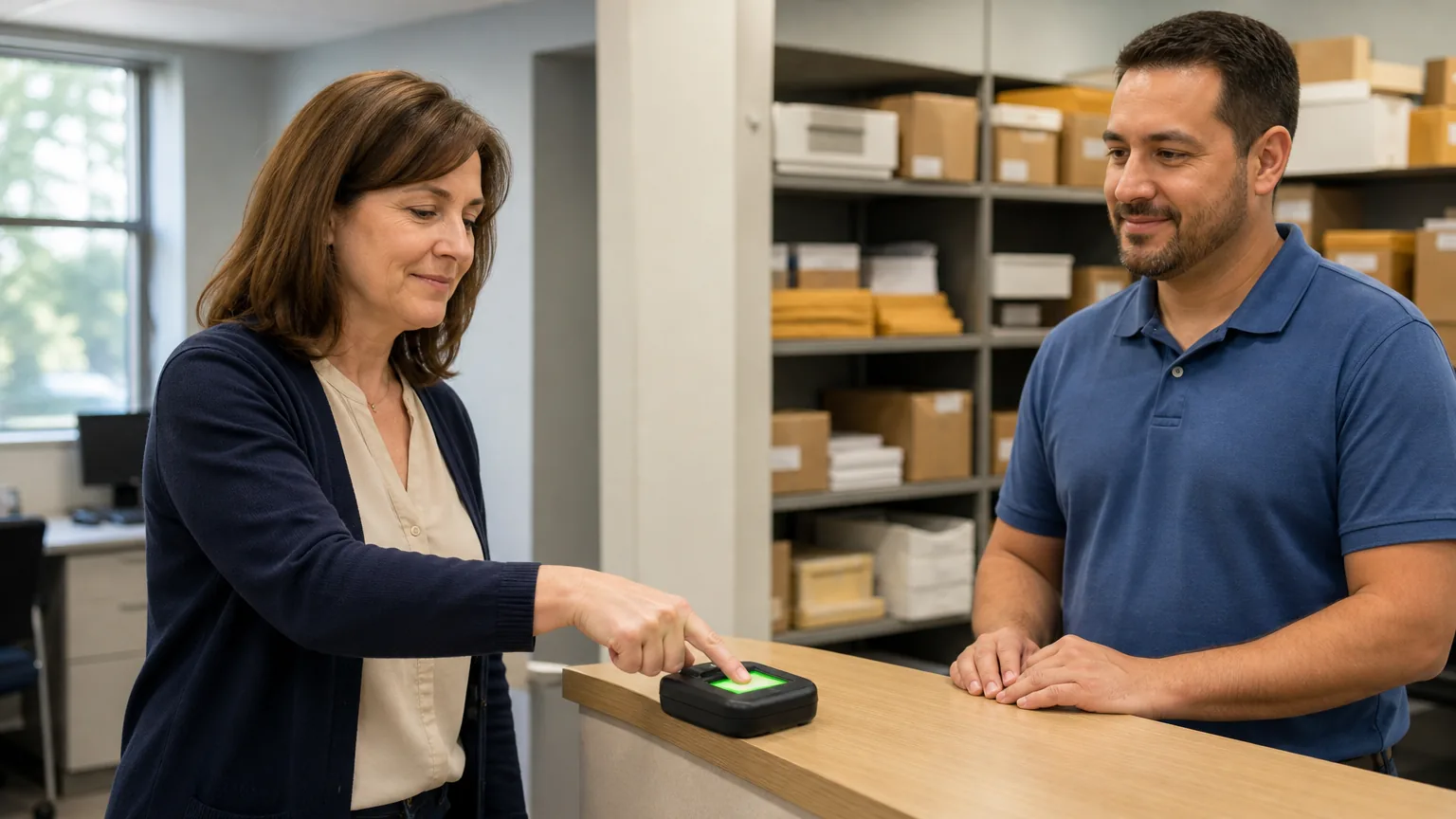
- Electronic fingerprints, taken at a participating post office after you submit the first part of the online application.
- Sworn statements from three references who are not related to you, have known you at least three years and are not prohibited themselves.
- Your own sworn statement that you have committed no crime in the past five years.
Once you start the online application, you have 30 days to finish it. DOJ is opening the door in stages: invited applicants first, then the first 5,000 members of the public on November 4, first come, first served, then 500 more on January 4, 2027, when a $30 fee begins. The fee can be waived or reduced for indigency. Demand could be heavy, since the rule itself counts more than 31 million active NICS records showing a federal prohibitor, though one person can account for several.
The heart of the rule is a set of presumptions. Applications in these groups are denied “absent extraordinary circumstances”:
- Permanently: violent and sexual felonies, including those involving a death, rape or sexual assault, kidnapping, human trafficking, domestic violence, burglary, robbery, carjacking, arson, assault or battery, stalking, terrorism or witness tampering, plus any felony in which a gun was brandished or fired.
- For ten years: felonies involving drug distribution, threats, explosives, gun crimes such as unlawful possession, straw purchasing or trafficking, weapons on school property, or animal abuse, plus misdemeanor domestic violence.
- For five years: any other felony, and any assault, battery, stalking or threat offense, even a misdemeanor.
The clock runs from the last day you served “any part of a sentence,” and the rule defines a sentence to include probation, parole and any period while fines or other penalties remain unpaid. An old fine you never paid off can keep the clock from starting at all.
Marijuana gets different treatment. After the Supreme Court’s narrow June decision in United States v. Hemani, which our Second Amendment case law guide covers, DOJ took marijuana out of the rule’s definition of a controlled substance. Using only marijuana no longer presumptively disqualifies an applicant, and on a plain reading of the rule, a marijuana-only distribution felony falls in the five-year group rather than the ten-year one. None of that repeals the federal ban on unlawful drug users itself, which our guide to the unlawful user ban explains.
Know the costs before you file. A grant is published in the Federal Register with your name and the reasons for it. A denial on a permanent disqualifier is effectively final, a denial on the merits blocks a new application for five years, and a denial under one of the time limits simply means waiting it out. Relief obtained with a willful misstatement or omission is void from the start. Unlike the old limbo, though, a denial is now an actual decision, and the statute lets you ask the federal district court where you live to review it. DOJ has set no deadline for decisions and has warned that early cases may take longer. And relief “shall not extend to disabilities imposed by State law”: it lifts the federal ban and nothing else.
Pardons: Only the Right Executive Can Grant One
The President’s clemency power is “limited to federal offenses,” in the words of DOJ’s own pardon office, so a presidential pardon cannot touch a state conviction. For a federal conviction, it is the cleanest fix available. “A federal pardon does restore a person’s federal firearms rights,” the office says. That is why a pardon is even on the table for Myers: his was a federal prosecution in Georgia that closed in 2019, so a pardon would reach it. The same plea in a state court would leave the White House nothing to pardon.
A pardon is forgiveness, not erasure. DOJ says both the conviction and the pardon will appear on your record, and Military Times made the same point about Adamiak’s. Background checks will keep finding the case, which matters at the gun counter.
State convictions belong to the governor or a state pardon board. Under 921(a)(20), a state pardon lifts the federal ban unless it expressly says otherwise, but each state decides what its own clemency covers. Kentucky is a useful warning. Its restoration of civil rights is a “partial pardon” that returns the vote and the right to hold office, and the state’s own FAQ says it “DOES NOT give a convicted felon the right to purchase, own, or have in possession a firearm.” Only a full pardon does that.
Expungement and Set-Aside
Federal law treats a conviction that was expunged or set aside as no conviction at all, with the same exception if the order, or the state law behind it, still bars guns. Two cautions apply. An order is judged by what it does under the convicting state’s law, not by its title, and one that only seals a file from public view may leave the conviction intact. Federal convictions rarely qualify at all: DOJ’s pardon office calls expungement “a judicial remedy that is rarely granted by the court.”
Restored Civil Rights and State Firearm Relief
Many states hand back the vote and jury service once a sentence ends. For a state conviction, that restoration can lift the federal ban too, but only when two conditions hold.
The state must have taken the rights away in the first place. In Logan v. United States (2007), the Court held that “civil rights restored” does not cover an offender who never lost them, and most people convicted of misdemeanors never do. For a domestic violence misdemeanor, the realistic routes are usually expungement, set-aside or a pardon, or 925(c) once the ten-year presumption runs out.
The restoration must also leave guns alone entirely. In Caron v. United States (1998), Massachusetts had restored Gerald Caron’s civil rights and allowed him to own rifles and shotguns, but limited where he could have a handgun. Agents found six rifles and shotguns in his home, guns his state permitted. The Supreme Court held that the handgun limit kept the federal ban in place for every firearm, so the long guns were still a federal crime. The same logic catches Texans who rely on Penal Code 46.04, which lets a person with a felony record keep a gun at home once five years have passed since release from prison or the end of supervision, whichever is later. That only narrows the Texas crime. Federal law has no home exception.

Some states run a dedicated firearm process. Washington lets many people petition a superior court after five consecutive crime-free years following a felony, but class A felonies, felony sex offenses and felonies carrying a maximum of 20 years or more can never be restored that way. Virginia makes it two steps: the governor restores civil rights first, then a circuit court may, “for good cause shown,” issue an order that must authorize firearms “unconditionally,” wording that keeps it clear of the Caron trap. For a mental health commitment, a state relief program that meets federal standards ends the federal ban, and DOJ expects you to use yours before applying to it. Its FAQ lists Arkansas, Montana, New Hampshire and Wyoming among the places with no such program.
At the Counter: Form 4473, NICS, and the Permit Office
Restored rights live on paper, and you will need the paper. Form 4473 asks whether you have ever been convicted of a felony or a domestic violence misdemeanor, and its instructions explain how a qualifying pardon, expungement, set-aside or grant of 925(c) relief changes that answer. Read them on the copy in front of you. A wrong answer is a separate felony under 18 U.S.C. 922(a)(6), so if your relief does not fit cleanly, get a firearms attorney’s opinion in writing before you check a box.

Then expect NICS to stumble, because records rarely update cleanly and a pardon leaves the conviction visible. Under 28 C.F.R. 25.10, you can ask for the reason for a denial in writing (the agency has five business days to answer) and appeal with certified copies of your pardon, order or relief letter. In states where a state agency runs the check, the appeal starts with that agency. If the appeal succeeds within 30 days of the original check, the sale can go ahead; after that, the dealer has to run you again. Once you are cleared, apply to the FBI’s Voluntary Appeal File. Approved applicants receive a Unique Personal Identification Number, or UPIN, to give the dealer on future checks, so the same old record does not stall every purchase.
A carry permit is its own test. Permit statutes write their own disqualifiers, and our overview of state permit laws and training requirements shows how much they vary. Texas shows the gap: it will not license anyone “convicted of a felony,” and its definition of convicted drops only cases that were expunged, pardoned, vacated, set aside or sealed. On the statute’s terms, 925(c) relief, which lifts the federal ban but leaves the conviction on the books, would not clear that line. Permitless carry is no shortcut either, because it is only open to people who can lawfully possess a gun under state law in the first place.
The Bottom Line
There is a way back for many people with old records, and for the first time in a generation that includes a working federal door. But restoration is a stack, not a switch: the federal ban, the state ban and the permit statute each have to come down, and every route reaches only some of them. Pull your certified records first, name every prohibition that applies to you, and run your plan past a firearms attorney who knows the law of the state that convicted you and the state where you live. Once you are cleared, if it has been years since you handled a gun, take an in-person course before you carry one.
Further reading (sources)
- Federal Register publishes the Justice Department’s final rule reviving 925(c) relief, with its presumptive disqualifiers, the first ten grants of relief in March 2025, Mel Gibson’s among them, the latest batch, granted in May and August 2026 and the FBI’s notice describing the Voluntary Appeal File and the UPIN
- U.S. Department of Justice on the restoration program’s rollout dates, fee and application steps and the Pardon Attorney’s answers on pardons, records and gun rights
- Cornell’s Legal Information Institute hosts the statute defining when a pardon or expungement removes a conviction, the relief from disabilities statute itself and the federal rule on NICS denials, appeals and the Voluntary Appeal File
- U.S. Supreme Court rulings in Caron, on restorations that still limit some guns, Beecham, on why state relief cannot cure a federal conviction, Logan, on offenders who never lost their civil rights and Bean, on why courts could not act while ATF was defunded
- Military Times on the September pardon of former Navy master-at-arms Tate Adamiak
- AmmoLand with the argument for pardoning Kyle Myers over his marijuana felony
- CourtListener carries the federal docket in Myers’s Georgia drug case
- Collateral Consequences Resource Center for findings on how states take and restore firearm rights after a conviction
- Commonwealth of Kentucky explains why restored civil rights do not include firearms there
- Washington State Legislature on the superior court petition to restore firearm rights
- Code of Virginia with the circuit court restoration order that follows the governor’s restoration of rights
- Texas Public Law reproduces the license to carry eligibility rules and the license law’s definition of a conviction