Second Amendment Case Law for Concealed Carriers: Heller, McDonald, Bruen, Rahimi, and How Lower Courts Apply Them
Published on October 4, 2026
Every few weeks a headline announces that a court has struck down a gun law, and soon another court upholds one that looks almost the same. On September 18, a divided Fifth Circuit panel threw out the federal ban on buying a handgun directly from an out-of-state dealer. Four days later, the full Ninth Circuit upheld two of Hawaii’s handgun purchase rules by a single vote. It is tempting to treat all of this as noise, but it is not random. Every one of those rulings applies the same short list of Supreme Court decisions, and once you know what those cases held, and what they left open, the headlines start to make sense.
This is the map: the four cases that define the modern right to keep and bear arms, the test they produced, where the federal appeals courts are splitting, and why none of it changes the law where you stand until a court with power over your state enters an order that covers you. It is general information, not legal advice, and anything touching your own situation belongs with a firearms attorney.
Heller (2008): An Individual Right, Starting at Home
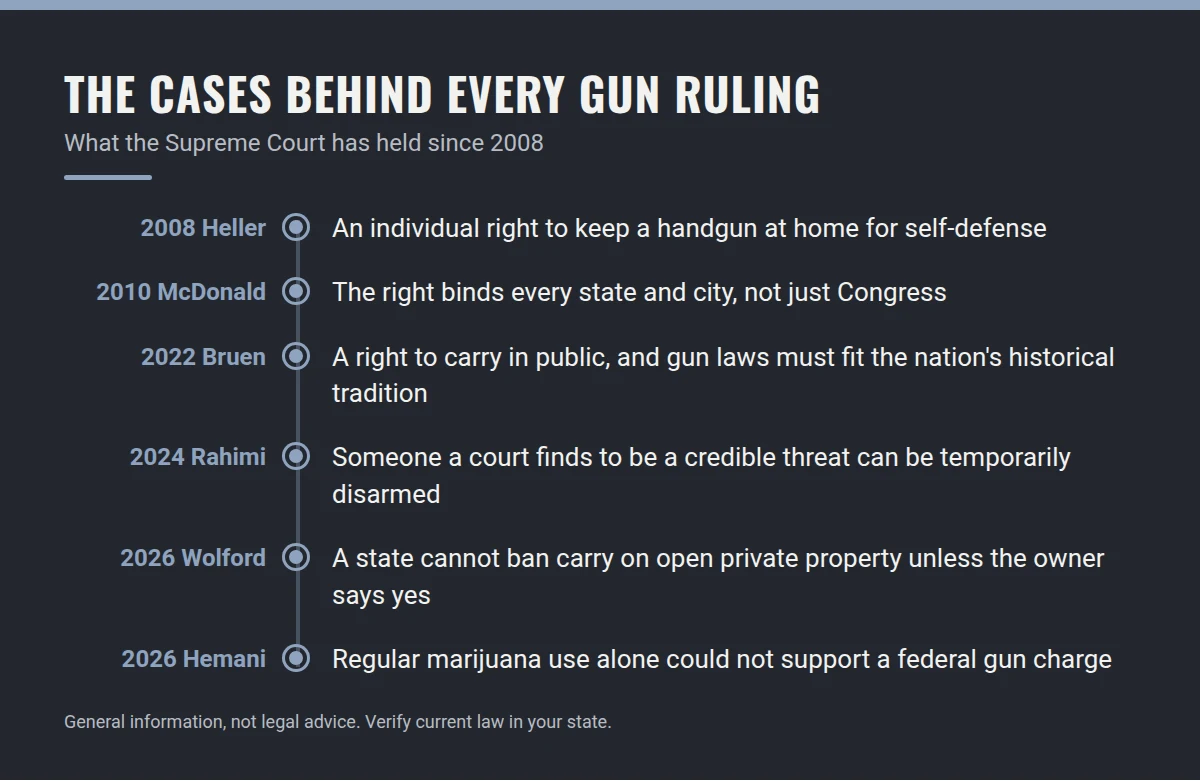
District of Columbia v. Heller is where the modern law begins. The District banned handguns in the home and required any other firearm kept there to be disassembled or bound by a trigger lock at all times. Dick Heller, a special police officer who carried a handgun on duty at the Federal Judicial Center, wanted to keep one at home. The Supreme Court ruled for him 5 to 4 in an opinion by Justice Antonin Scalia.
Heller held that the Second Amendment protects an individual right to keep and bear arms, unconnected to militia service, with self-defense at its core. The Court called the handgun “the quintessential self-defense weapon” and struck down both the home handgun ban and the rule that left every other gun inoperable. It also said the Amendment “codified a pre-existing right.” The Constitution did not create the right to armed self-defense. It recognized one that already existed.
Two more lines from Heller drive today’s cases. The right reaches “all instruments that constitute bearable arms, even those that were not in existence at the time of the founding,” so the argument that a modern rifle falls outside the Amendment because nothing like it existed in 1791 runs into the Court’s own words. But the protected arms are those “in common use at the time,” a limit the Court tied to the old tradition of prohibiting “dangerous and unusual weapons.” Common use is the heart of the rifle case the justices will hear in December.
What Heller left open matters just as much. It rejected a “judge-empowering” balancing test without saying what courts should use instead, and it said nothing about carrying outside the home. It also named “presumptively lawful regulatory measures,” including bans on possession by felons and the mentally ill, laws against carrying in “sensitive places such as schools and government buildings,” and conditions on the commercial sale of arms, offered “only as examples.” Much of the litigation since has been a fight over how far that list reaches.
McDonald (2010): The Right Binds Your State and City
Heller arose in the District of Columbia, a federal enclave, so it left a gap: did the Second Amendment restrain states and cities at all? McDonald v. City of Chicago closed it two years later. Ruling 5 to 4 against a Chicago handgun ban much like the District’s, the Court held that “the Second Amendment right is fully applicable to the States” through the Fourteenth Amendment. Justice Samuel Alito wrote the lead opinion, and Justice Clarence Thomas supplied the fifth vote through the Privileges or Immunities Clause rather than the Due Process Clause.
For a permit holder, McDonald is what makes everything else matter. Without it, the Second Amendment would limit only federal law, and your state’s permit statute, carry restrictions, and purchase rules could not be challenged under it. It also means the right is the same everywhere. When Hawaii argued this year that its own customs justified a stricter rule, the Court answered with a point it traced to McDonald: the Second Amendment “has the same meaning in all parts of the United States.”
For the next twelve years, most federal appeals courts filled the gaps Heller and McDonald left with a two-step approach ending in “means-end scrutiny,” weighing a law’s public safety benefits against its burden on the right. Most gun laws survived it.
Bruen (2022): Carry Outside the Home, and a New Test
New York State Rifle & Pistol Association v. Bruen answered the carry question and scrapped the balancing approach at once. New York issued unrestricted carry licenses only to applicants who showed “proper cause,” a special need for self-protection beyond that of the general public. The Court struck that requirement 6 to 3 in an opinion by Justice Thomas, holding that the Constitution protects an individual’s right to carry a handgun in public for self-defense. It called the lower courts’ two-step method “one step too many” and replaced it with the test explained in the next section.
Bruen also drew three lines every permit holder lives with now.
- Shall-issue permitting survived. Footnote 9 says nothing in the opinion should suggest the unconstitutionality of the 43 states’ “shall-issue” regimes, which license on objective criteria. Justice Brett Kavanaugh, joined by Chief Justice John Roberts, added that those states may require “fingerprinting, a background check, a mental health records check, and training in firearms handling and in laws regarding the use of force.” But because “any permitting scheme can be put toward abusive ends,” the footnote left room to challenge “lengthy wait times” or “exorbitant fees.”
- Sensitive places survived, within limits. The Court found historical support for bans in “legislative assemblies, polling places, and courthouses” and allowed analogies to new places, but said a state cannot declare the island of Manhattan a sensitive place “simply because it is crowded and protected generally by the New York City Police Department.”
- Discretionary permits ended. New York and the six other jurisdictions with similar may-issue laws had to change course, and several answered with dense new restrictions that are still in court. Our guide to getting a New York permit in 2026 shows what that looks like for applicants.

Bruen left three questions open: whether courts should read history as of 1791, when the Bill of Rights was ratified, or 1868, when the Fourteenth Amendment that applies it to the states was ratified; how close an old law must be to count; and which modern places qualify as sensitive. The Court has declined to settle the 1791 versus 1868 question in every Second Amendment case since, including both of its 2026 decisions.
How the Text, History, and Tradition Test Works
Bruen’s two steps are now the framework for every Second Amendment challenge, and the Court restated them in plain terms this June in Wolford v. Lopez.
Step one: does the plain text cover the conduct? A court asks three questions. Is the challenger among “the people,” meaning a member of the political community? Does the law concern “arms,” meaning weapons customarily used for offense or defense? Does it restrict keeping (possessing) or bearing (carrying) them? If all three answers are yes, the law is presumptively unconstitutional and the burden shifts to the government. Wolford added that arguments about the right’s historical limits, in that case a property owner’s traditional control over who may enter, are “out of place” at this step.
Step two: does the law fit the nation’s historical tradition? The government usually answers with historical analogues, older laws showing that the founding generation accepted a similar restriction. Courts weigh how many jurisdictions adopted the old law, how widely it was accepted, and whether it is “relevantly similar” in how it burdened the right and why. Bruen asked for “a well-established and representative historical analogue, not a historical twin,” but the match must be close enough to infer that the modern law fits the right as originally understood.
This June’s marijuana case, United States v. Hemani, shows the comparison at work. To defend prosecuting a man who used marijuana about every other day, the government pointed to founding-era laws on habitual drunkards. The Court found that those laws “targeted different kinds of people, did so for different purposes, and operated in different ways.” They reached people too impaired to manage their own affairs, usually after some legal process, while the modern statute disarms automatically.
Rahimi (2024): Not “a Law Trapped in Amber”
Within two years of Bruen, some lower courts were reading it to demand a near-identical founding-era law, and United States v. Rahimi corrected course. The case involved 18 U.S.C. 922(g)(8), the federal ban on gun possession by people under certain domestic violence restraining orders, which the Fifth Circuit had struck down. The Supreme Court reversed 8 to 1 in an opinion by Chief Justice Roberts, with Justice Thomas dissenting.
The holding is narrow: “When an individual has been found by a court to pose a credible threat to the physical safety of another, that individual may be temporarily disarmed consistent with the Second Amendment.” The government won with two founding-era traditions: surety laws, which let magistrates require a bond from someone suspected of future misbehavior, and “going armed” laws, which punished those who went armed to “terrify the good people of the land.”
The method mattered more than the result. “Some courts have misunderstood the methodology of our recent Second Amendment cases,” Roberts wrote. “These precedents were not meant to suggest a law trapped in amber.” Courts are to ask whether a modern law fits “the principles that underpin our regulatory tradition.” The Court also rejected the government’s theory that anyone who is not “responsible” may be disarmed, calling the word “a vague term.”
Rahimi upheld one provision against a facial challenge and settled nothing about the rest of the prohibited persons list, including the lifetime ban for anyone convicted of a felony, which has since split the circuits.
The 2026 Decisions: Wolford and Hemani
The Court’s two newest rulings trimmed restrictions at the edges rather than rewriting the test. Wolford, decided 6 to 3 on June 25, held that Hawaii could not make it a crime for a licensed carrier to bring a handgun onto private property open to the public, such as a store, without the owner’s express permission. We covered what the Hawaii decision did and did not change when it came down. Hemani, decided a week earlier, was unanimous in result but called itself narrow, expressly setting aside addicts, people who are presently intoxicated, and the felon ban. The statute is still on the books, and our guide to the federal unlawful user ban covers the traps it still sets for marijuana cardholders and prescription users.
Where the Lower Courts Are Splitting
The Supreme Court decides a few gun cases a year. The federal courts of appeals decide the rest, and each binds only the states in its own circuit. When two circuits read the same Supreme Court language differently, the result is a circuit split, and the same kind of law can be valid in one state and unconstitutional in the next. These are the splits that matter most to carriers now.
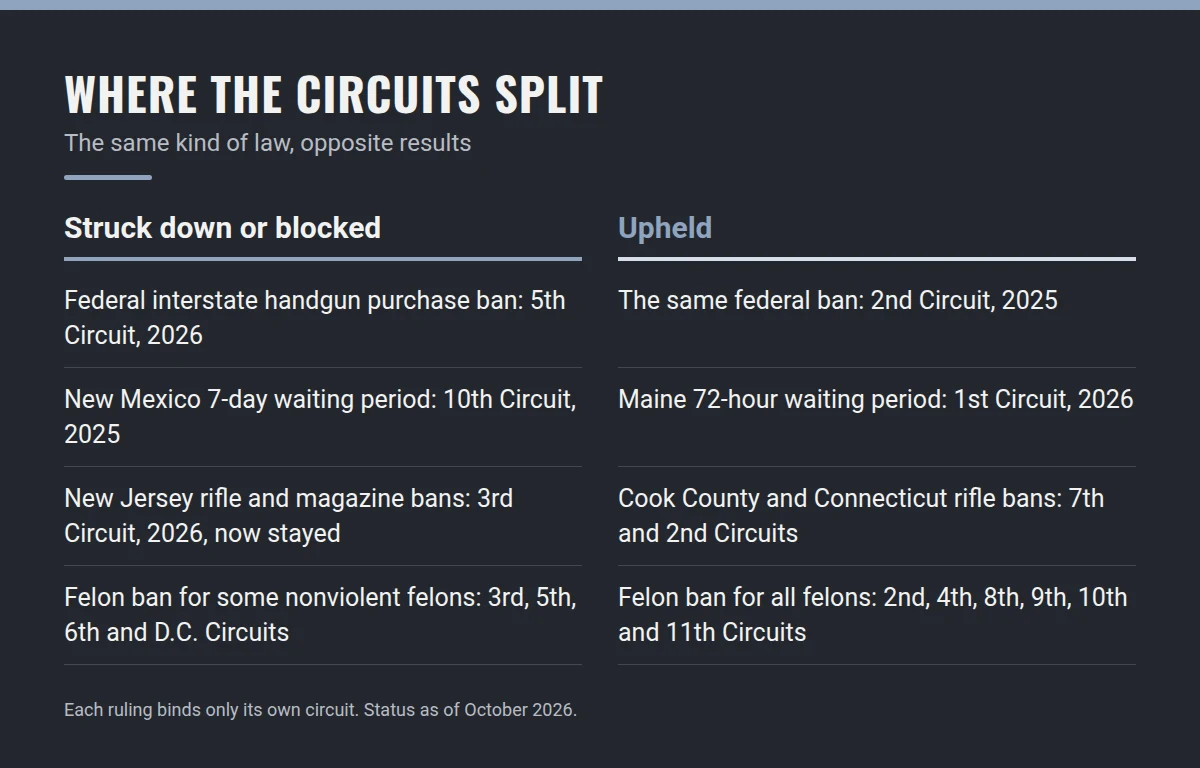
Permits and purchase licensing. Here the circuits mostly agree, and mostly side with the states. On September 22, the full Ninth Circuit voted 6 to 5 to uphold two Hawaii rules: a permit to acquire a handgun that is void if not used within thirty days, and a police station inspection for certain newly acquired guns. The majority read footnote 9 as making objective, non-abusive shall-issue rules presumptively lawful, required the challengers to show the rules had been “put toward abusive ends,” and found they had not, describing the other circuits as having “converged” on that principle. Five judges dissented, arguing that footnote 9 is not a “safe harbor” from the historical test. That frames the issue neatly for a Supreme Court petition.
Buying across state lines. The September 18 Fifth Circuit decision struck down the federal provisions that together bar buying a handgun directly from a dealer in another state, 18 U.S.C. 922(a)(3), (a)(5), and (b)(3). The majority held that “the right to keep firearms logically entails the right to purchase them as well,” found no historical tradition supporting the ban, and openly rejected the Second Circuit, which upheld it in 2025. A split over an act of Congress is a strong candidate for Supreme Court review, but this one is not a license to buy across state lines. The government can still seek rehearing or review, the precedent reaches only Texas, Louisiana, and Mississippi, and the ban is fully enforced everywhere else. The same court struck the federal ban on dealer handgun sales to adults under 21 in 2025 while the Fourth Circuit upheld it, and our breakdown of the Justice Department’s under-21 opinion covers where that stands at the counter.
Waiting periods. This is the sharpest split. In August 2025 a divided Tenth Circuit panel held New Mexico’s seven-day waiting period likely unconstitutional and ordered it blocked, and that December the full court declined to rehear the case over the objections of two judges. In April 2026 a unanimous First Circuit went the other way on Maine’s 72-hour wait, holding that a rule governing the moment of acquisition does not regulate conduct the text protects and is presumptively valid unless shown to be abusive. The Maine challengers have asked the Supreme Court to take the case, and the justices are scheduled to consider it at their October 16 conference.
“Common use” arms. The biggest fight is over the guns themselves. The Seventh Circuit upheld Cook County’s ban on semiautomatic rifles, and the Second Circuit upheld Connecticut’s. On June 30, 2026, the Supreme Court agreed to hear both together on whether the Second and Fourteenth Amendments “guarantee the right to possess AR-15 platform and similar semiautomatic rifles,” with argument set for December 2. Meanwhile the full Third Circuit struck down New Jersey’s rifle and magazine bans 10 to 5 in July, then stayed its own ruling, so both remain enforceable there. We explained that trap in our piece on how stays and appeals catch carriers.
Prohibited persons. The Congressional Research Service counts the Third, Fifth, Sixth, and D.C. Circuits as holding that the felon ban can be unconstitutional as applied to some people with nonviolent convictions, while the Second, Fourth, Eighth, Ninth, Tenth, and Eleventh Circuits uphold it for everyone. The Justice Department has asked the Supreme Court to review a Fifth Circuit ruling for a man whose only felony was possessing methamphetamine. If a permit application or a background check ever turns on an old conviction, that is a conversation for an attorney, not a research project.
Why a Ruling Does Not Change the Law Where You Stand
This is the section that keeps carriers out of handcuffs. A court decision changes nothing for you until it is final, binds the courts where you are, and covers you.
- A Supreme Court opinion binds every court, but it does not erase statutes. After Wolford, the similar private property rules other states adopted still have to be challenged in their own cases.
- A circuit decision binds only its circuit. That is how Maine can enforce a 72-hour wait while the Tenth Circuit has held New Mexico’s seven-day wait likely unconstitutional.
- Relief may reach only the people who sued. Since the Supreme Court’s 2025 decision in Trump v. CASA curbed universal injunctions, a win often protects only the named plaintiffs or an organization’s members. One dissent in the Ninth Circuit’s Hawaii case would have trimmed that injunction to the two men who sued.
- Finality takes time. The losing side can seek rehearing or Supreme Court review, and courts often stay their rulings in the meantime. New Jersey’s magazine limit is still enforced months after a federal appeals court called it unconstitutional.
So obey the statute on the books where you are standing, and change what you carry, buy, or do only when an order that covers you is actually in effect. When you travel, check every state on the route the week you leave.
What to Watch Next
- October 16: the justices consider the Maine waiting period petition, Beckwith v. Frey.
- The felon ban: the government’s petition in United States v. Hembree is awaiting action after the justices’ September 28 conference.
- December 2: argument in Viramontes v. Cook County and Grant v. Higgins, the Court’s first full hearing on a rifle ban.
- Hawaii and interstate sales: watch for a petition from the Hawaii challengers and for the government’s next move after the Fifth Circuit ruling.
The Bottom Line
Heller recognized the right, McDonald applied it to your state, Bruen carried it outside the home and set the test, and Rahimi told courts to look for principles rather than twins. Nearly everything since, this September’s headlines included, is lower courts arguing over how those principles apply to permits, purchases, waiting periods, and the guns themselves. Until the Supreme Court takes the next case, a ruling from another circuit is news, not a defense. Carry under the law where you stand, keep your training and your legal knowledge current, and take anything specific to your situation to a firearms attorney.
Further reading (sources)
- District of Columbia v. Heller for the individual right and the list of presumptively lawful measures
- McDonald v. City of Chicago on applying the Second Amendment to states and cities
- New York State Rifle & Pistol Association v. Bruen with the public carry holding, footnote 9, and the history test
- United States v. Rahimi on temporary disarmament and the principles approach
- Wolford v. Lopez for the Court’s restatement of both steps and the Hawaii default rule
- United States v. Hemani on why habitual drunkard laws could not justify the unlawful user prosecution
- U.S. Court of Appeals for the Ninth Circuit with the en banc opinion upholding Hawaii’s handgun purchase rules
- U.S. Court of Appeals for the Fifth Circuit for the opinion striking the interstate handgun purchase ban
- U.S. Court of Appeals for the Tenth Circuit on the order leaving the New Mexico waiting period ruling in place
- Duke Center for Firearms Law with an analysis of the First Circuit ruling upholding Maine’s 72-hour wait
- U.S. Court of Appeals for the Third Circuit for the en banc opinion on New Jersey’s rifle and magazine bans
- Supreme Court of the United States on the Viramontes docket, cert grant, and December 2 argument date
- Supreme Court of the United States with the Beckwith petition and its October 16 conference
- Congressional Research Service for the circuit split over the felon ban and the Hembree petition