How Long Does a Carry Pistol Last? Round Counts, Spring Replacement, and When to Retire a Gun
Published on October 31, 2026

San Francisco’s police department is retiring the SIG Sauer P226 pistols it has issued to officers since 2004, about 2,000 of them. As the San Francisco Standard reported in September, the department had known for some time that their days were numbered: the guns had cracking frames and worn-out night sights. New pistols are arriving 400 at a time every six months, and the department expects to finish rearming by the end of 2028. Most officers never fire their weapons on duty, and range qualification comes twice a year. Those pistols spent two decades mostly riding in holsters, and they wore out anyway.
That is a useful mirror for anyone who carries. A civilian carry gun lives the same life as a duty gun: worn every day, shot now and then, rarely opened up beyond a field strip. Plenty of carriers have run the same pistol for ten years without replacing a single part, on the theory that a gun that has always worked will keep working. What follows is what actually wears on a modern carry pistol, the schedule that fits each part, and how to tell when a gun has earned retirement rather than another spring.
Carried Is Not the Same as Shot
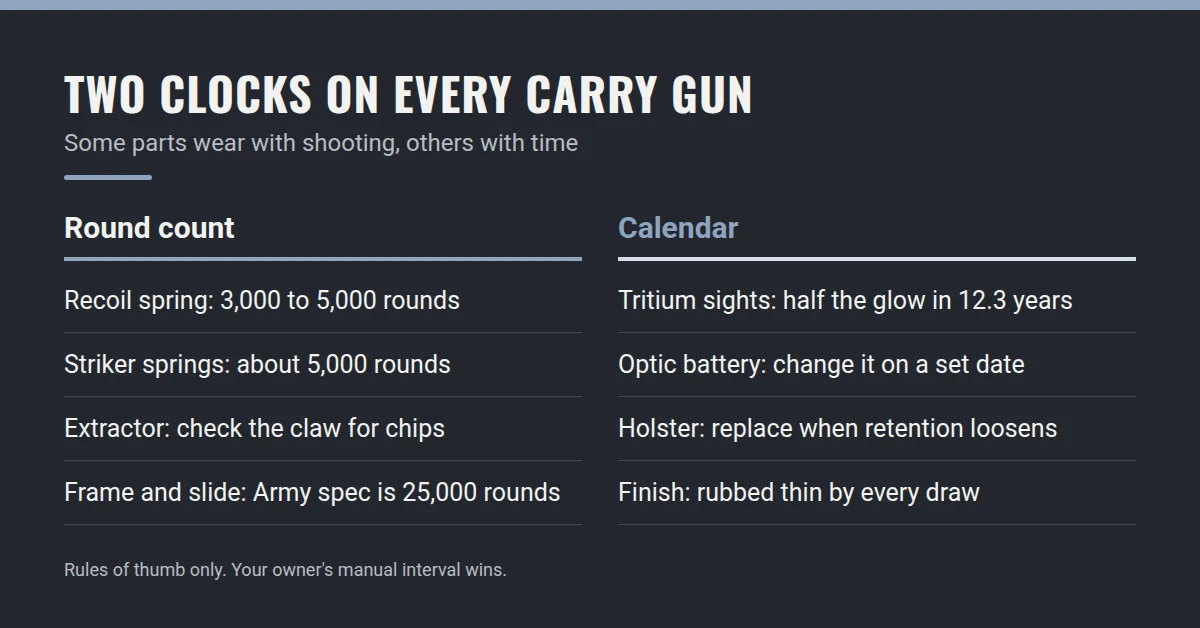
A carry pistol runs on two clocks at once. The first is the round counter. Every shot cycles the slide, compresses the recoil spring, works the extractor against a case rim and loads the locking surfaces, so springs and extractors (and, far later, barrels and frames) wear in proportion to how much you shoot. The second is the calendar. The tritium in night sights decays whether or not the gun is ever fired, optic batteries drain, every draw rubs a little finish off the slide, and holsters slowly lose their grip on the gun, all on a timeline set by days carried rather than rounds fired.
Which clock runs out first depends on how you use the gun. Shoot 200 rounds a year and a recoil spring rated for a few thousand rounds will last well over a decade, while your night sights lose about a quarter of their glow in the first five years. Take a 500-round class every year and shoot a 100-round practice session every month, and you will put 1,700 rounds a year through the gun, enough to wear out a recoil spring every two or three years. Most carriers are the first kind of shooter, and the usual mistake is to fret about springs and forget the sights. The schedule below covers both.
What the Army Expects a Pistol to Survive
When the Army tested the pistols that became its current M17 and M18, the Pentagon’s weapons testing office reported that they were fired “out to the required service life of 25,000 rounds per pistol.” The same requirements set reliability at 5,000 mean rounds between failures, and they define a failure as a hardware problem that “requires replacement or repair.” Put plainly, the spec accepts a part needing repair or replacement about once every 5,000 rounds, while expecting the pistol itself to keep going to 25,000.
That is a useful anchor for a civilian. At 200 rounds a year, 25,000 rounds is more than a century of shooting. The frame and slide of a quality modern pistol will very likely outlast your interest in it, and San Francisco’s cracking frames belonged to a fleet that had been on duty since 2004. The springs, the extractor and the small parts will not last that long, and they are the inexpensive part of the gun. A carry pistol that feels worn out is usually a pistol that needs a few springs and an hour with an armorer.
The Parts That Wear, and When to Replace Them
| Part | What wears it | When to act |
|---|---|---|
| Recoil spring | Firing | Every 3,000 to 5,000 rounds or at your manual’s interval, and at purchase on any used gun |
| Striker or firing pin spring | Firing | Around 5,000 rounds on a striker-fired gun, or at the first light strike |
| Extractor | Firing and rounds dropped into the chamber | At a chip, erratic ejection or a failure to extract |
| Tritium sight inserts | Time alone | Half the glow every 12.3 years; replace when the dots are hard to find in the dark |
| Optic battery | Time alone | On a fixed date you will remember |
| Holster | Draws, heat and age | When retention loosens or the mouth deforms |
| Barrel, frame and slide | Tens of thousands of rounds | Not on a schedule; retire the gun at a crack or a bulge |
The recoil spring is the part people mean when they say a carry gun needs springs. American Rifleman’s long-standing answer is that a quality recoil spring should last “a minimum of 3,000 to 5,000 firing cycles before changing,” and that the best warning is a change in how the gun behaves: brass landing in a different place or flying farther, rounds that do not fully chamber, stovepipes, and feeding trouble from magazines that used to run. America’s 1st Freedom adds two practical points. If you bought the gun used, replace the spring right away, because you have no idea what it has been through, and most manufacturers will send a replacement for little or no cost. Where your owner’s manual gives an interval, use it. Intervals differ from model to model, and the maker’s number beats any rule of thumb.
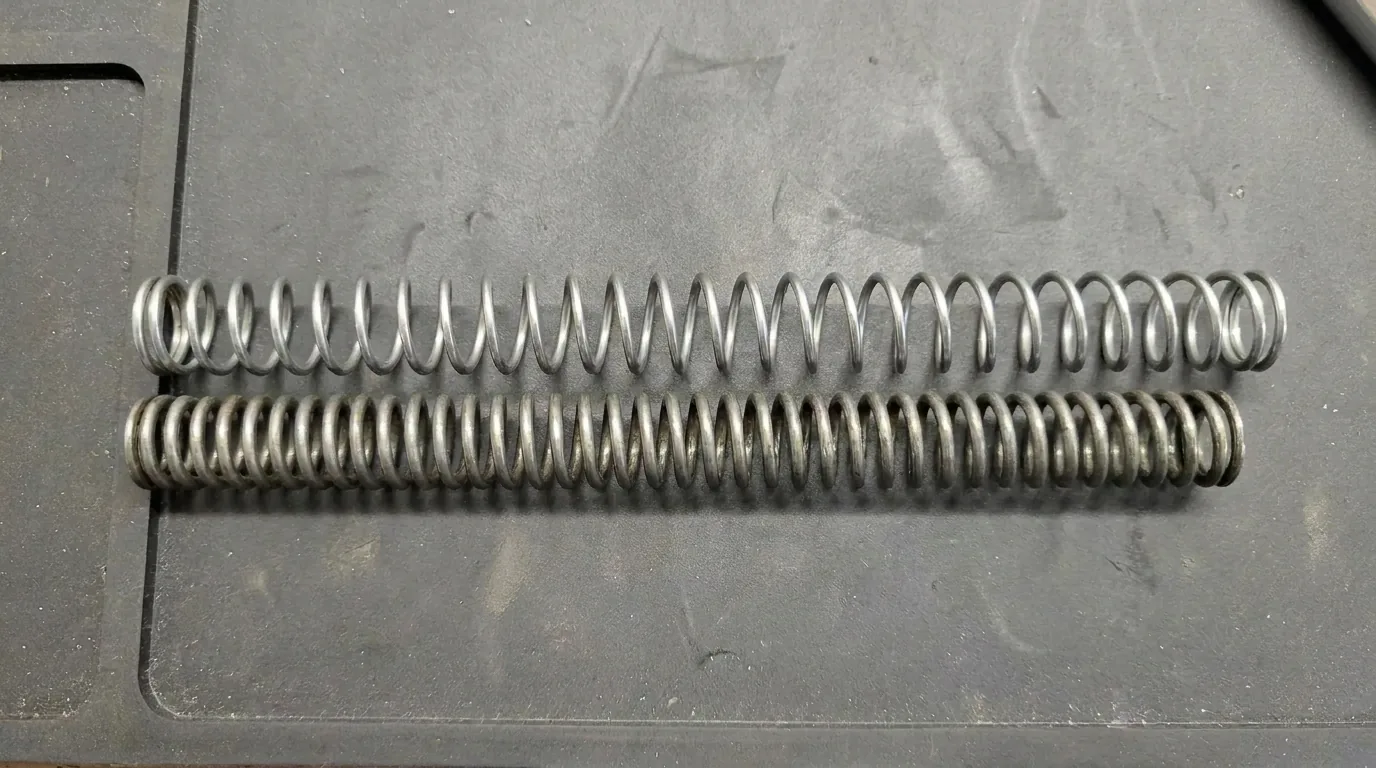
Striker and firing pin springs come next. NRA Family’s rule of thumb is that the springs on a modern striker-fired pistol “should be good up to about 5,000 rounds.” The classic sign of a tired striker spring is a click and a lightly dented primer from ammunition that used to fire every time.
The extractor is the part your carry routine can wear out without a shot fired. On most pistols, the claw that pulls each empty case from the chamber is meant to catch the rim as a round rises out of the magazine. Drop a round straight into the chamber and let the slide slam forward over it, and the claw has to snap over the rim instead. The Sonoran Desert Institute, a gunsmithing school, warns that this slowly damages the extractor until it develops “a small chip or notch that’s difficult to spot,” and that a worn extractor shows up as double feeds and failures to extract that look like a dirty gun. If you unload at night and reload in the morning, chamber from the magazine every time, then top the magazine off.
Night sights are the purest calendar item on the gun. The EPA puts the half-life of tritium at 12.3 years, and a tritium sight’s glow fades along with its supply. Five years in, an insert has about three quarters of its original tritium. At ten years, a little over half. An insert made in 2004, the year San Francisco issued those pistols, has less than a third left today, which is what “worn-out night sights” means in practice. The test is simple: with the gun unloaded, stand in a dark room for a few minutes and see whether the dots jump out at you. If you have to hunt for them, have the inserts or the sights replaced. Unlike a spring, a tritium insert wears out just as fast in a safe as on your hip.
Optics, finish and holsters round out the calendar. If your carry gun wears a red dot, change its battery on a date you will remember rather than waiting for the dot to fail, and check the mounting screws at the same time. Holster wear on the edges of the slide, the muzzle and the front sight is the honest signature of daily carry, and mostly cosmetic. The holster itself is another matter: kydex loses retention and leather softens until it can fold into the trigger guard, and our holster guide covers retention and fit. Magazines wear too, and they are the usual suspect when a gun stops running, so any magazine that has caused a stoppage should leave your carry rotation until it is fixed or replaced.
Keeping Count Without Becoming an Accountant
Replacement intervals mean nothing without a number to compare them to, and few carriers know how many rounds have gone through their gun. You do not need precision. Count boxes, not rounds: keep a note on your phone and add a line each time you come home from the range. Record the date you bought the gun, the date its sights went on and the date of each spring change. Within a year you will have a real number instead of a guess.

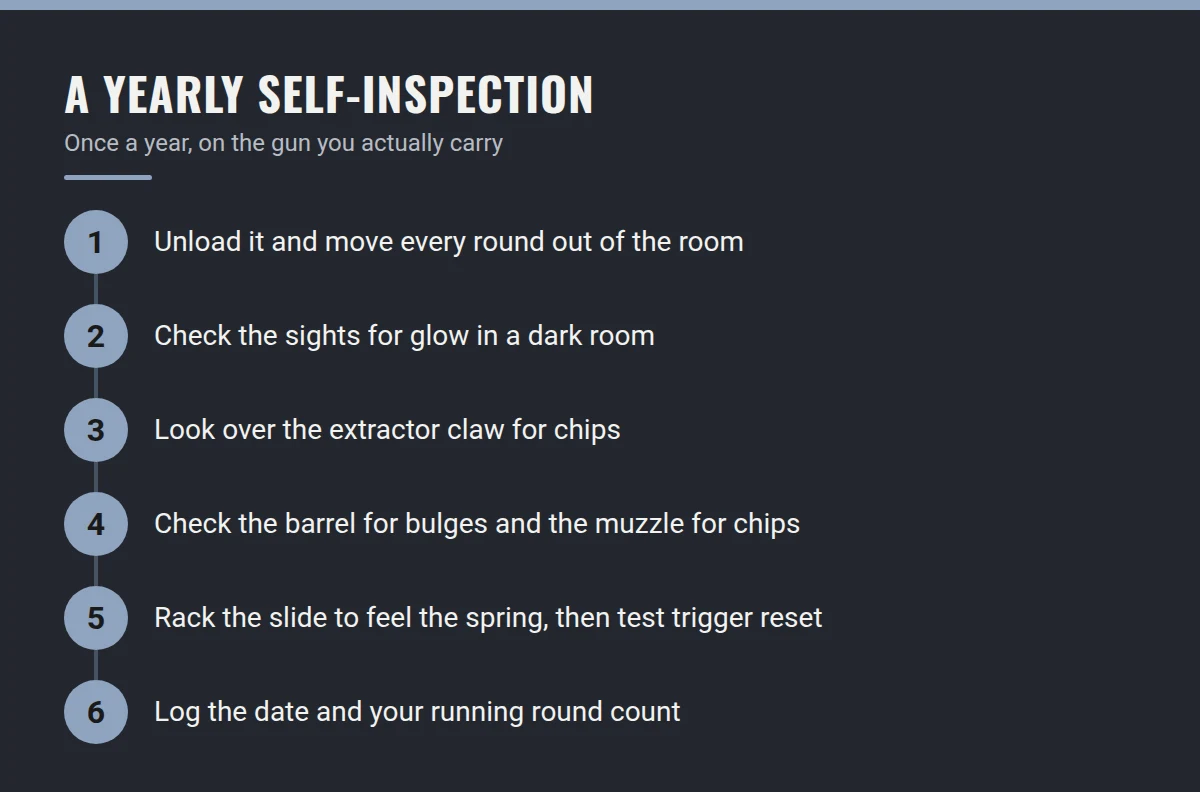
Police departments do not wait for failures, either. One Massachusetts department’s written policy requires every issued firearm to be inspected at least three times a calendar year, and its checklist makes a good template for a carrier’s own yearly look: sights checked for loose or missing inserts, the breech face and extractor examined, the barrel checked for bulges and the muzzle for chips, the slide racked several times to feel the recoil spring tension, and a trigger function check that confirms the reset. Do the same with the gun unloaded and every round out of the room, and add the dark-room test for your sights. Every few years, or whenever you reach a spring interval, have an armorer detail strip the gun and look at what a field strip never shows you, including the locking surfaces and frame rails.
When It Is Time to Retire the Gun
A new model is not a reason. Glock launched its Gen 6 pistols in January 2026, and even a review that welcomed the changes said Gen 5 guns “are still excellent, reliable pistols and will be for a long time.” Whether you want a newer gun is a shopping decision. Whether the one you carry is still fit for the job is a mechanical one, and these are the signs that it is not:
- A crack anywhere in the frame or slide. This is where San Francisco’s pistols ended up. Cracks tend to grow with every shot, and fixing one is not a parts swap: federal law defines the frame or receiver as the firearm itself, so a replacement runs through the manufacturer or a licensed dealer. Stop shooting the gun.
- A bulged or cracked barrel, or one a gunsmith says is out of specification.
- Doubling, or an open safety bulletin. A pistol that fires twice on one pull of the trigger is out of service until it is fixed. Our piece on Queensland’s Glock recall explains doubling and how to check your serial number.
- Stoppages that survive new springs and known-good magazines. At that point the problem lives in the gun, and our malfunction guide shows how to read the pattern.
- Parts you can no longer buy. If springs for a discontinued model have dried up, its next failure may be its last.
- A repair bill that approaches the price of a new pistol.
Retiring a gun from carry does not always mean getting rid of it. A pistol that is safe but tired can stay on as a practice gun, as long as it is not the one you are betting on. One with a cracked frame or slide should not be fired at all. If you sell it, the rules you met as a buyer apply in reverse: many states route private sales through a dealer for a background check, and a handgun sale to a resident of another state always has to go through one, as our guide to how buying a handgun works explains.
The same logic applies when you buy someone else’s retired gun. San Francisco is letting its officers keep their old P226s for $325, and retired duty guns regularly find their way onto the used market. Treat any used pistol as having an unknown round count: a new recoil spring on day one, a dark-room check of the sights, and an armorer’s look at the frame before it rides in your holster. If you are shopping new instead, our 2026 roundup of carry handguns by size class is a reasonable place to start.
The Bottom Line
A carry pistol does not wear out all at once. Its springs and extractor wear with the rounds you fire, its sights and holster wear with the days you carry, and its frame and slide will very likely outlast your interest in the gun. Count boxes, check the sights in the dark once a year, replace springs on the manual’s interval rather than on a feeling, have an armorer look inside every few years, and retire the gun for a crack, not for a catalog.
Further reading (sources)
- The San Francisco Standard on the police department replacing pistols with cracking frames and worn-out night sights
- Director, Operational Test and Evaluation with its archived report on the Army pistol tested to a 25,000-round service life
- American Rifleman for how long a recoil spring lasts and the signs it is due
- America’s 1st Freedom on replacing the recoil spring in a used or hard-shot pistol
- NRA Family with a rule of thumb for spring life in striker-fired pistols
- Sonoran Desert Institute explaining how dropping a round into the chamber chips an extractor
- U.S. Environmental Protection Agency on tritium and its 12.3-year half-life
- Braintree Police Department for a written duty-pistol inspection checklist
- 19FortyFive with a review of the 2026 Gen 6 redesign and why older guns still serve
- Legal Information Institute on the federal definition that makes a frame or receiver a firearm