Queensland's 15,000-Glock Recall: What Firearm Safety Bulletins Mean for Your Carry Gun
Published on September 2, 2026
In April 2026, the Queensland Police Service announced it was pulling every one of its 15,000 service-issued Glock handguns for testing after routine maintenance checks turned up a fault that could cause the pistol to fire more than one round from a single trigger pull. That is an alarming sentence to read if you carry a Glock, and Glock pattern pistols are the single most common thing riding in American holsters. So it is worth being precise about what happened in Queensland, what it does and does not say about the gun on your hip, and how the firearm industry handles safety defects differently from almost every other consumer product you own.
What Actually Went Wrong in Queensland
The fault surfaced the way faults are supposed to surface. Guns coming back from the frontline for ordinary maintenance were run through a new testing regime, and a small number failed in a specific way: hold the trigger down, and the pistol kept firing. Police union president Shane Prior described it plainly, noting that this is something that should not occur in a semiautomatic weapon. Deputy Commissioner Chris Stream confirmed three firearms had been identified with the issue at the time of the announcement, out of a fleet of more than 15,000, and said there had been no operational incidents connected to the pistols.
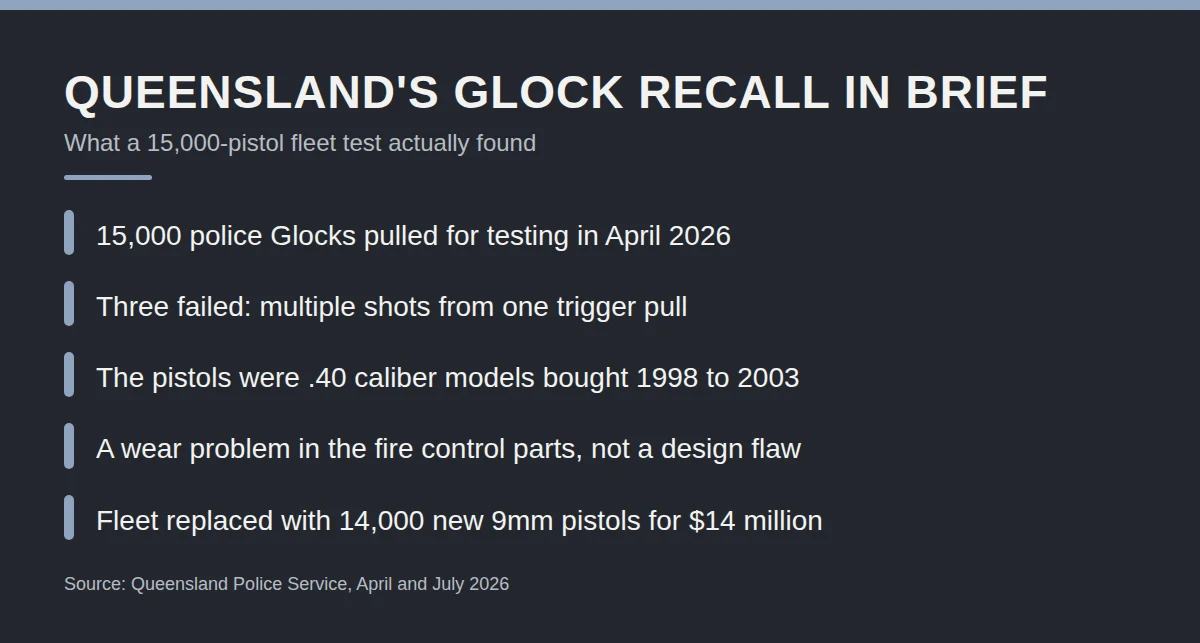
The detail that matters most for American readers is the one that got buried under the headlines. These were not new guns. They were .40 S&W Glock 22s purchased between roughly 1998 and 2003, meaning the youngest of them was more than two decades old, and reporting on the replacement program noted that some had received minimal maintenance since they were first issued. This was a wear story, not a design story. Springs sag, trigger bars and connectors round over, and the parts that make a striker-fired pistol reset correctly do not last forever in a duty gun that has been carried and shot for twenty-five years.
Queensland’s answer, announced at the end of July 2026, was to spend about $14 million replacing the fleet outright with roughly 14,000 Glock 45 Gen 6 pistols in 9mm, with issue beginning in December. The old .40 caliber guns are being retired rather than rebuilt. That is the correct read on the story: an aging fleet reached the end of its service life, and the testing regime caught it before anyone got hurt.
Doubling Is Not Drop-Fire, and the Difference Matters
Two very different failure modes get lumped together as “the gun went off by itself,” and untangling them is the most useful thing a carrier can take away from this.
What Queensland found is doubling, sometimes called a runaway. The trigger gets pulled once, the pistol cycles, and the disconnector or trigger reset fails to catch the striker on the way back, so the gun fires again. It is a wear and tolerance problem in the fire control parts, and it happens during shooting, with the shooter’s finger on the trigger.
The SIG Sauer P320 controversy is a different animal. There, the allegation is an uncommanded discharge: the pistol firing with no finger on the trigger at all, sometimes while holstered. SIG has faced more than 100 legal challenges over the design since 2014, including a Maine deputy’s suit alleging the pistol fired in its holster and a Law360-reported case the company failed to get dismissed in August 2026. On the military side, the Department of War reached the opposite conclusion. After the Air Force inspected 113,479 M18 pistols and the Army ran more than 1.5 million rounds through the Modular Handgun System program, the Pentagon stated on August 7, 2026 that every investigated incident of an alleged uncommanded discharge traced back to the trigger being pulled. Worth noting, though: the M17 and M18 carry a manual safety the civilian P320 does not.
The lesson is not that one platform is cursed and another is safe. It is that a carry pistol is a mechanical device with consumable parts, and both failure modes are found by inspection and testing rather than by hoping. If you are still choosing a platform, our guide to choosing your first concealed carry pistol walks through the action types and what each one asks of you.
Nobody Can Order a Gun Recall
Here is the structural fact most owners do not know. The Consumer Product Safety Commission, the agency that can force a recall of a crib, a space heater, or a lithium battery, has no authority over firearms and ammunition. Congress carved them out of the Consumer Product Safety Act’s definition of a consumer product. The ATF regulates who may manufacture, sell, and possess guns, not whether a given model is mechanically safe. There is no NHTSA for handguns, no mandatory defect reporting, and no VIN lookup that tells you your serial number is affected.
Everything the industry does about safety defects is therefore voluntary, and manufacturers choose their words with care. SIG’s 2017 response to the P320 drop-fire videos was branded a “Voluntary Upgrade Program,” not a recall. Ruger’s 2017 action on the Mark IV was called a recall. Remington’s long-running Model 700 trigger saga went through both labels and a class settlement. Glock has historically preferred the quietest end of that spectrum, handling service issues through armorer bulletins and running production changes rather than public announcements. The best-known example is the Gen4 recoil spring assembly, which was revised more than once and exchanged through customer service and certified armorers without a press release.
None of that is sinister, but it does mean the burden of finding out sits with you.
How to Check Whether Your Pistol Has an Open Bulletin
There is no central database, so this is a short list of things that actually work.

Call the manufacturer’s US customer service line with your serial number and generation in hand. This is the only authoritative answer. Glock, SIG, Smith and Wesson, and Ruger all maintain US service departments that can look up a serial and tell you whether it falls in an affected range. Ask directly whether there is an open service bulletin or upgrade program for that serial.
Register the gun with the manufacturer. Warranty registration is the only way a maker can reach you when something changes. Plenty of owners skip it out of privacy concern; understand that the tradeoff is not being notified.
Find a certified armorer for your platform. A Glock-certified armorer has the current bulletins, the gauges, and the part numbers. Most decent gun shops either employ one or know who locally does.
Check the maker’s website news or safety section before a long trip or a class, and treat enthusiast forums as a tip source rather than an answer. Forums are often first to notice a pattern and frequently wrong about the cause.
What You Owe Your Everyday Gun
Queensland’s fleet failed because guns were carried for a quarter century with minimal service. The civilian version of that mistake is the pistol that lives in a holster, gets shot fifty rounds a year, and never gets looked at. Here is the maintenance floor for a gun you are betting your life on.
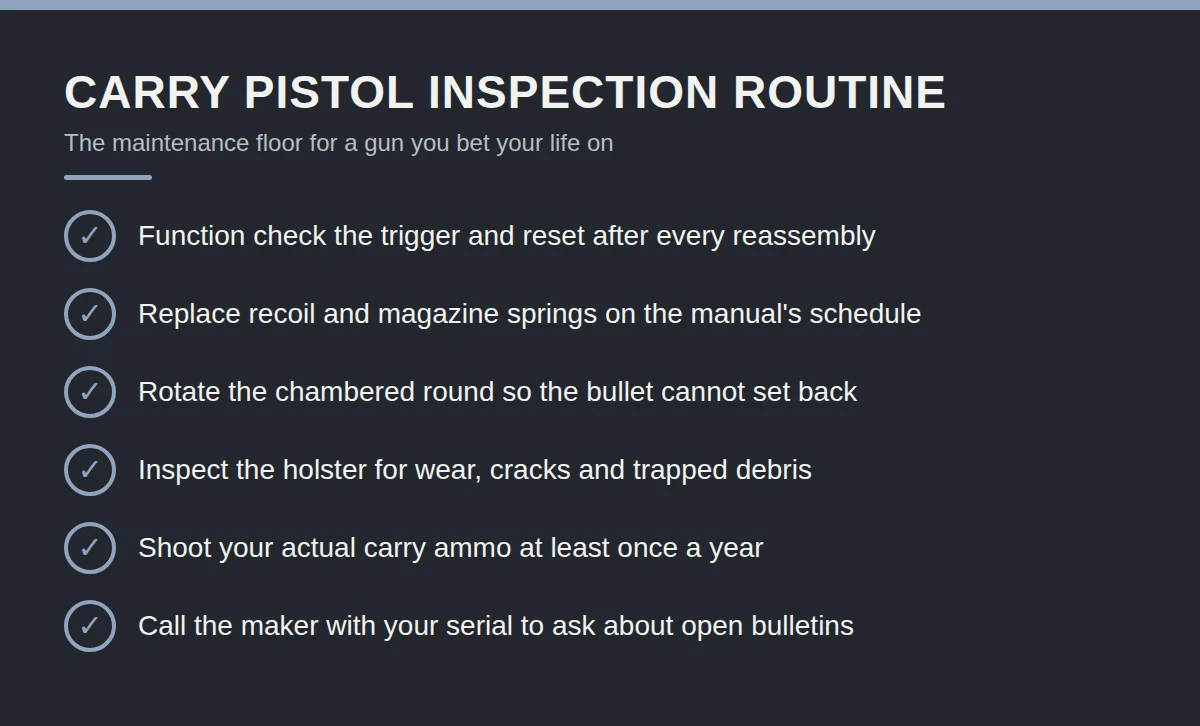
Run a function check every time you reassemble. Unloaded, in a safe direction: press the trigger, hold it back, cycle the slide, release the trigger and feel for the reset click, then press again. Check that the trigger safety lever blocks a press when you push only the shoe’s edge. Thirty seconds, and it catches most fire control problems.
Replace springs on a schedule, not on a feeling. Recoil spring life on compact pistols is commonly rated in the low thousands of rounds, and magazine springs left loaded and cycled for years are a leading cause of feeding failures. Your manual has the interval. Follow it, and keep a rough round count so the interval means something.
Stop rechambering the same cartridge. Repeatedly stripping the same round from the magazine can push the bullet deeper into the case, and a set-back bullet raises chamber pressure sharply. Rotate your chambered round, or mark it and retire it after a few loadings.
Inspect the holster too. Worn kydex loses retention, a cracked mouth can collapse into the trigger guard, and debris inside a holster has caused more discharges than defective guns have. Our concealed carry holster guide covers retention and fit in depth.
Actually shoot it, with your carry ammo. A gun you never test is a gun with an untested claim attached to it. Building that into a yearly rhythm is exactly what our 12-month training roadmap is for, and it is the same self-imposed standard that makes sense in a state where no course is legally required to carry.
If Your Pistol Ever Doubles
Stop shooting. Keep it pointed downrange, unload it, bench it, and do not fire it again to “see if it does it twice.” Then take it to a gunsmith or back to the manufacturer.
There is a legal dimension here that carriers should understand without panicking about. Federal law defines a machine gun as a weapon that fires more than one shot by a single function of the trigger. A worn semiautomatic that doubles is a malfunction rather than a conversion, and prosecutions turn heavily on knowledge and intent, but continuing to carry or shoot a pistol you know doubles is genuinely bad territory to be in on both the safety and the legal side. Fix it or retire it, and if you are ever in a situation where the question is live, ask a firearms attorney rather than a forum. The broader federal framework is laid out in our federal firearms law reference.
The Bottom Line
Queensland’s recall is a good news story wearing a bad news headline. A testing program caught three faulty pistols out of 15,000 before anyone was hurt, and a police service retired a fleet that should have been retired years earlier. The uncomfortable part for American carriers is that no equivalent program exists for you. No agency inspects your gun, no regulator can order a recall, and no letter arrives unless you registered the firearm. That leaves the four habits above: know your serial and generation, call the maker when something surfaces in the news, replace consumable parts on a schedule, and shoot the gun you carry. A pistol is a machine, and machines wear. The carriers who stay safe are the ones who treat their gun that way rather than as a talisman that works because it always has. If you are shopping for something newer, our roundup of the best concealed carry handguns of 2026 is a reasonable place to start.
Further reading (sources)
- The Guardian on the recall of 15,000 service Glocks after a multiple-shot fault
- Queensland Police Service with the force’s own statement on the testing program
- ABC News for why untested pistols stayed on the frontline during the checks
- Sporting Shooter reporting the $14m switch to Glock 45 Gen 6 pistols in 9mm
- Military Times on the Pentagon’s finding that the M17 and M18 are safe and reliable
- News Center Maine covering a deputy’s claim that his SIG fired while holstered