Amtrak, Greyhound, and Cruise Ships: Traveling With a Handgun When You Are Not Flying or Driving
Published on October 9, 2026

Most gun owners who travel know the airport routine by heart: unloaded, locked hard case, declared at the counter. It is so standardized that people assume it is simply how guns travel. It is not. The federal checked-baggage rule behind that routine covers airliners and nothing else, and once your trip runs on rails, on a bus, or on water, the carrier writes its own answer.
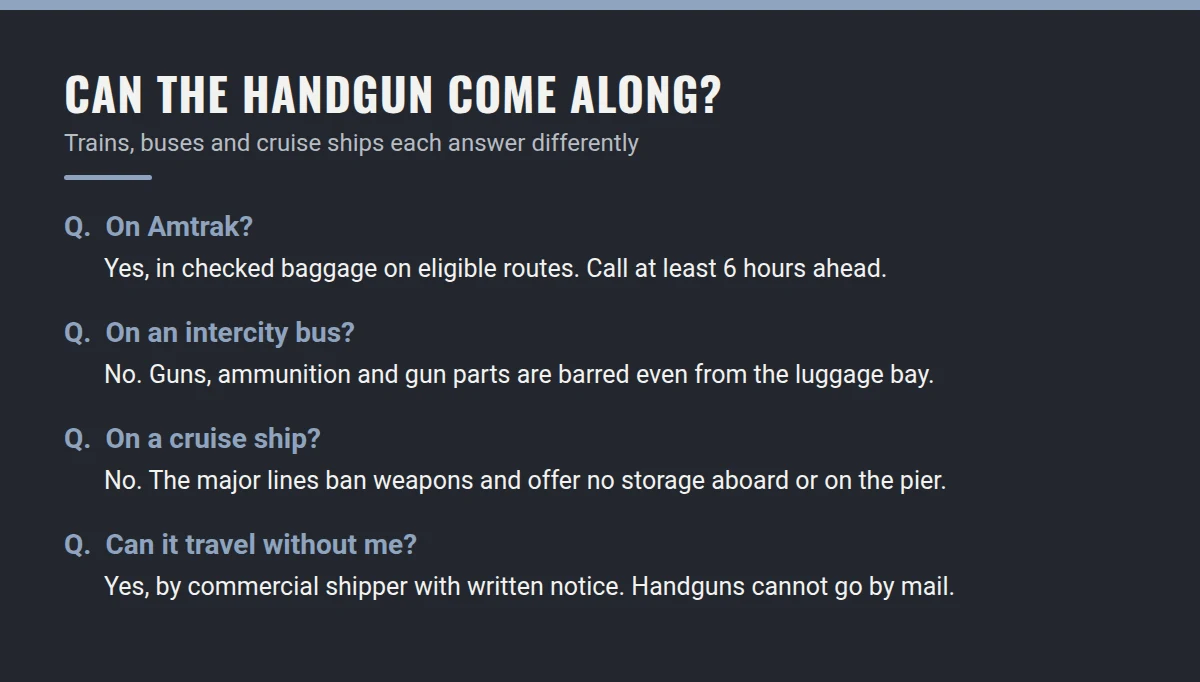
The three answers could hardly be further apart. Amtrak says yes, on some trains, after a phone call and some paperwork. Every major intercity bus line says no, luggage bay included. Cruise lines also say no, and then sail you into ports where one forgotten cartridge can put you in a jail cell. Handgunlaw.us, the long-running carry law reference, files Amtrak, cruise and bus lines, and airlines under separate entries in its travel section, which tells you how little the rules have in common.
Amtrak Says Yes, Because Congress Made It
Amtrak did not volunteer for this. In December 2009, Congress wrote a provision into the Consolidated Appropriations Act ordering the railroad to build a checked firearms program within a year, and the service opened in December 2010. The Government Accountability Office later concluded that, unlike most provisions in a spending bill, this one is permanent law rather than a one-year condition.
The statute sets the floor. A ticketed passenger may put an unloaded firearm in a checked bag on a route whose station accepts checked baggage, provided the passenger declares it in advance, it sits in a locked, hard-sided container, and only the passenger holds the key or combination. The same law told Amtrak to build in inspections of any container holding a firearm, along with the power to suspend the service temporarily if credible intelligence points to a threat against the rail system or a particular train.
Amtrak’s own policy fills in the rest:
- Call ahead. Notify Amtrak at 800-USA-RAIL at least six hours before travel. Firearm reservations cannot be made online. Older guides still repeat the 24-hour deadline written into the 2009 statute, so go by the current policy page rather than an old forum answer.
- Case it properly. The gun travels unloaded in a locked hard-sided case no larger than 62 by 17 by 7 inches and no heavier than 50 pounds. A handgun case goes inside a suitcase or other checked bag, and only you hold the key or combination.
- Box the ammunition. Rounds go in the factory box or another fiber, wood, or metal box made for small amounts, and all of it together, packaging included, can weigh no more than 11 pounds.
- Check in early. Check the gun in at least 30 minutes before departure (earlier at some large stations) and sign a two-part declaration form.
- Ride with it. You must be on the same train as the gun. It cannot be sent ahead or follow you on a later train.
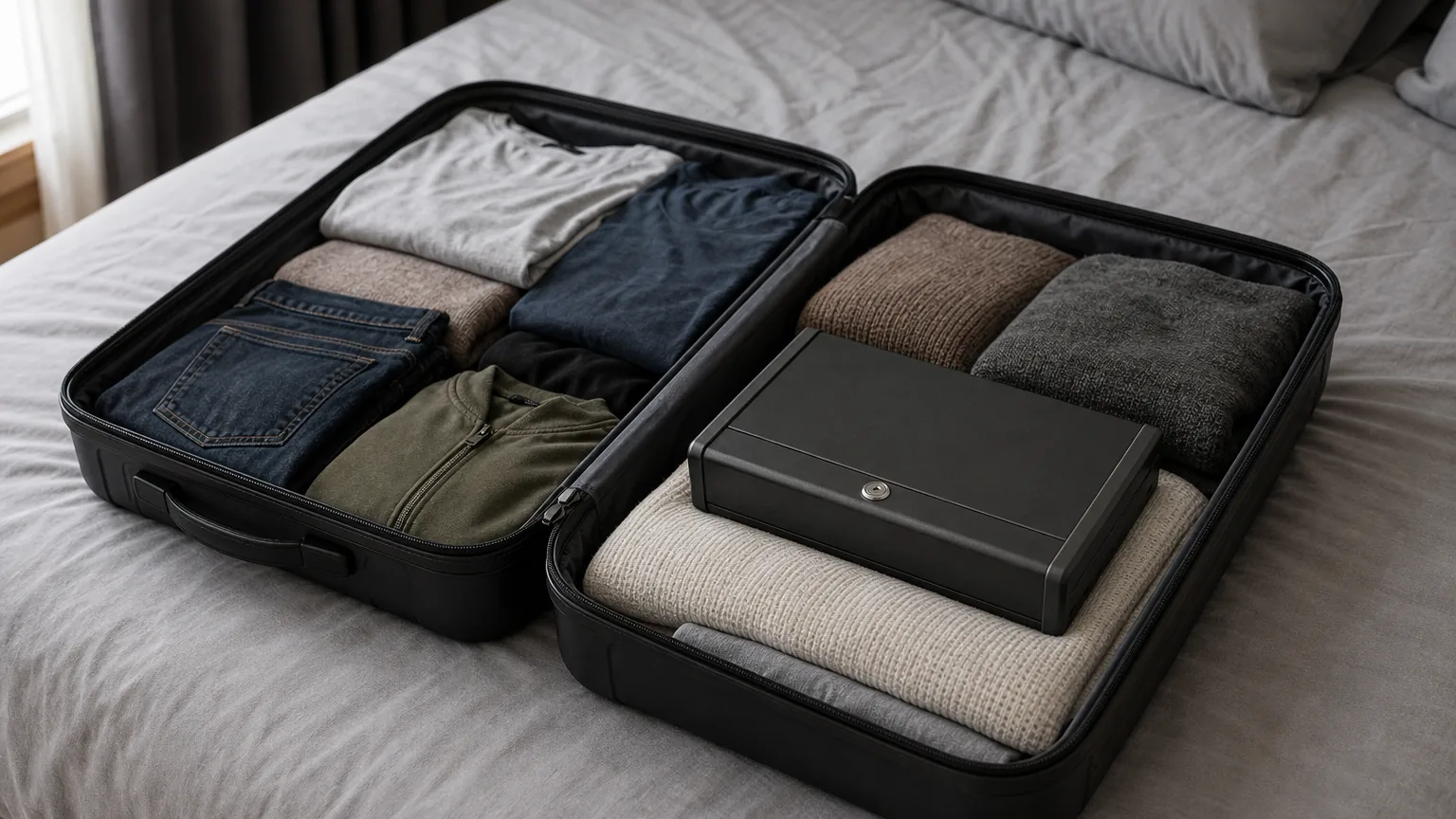
Two details trip people up. BB guns, air guns, and even paintball markers count as firearms under the policy. And nothing goes in carry-on, not the pistol and not a single round. Fall short on any of these and Amtrak’s stated remedy is simple: you are denied transportation.
Where the Train Cannot Take It
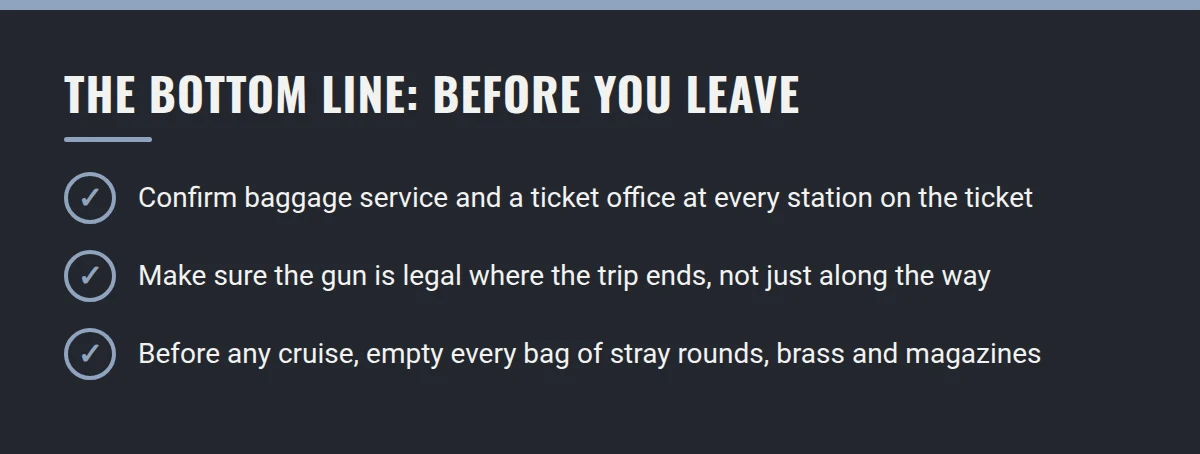
The program covers Amtrak trains within the United States that offer checked baggage service and a ticket office, and every train and every station on your itinerary has to qualify. That requirement does most of the filtering. Amtrak says plainly that not all of its trains and stations can handle checked baggage, and the ticket office condition rules out the many unstaffed platform stops on the network.
Three more gaps are worth checking before you buy a ticket:
- Bus legs. Amtrak sells plenty of itineraries that include a connecting bus, and its Connection bus services are excluded from the firearms program. Since you have to travel with the gun, a single bus segment takes that itinerary off the table.
- Tight connections. Amtrak advises at least two hours of scheduled layover so checked luggage can make a transfer. When a route lacks baggage service, an ordinary suitcase can sometimes be sent on another train bound for the same destination, but firearms are specifically excluded from that workaround.
- Canada. The program stops at the border. A train into Canada is not an option for a handgun.
The Auto Train between Virginia and Florida runs its own system, because your car rides along. The gun stays locked in your vehicle for the whole trip, unloaded, in a hard-sided case with at least two locking points, and biometric-only or keypad-only cases with a single locking mechanism are not allowed. You reserve at least six hours ahead, declare the firearm in person no later than two and a half hours before departure, and it never comes into the coach or sleeper with you. Ammunition is capped at 11 pounds per passenger and can share the case. Once you drive off at the other end, our guide to carrying a gun in your vehicle takes over.
The Baggage Car Crosses State Lines and Your Permit Does Not
Amtrak’s policy puts one more obligation on the passenger, in writing: you are responsible for knowing and following the federal, state, and local firearm laws of every jurisdiction on the route. That sentence weighs more on a train than on a plane. A long-distance train spends hours rolling through states, stopping in them, and now and then stranding its passengers in them.
Federal safe passage is the backstop. Under 18 U.S.C. 926A, you may transport a firearm from a place where you may lawfully possess and carry it to another such place, provided it is unloaded and neither it nor the ammunition is readily accessible from the passenger compartment. A locked case in a baggage car fits that model well, since the statute that created the program defines checked baggage as baggage accessible only to select Amtrak employees.
But 926A protects travel between two lawful endpoints, and Amtrak’s policy leaves the endpoints to you. If your ticket ends in a city where possessing a handgun without a local license is a crime, a locked case and a signed declaration form do not change that. Whether you can carry at all once you arrive is a reciprocity question, and our state travel atlas maps which permits are honored where.
Disruptions are the rail version of the missed flight connection. Amtrak’s firearms page says nothing about what happens to a checked gun when a train is cancelled, a connection is missed, or a bus replaces a broken segment. If a delay leaves you holding a cased pistol overnight in New Jersey, you are in exactly the position our guide to flying with a handgun describes, where a federal appeals court held that an overnight hotel stay put a traveler outside 926A altogether. Ask at check-in what the station does with a firearm bag when service breaks down, and prefer routes that do not change trains in a restrictive state.
Arriving with a cased gun is not permission to carry it, either. Take the pistol out of the case in a state that does not recognize your permit and you are carrying unlawfully, and as a Michigan case showed, even a justified act of self-defense does not wipe out that charge.
Intercity Buses: A Flat No, Luggage Bay Included
If Amtrak’s answer is a qualified yes, the bus industry’s is a flat no. Every intercity bus line Handgunlaw.us checked bans firearms anywhere on the bus, checked baggage included: Greyhound, FlixBus, Megabus, Peter Pan, Trailways, Jefferson Lines, Red Coach, and Vamoose.
The co-branded prohibited items list that Greyhound and FlixBus publish shows how complete the ban is. Firearms, ammunition, gun parts, starter pistols, BB and pellet guns, and realistic replicas are barred from carry-on and from the luggage bay alike. The same list lets you stow a hunting knife, a bow and arrows, or a baseball bat underneath. A single loose cartridge in a checked duffel breaks the rule; a fixed-blade knife in the same duffel does not.
Why the gap between the train and the bus? Mostly because nobody required otherwise. Amtrak’s program exists because Congress ordered it, and there is no equivalent mandate for private bus companies. An intercity coach also has nowhere suitable to put a gun: no baggage car that only employees can reach, no declaration desk, and a luggage bay that is opened and closed at stop after stop.
Your carry permit changes none of this. The ban is a condition of carriage, and the remedy for breaking it is being refused boarding, or being removed from the bus at whatever stop you happen to be near.
If the gun has to make the trip while you take the bus, ship it ahead. Federal law makes concealable firearms nonmailable through the Postal Service for anyone but dealers, manufacturers, and certain officials (18 U.S.C. 1715), which leaves commercial shipping companies. Under 18 U.S.C. 922(e) you must give the shipper written notice that the package contains a firearm, and ATF’s long-standing guidance lets an unlicensed owner ship a gun to themselves in care of someone in the state where they are headed. The shipping companies’ own rules are stricter than the statute and change often, so read them before you tape up the box.
Cruise Ships: No Storage on the Ship or the Pier
Cruise lines go further than the bus companies, for an obvious reason: a ship carries you into someone else’s law. Handgunlaw.us surveyed the major lines sailing from U.S. ports (Carnival, Royal Caribbean, Norwegian, Princess, Celebrity, Holland America, Disney, MSC, Costa, and Viking) and every one bans weapons aboard. The bans reach past firearms to pepper spray, stun guns, and knives, and most lines even make scuba divers declare their dive knives.

The detail travelers miss is that nothing gets held for you. A train has a baggage car; a cruise terminal has no checked-gun desk. One of the largest lines states outright that it provides no storage on the ship or the pier. Others say prohibited weapons are confiscated and never taken aboard, that items found to be illegal are reported to the authorities, and that a guest carrying one may be refused boarding.
Federal law actually allows more than the lines do. The same 18 U.S.C. 922(e) lets a passenger hand a lawfully owned firearm to a carrier’s captain for the duration of the trip without violating federal gun law. That makes the handoff legal; it does not oblige anyone to accept it, and none of the lines in that survey will. Coast Guard security rules also require cruise ships to screen every person, bag, and personal effect for dangerous substances and devices before passengers enter the ship’s secure areas (33 CFR 104.295), so the terminal is where a gun in your luggage gets found.
That leaves the practical question of where the gun spends the week. If you drive to the port, the tempting answer is the car, and a vehicle parked for seven days in a port garage is about the weakest storage you can choose. Parked cars are now the single largest source of stolen guns, as the theft data in our vehicle carry guide shows, so the gun belongs at home in a safe.
The Ports of Call Are the Real Exposure
Even an itinerary that feels domestic usually touches foreign soil. The Passenger Vessel Services Act, a cabotage law dating to 1886, bars foreign-flagged ships, which most large cruise ships are, from carrying passengers between U.S. ports, so a round trip that visits other American ports has to call at a foreign one along the way. That is why Seattle sailings to Alaska stop in British Columbia, and why West Coast Hawaii cruises have long made a brief, often early-morning call at Ensenada, Mexico.
Once you are ashore, or in a country’s waters, that country’s law applies, and every country in the Caribbean and Central America regulates bringing in firearms and ammunition. Most require a declaration on arrival, others require paperwork in advance, and some do not allow them at all, according to Handgunlaw.us’s survey of the region. Taking a gun out of the United States, even temporarily, is also an export under federal law, with licensing rules of its own.
The realistic risk for a cruise passenger is not the gun, which never got aboard. It is the cartridge nobody remembered packing. In the spring of 2024, Tyler Wenrich, a Virginia paramedic whose cruise had docked at Grand Turk in the Turks and Caicos Islands, was arrested after a security checkpoint turned up ammunition left in his bag from a hunting trip. The charge carried a potential 12-year prison sentence. A judge found extraordinary circumstances and sentenced him to time served and a $9,000 fine, and he was one of several Americans arrested in the islands that year over stray rounds.
The State Department says hundreds of U.S. citizens are arrested abroad each year for carrying firearms or ammunition they could legally possess at home, including several in the Caribbean over shell casings or ammunition in suitcases. Consular officers can give you a list of local attorneys and visit you in jail. They cannot get you out.
So pack for the ports, not for the ship. Take the cruise in luggage that has never been to the range. Then go through every pocket of the backpack and jacket you plan to bring, looking for loose rounds, spent brass, and empty magazines.
The Bottom Line
Off the airplane and out of your own car, there is one real way to bring a handgun along. Amtrak will carry it in a locked case on trains and at stations with checked baggage and a ticket office, if you call at least six hours ahead and ride the same train. Book long layovers, and judge the itinerary by its weakest point: a bus leg, an unstaffed station, or a destination where the gun becomes illegal the moment you pick up the bag.
Buses and cruise ships are not hard cases; they are closed doors. The useful work there is making sure nothing gun-related comes along by accident, because the stray round that costs you a seat on a bus can cost you your freedom at a Caribbean pier. Carrier policies and state laws change, so confirm each one against its current source before you travel, and when an itinerary leaves you genuinely unsure, put the question to a firearms attorney licensed where the doubt lives before you buy the ticket.
Further reading (sources)
- Handgunlaw.us keeps a running list of cruise line and intercity bus firearm policies
- Handgunlaw.us with firearm and ammunition entry rules across the Caribbean and Central America
- U.S. Code notes under 49 U.S.C. 24306 for the 2009 law that ordered Amtrak to accept checked firearms
- Government Accountability Office on why the Amtrak firearms provision is permanent law
- Legal Information Institute for the carrier notice rule and passenger exception in 18 U.S.C. 922(e)
- Legal Information Institute with the federal safe passage statute, 18 U.S.C. 926A
- U.S. Coast Guard regulations requiring cruise ships to screen every passenger and bag
- U.S. Department of State explaining why Americans are arrested abroad over firearms and stray ammunition
- NBC News reporting the sentencing of a cruise passenger caught with ammunition on Grand Turk
- U.S. Customs and Border Protection describing Hawaii cruises that stop in Ensenada to satisfy the Passenger Vessel Services Act