Carrying in Your Vehicle: A Complete Guide to Guns in Cars
Published on September 4, 2026
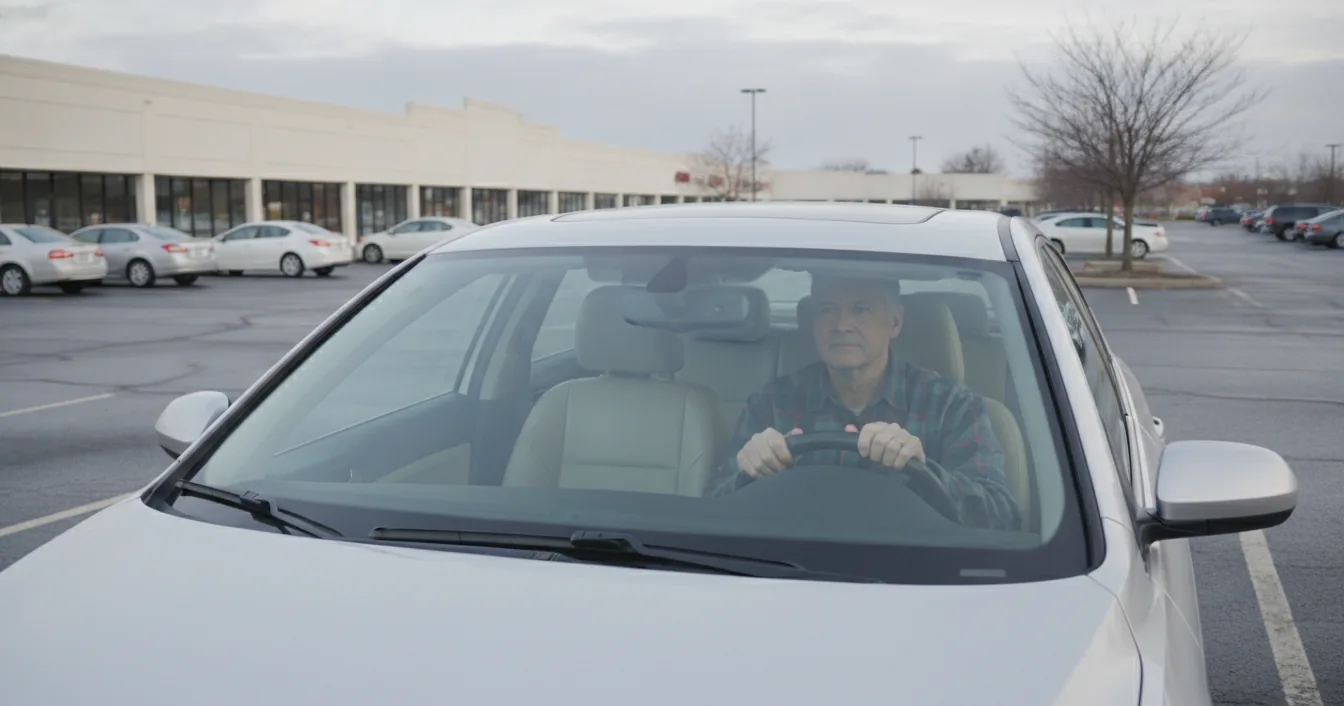
The average American commute runs a little under half an hour each way. Add the school run, the grocery trip, and the occasional long drive to see family, and a daily carrier spends more armed hours belted into a car seat than anywhere else outside the house. It is also the one environment almost nobody trains for. The permit class covers a classroom and a range, and neither of those is upholstered.
Sitting down changes three things at once. It changes what the law says about your firearm, it changes whether you can actually reach it, and it drops your gun into the single largest theft pool in the country. Most carriers improvise on all three, which is how a lawfully owned pistol ends up loose in a center console and then in somebody else’s waistband.
The Law Changes When You Sit Down
Vehicle carry law sorts roughly into three regimes, and your state sits in one of them.
The gun is an extension of you. In permitless and broadly permissive states, a loaded handgun concealed on your person stays lawful when you get in the car, and often a loaded gun in the vehicle itself is fine too. Texas and Florida sit near this end, allowing a loaded handgun in a private vehicle when it is concealed or, in Florida’s phrasing, “securely encased.”
The permit is what makes it lawful. In a large group of states the answer flips entirely on whether you hold a valid license. With the permit, loaded carry in the car is legal. Without it, the same gun in the same seat is a crime. California is the cleanest example: carrying a loaded firearm in a vehicle is prohibited outright unless you hold a CCW license.
Unloaded and locked, always. The most restrictive regime requires the firearm unloaded and in a locked container regardless of what else you have. Here the definition of “locked container” does more work than anything else in the statute, and it is where carriers get burned. California’s definition covers a fully enclosed container secured by a lock, and it expressly includes the trunk while expressly excluding the glove compartment and the utility compartment. That pattern repeats nationwide. A glove box with a key hole in it is almost never the locked container your state means.
Federal law adds one narrow overlay for interstate trips. The Firearm Owners Protection Act at 18 U.S.C. 926A protects transport through a hostile state only when the gun is unloaded and neither it nor the ammunition is readily accessible from the passenger compartment. In a sedan that means the trunk. In an SUV or pickup it means a locked case that is not the console. How that plays out route by route is in the concealed carry travel atlas, and the statute itself sits in the federal firearms law reference.
On Your Body, or in the Car?
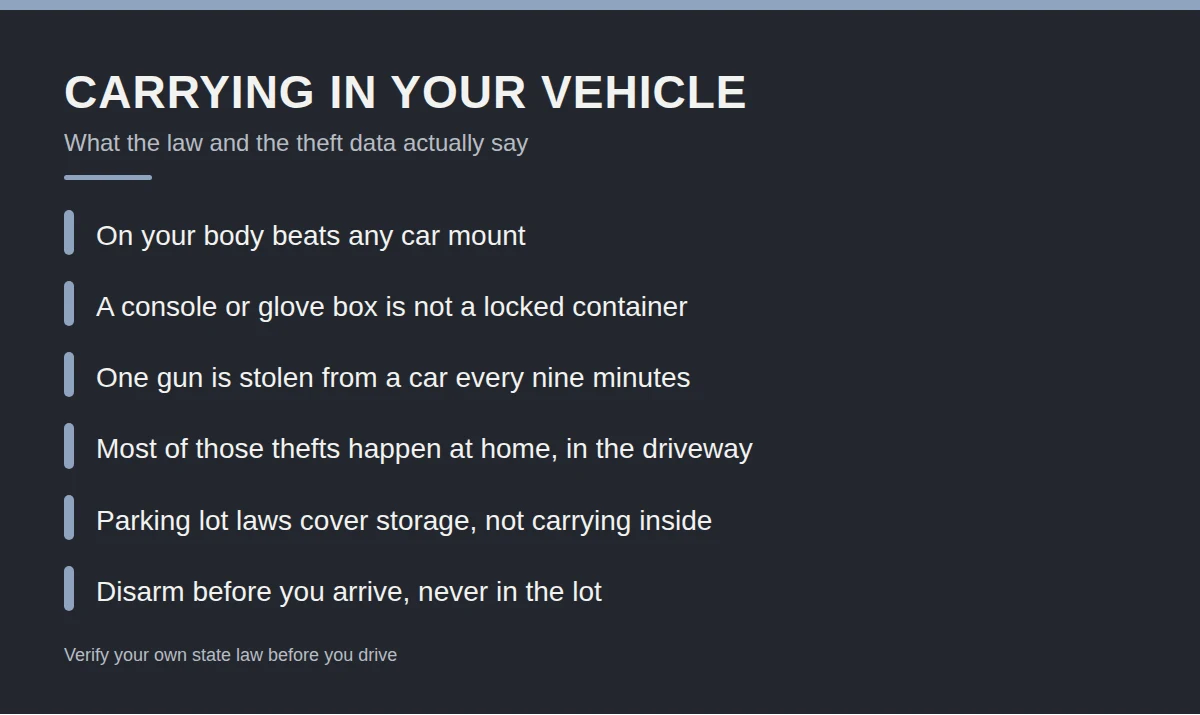
The default answer, in almost every case, is on your body.
Keeping the gun holstered on your person solves three problems at no cost. Legally it is the simplest arrangement possible, because the firearm stays concealed and covered by whatever your permit already authorizes. It walks out of the car with you, so there is no moment where you park, forget, and leave an unattended gun in a metal box on a public street. And there is no transfer step, which is the step where negligent discharges and misplaced guns happen.
The complication is that the seated draw is genuinely harder than the standing one, and most people never practice it. A seat belt runs diagonally across the exact real estate an appendix or strong-side holster occupies. Strong-side hip carry gets pinned between your body and the seat back, and the elbow the draw stroke needs hits the door panel.
Three fixes are worth the effort. Route the shoulder belt so it does not sit directly over the grip. Practice the draw from a seated position with an unloaded gun in your own car, since the geometry is car-specific and nothing on a range replicates it. And consider whether a different position earns its keep for long drives, which is a decision our holster guide works through in detail.
Vehicle mounts are the alternative most people ask about: a magnetic or clip mount under the steering column, on the console, or beneath the dash. They solve the access problem and create a worse one. A gun in a mount is an unattended gun the second you step out of the car, and a bare magnet provides no trigger coverage at all. If you use a mount, it should be a molded holster mount that fully covers the trigger guard, it should be invisible from outside the glass, and the gun should go back on your body every time you leave. A mount is a driving position, not a storage plan.
Why Console and Glovebox Carry Fails
It fails on all four axes at once, which is unusual for a habit this common. It usually fails legally, because those compartments are carved out of locked-container definitions by name. It fails on access, since working a latch and rummaging is slower than a practiced draw and often means leaning across the cabin. It fails on safety, because a gun rolling loose among registration papers and a tire gauge has nothing covering its trigger. And it fails on security, because the console is the first place a thief checks.
The habit is far from rare. A 2026 study in Injury Epidemiology, based on a YouGov survey of 1,856 firearm owners, found that about 26.8% leave a gun in a vehicle at least occasionally, which scales to roughly 21.8 million American adults, and 12.1% do it regularly. Asked where the gun goes, roughly 24% said the center console and 16.7% said the glove compartment. Only 19.7% named a dedicated lockbox or safe.
Every Nine Minutes
Everytown’s analysis of police data across 337 cities counted about 62,000 guns reported stolen from cars in 2022, which averages out to one gun every nine minutes. The rate roughly tripled over the preceding decade, from 21.0 thefts per 100,000 people in 2013 to 63.1 in 2022. A decade ago, cars accounted for about a quarter of all reported gun thefts. By 2022 they accounted for more than half, and the Council on Criminal Justice found the same crossover from a different direction: gun thefts from vehicles rose 31% over five years while gun thefts from home and business burglaries fell 40%.
The location data is the part that should change behavior. About 32% of these thefts happened in parking lots. Around 36% happened at residences, meaning the car in your own driveway, and roughly 20% happened on roads. The gun stolen from a car is usually stolen from a car parked at home overnight.
Four habits cover most of the risk. Do not leave a firearm in an unattended vehicle if you have any alternative. When you must, put it in a container that is bolted to the frame or cable-tethered to a seat mount rather than sitting loose, since a portable lockbox that is not anchored is simply a gift box with a handle. Keep it out of sight before you park, not after. And skip the manufacturer decal on the back glass, which functions as advertising.
Parking Lots, Posted Property, and Places the Gun Cannot Go
Roughly 29 states have some form of parking lot law, often called a “bring your gun to work” statute, which limits an employer’s ability to ban firearms stored in an employee’s own locked vehicle. States including Alabama, Arizona, Florida, Georgia, Indiana, Kentucky, Louisiana, Ohio, Oklahoma, Tennessee, Texas, and Utah expressly protect that storage. Alaska, California, Hawaii, and New York run the other direction and let employers prohibit it.
What these laws give you is narrower than the nickname suggests. They protect a lawfully possessed gun, locked in your personal vehicle, out of plain sight. They generally do not authorize carrying the gun across the lot, into the building, or into a company car, and several states let the employer require disclosure. Violating the policy can still cost you the job in ways the statute does not remedy.
Federal property is its own category and the parking lot is not automatically a safe harbor. Postal Service regulation 39 C.F.R. 232.1 bans firearms on USPS property, and the Tenth Circuit upheld that ban as applied to a post office parking lot in Bonidy v. USPS in 2015. Several district courts have since reached the opposite conclusion under the Bruen framework, so the question is genuinely unsettled and varies by circuit. Treat a federal facility lot as off limits until your own jurisdiction says otherwise.
For private businesses, whether the sign on the door reaches your car depends on the same state-by-state rules covered in our piece on whether no-guns signs carry the force of law.
Disarming Without Making It an Event
When the destination genuinely bars the gun, the transfer deserves a procedure.
Do it before you arrive, in your own driveway or a quiet spot, rather than in a busy lot where you are visible through the glass and rushed. Choose a lockbox that accepts the pistol still in its holster, which removes the handling step entirely and is the single best upgrade available. If you must unholster, keep the muzzle pointed at the floorboard, finger well clear of the trigger guard, and resist the urge to unload and reload as part of the ritual. Administrative handling in a car seat is where most vehicle negligent discharges live.
Lock the box, put it out of sight, and reverse the process the same deliberate way. Never make the glove box your storage answer, since that is the compartment you open in front of a police officer or hand to a valet.
What Long Drives Do to Your Gear
A gun that lives in a car takes abuse a range gun never sees. Sweat, heat cycling in a parked car in July, road grit, seat belt abrasion across the holster mouth, and lint packing into the muzzle and the striker channel all accumulate quietly, and belts stretch faster under a full day of seated pressure than most people expect.
Pull the gun down monthly, clean it, and function check it at the range rather than assuming. Rotate carry ammunition too, since repeated chambering of the same round sets the bullet back into the case. That is the same maintenance discipline described in our piece on firearm recalls and what your carry gun needs.
If You Get Pulled Over
About ten states plus the District of Columbia require a permit holder to proactively tell an officer they are armed during any official contact, Michigan, Nebraska, and Louisiana among them. Another large group requires disclosure only when asked, and roughly twenty states impose no legal duty at all. The list changes with nearly every legislative session, so verify your own state and any state on your route rather than trusting a memory of it.
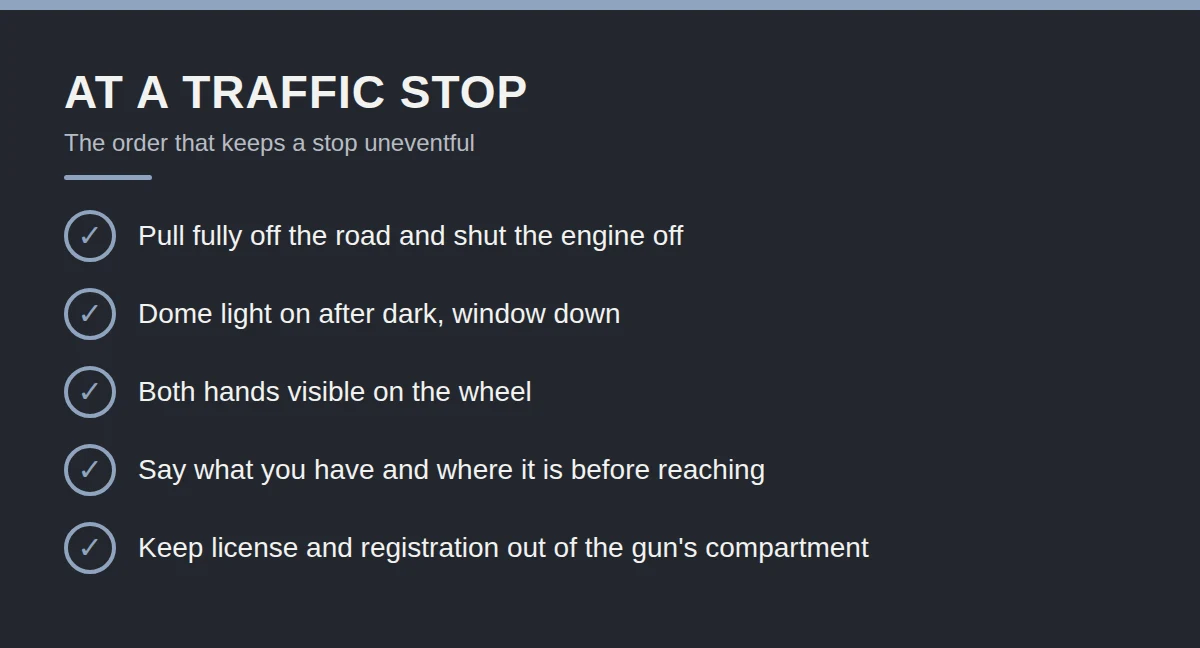
The mechanics matter more than the statute. Pull fully off the road, turn the engine off, put the dome light on after dark, roll the window down, and keep both hands visible on the wheel. Say what you have and where it is before you reach for anything, then follow instructions exactly. Keep your license and registration somewhere other than the compartment the gun is in, so no reach is ambiguous.
Defensive tactics from the driver’s seat, the carjacking scenario in particular, are a separate skill set with their own doctrine, and they deserve dedicated force-on-force training rather than a paragraph. What happens legally afterward is covered in the use of force primer.
The Bottom Line
Keep the gun on your body. That single decision resolves the legal question, the access question, and the theft question at once, and it costs nothing but the practice time to work out a seated draw in your own car. When the gun genuinely has to come off, it goes into an anchored locked container, out of sight, never a console or a glove box, and it goes there before you arrive rather than in the parking lot. Then read what your state actually says about loaded carry in a vehicle and about the container it demands, because that is the piece of law most carriers have never looked up and the piece a traffic stop will test. Anything specific to your circumstances belongs with a firearms attorney in your state rather than a forum thread.
Further reading (sources)
- Everytown Research on how parked cars became the largest single source of stolen guns
- Stateline reporting the shift from home burglaries to vehicle break-ins
- Council on Criminal Justice for five-year trend data on where stolen guns come from
- PsyPost summarizing survey findings on how many owners leave guns in vehicles
- California Attorney General sets out the unloaded and locked container transport rule
- Brightmine with a state-by-state breakdown of workplace parking lot statutes
- Justia reproduces the Tenth Circuit opinion upholding the postal parking lot ban
- handgunlaw.us maintains the current chart of duty-to-inform states