Flying With a Handgun: TSA Rules, Hard Cases, Ammunition, and Restrictive States
Published on September 12, 2026
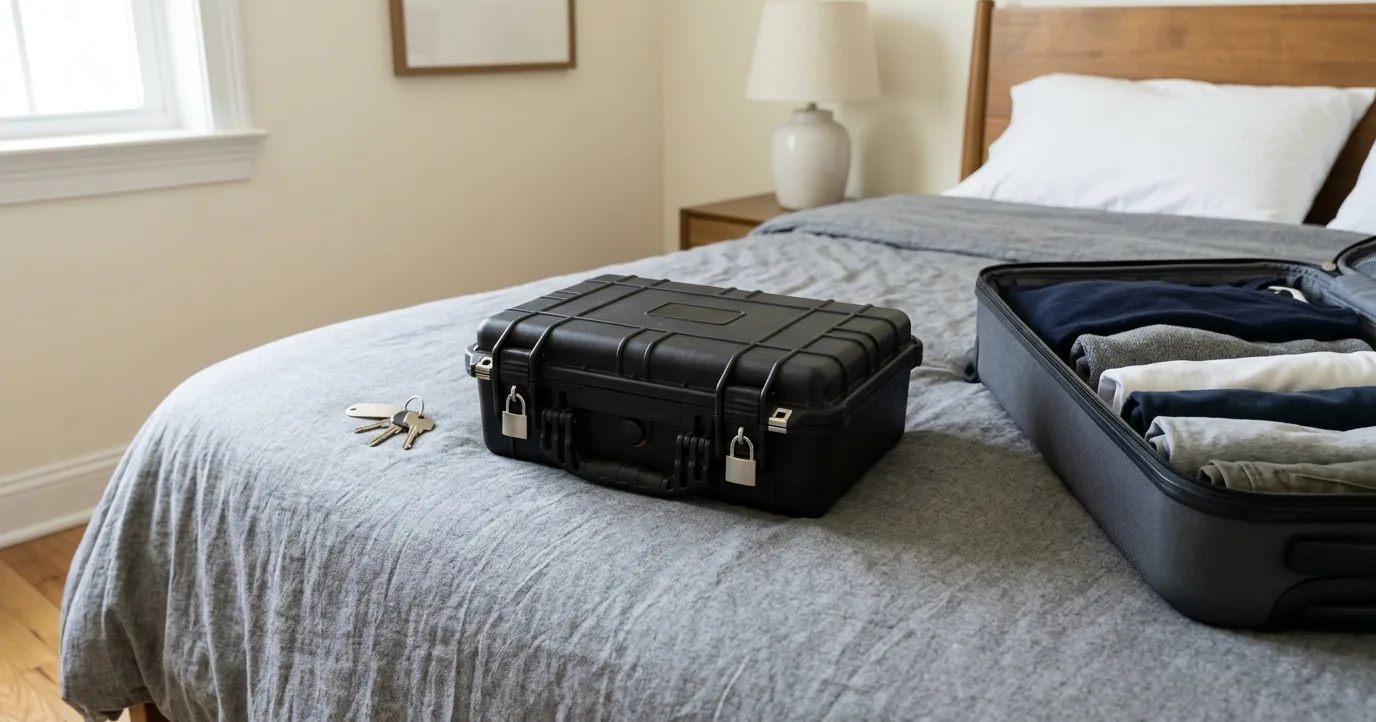
TSA officers pulled 6,678 firearms out of carry-on bags at airport checkpoints in 2024, an average of eighteen a day across 277 checkpoints, and about 94% of them were loaded. Almost none of those travelers were smugglers. They were carriers who packed in a hurry and forgot which bag the gun was in.
The irony is that flying with a handgun is entirely legal, federally standardized, and mostly boring. The gun goes in a checked bag, in a locked hard case, unloaded, and you say so at the counter. It adds about five minutes. What actually catches people out is never the rule they meant to follow. It is the lock they chose, the box the ammunition rode in, the connection they missed, and the state they landed in.
The Four Rules That Never Change
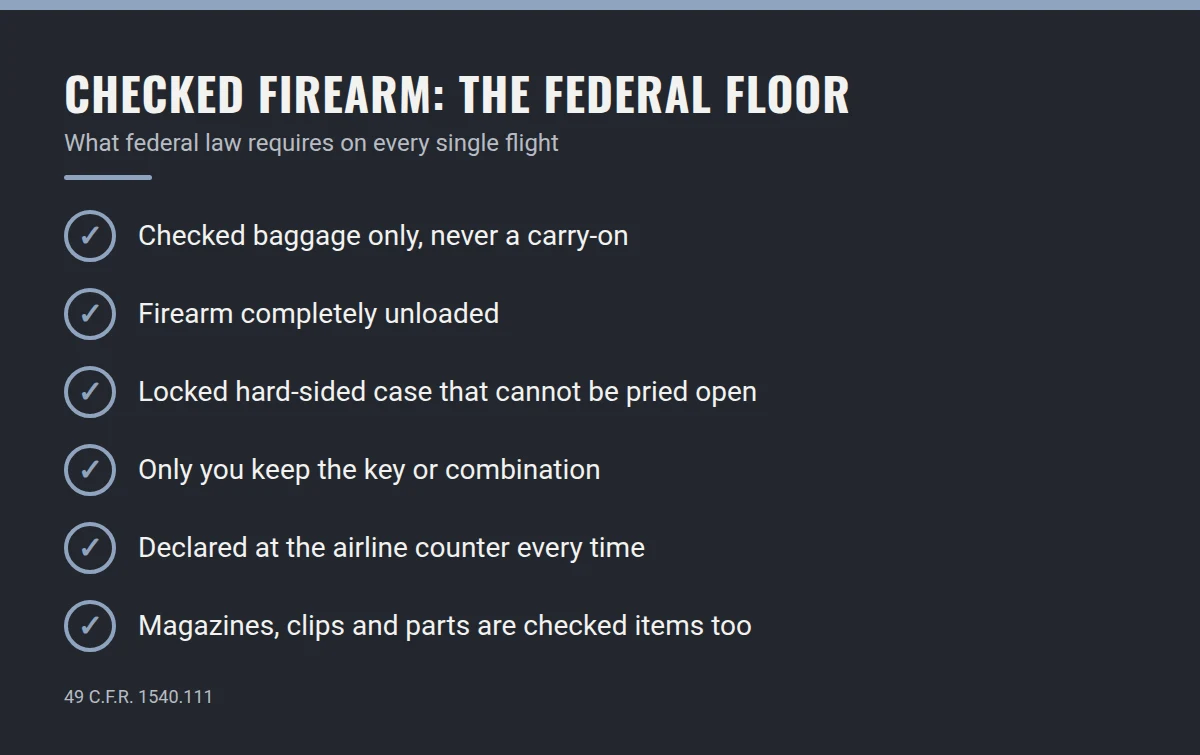
Federal law on this is short. Under 49 C.F.R. 1540.111, a firearm may travel as checked baggage only, and four conditions have to be true at once.
The firearm is unloaded. It is inside a locked, hard-sided container. Only you retain the key or combination. And you declare it to the airline at the ticket counter, every time you check it, on every itinerary.
There is no version of this involving a carry-on. Not in a backpack, not in a purse, not in a bag you fully intended to check at the gate. Firearm parts follow the gun: magazines, clips, bolts, and firing pins are all checked-baggage items, and so are replica firearms, including toys.
Your permit is irrelevant here. A concealed carry license from any state buys you nothing at a checkpoint, and the federal rules do not bend for a resident of the state you are flying out of. This is one of the few corners of carry law with no state-by-state asterisk, which is worth appreciating while it lasts.
What Counts as a Hard Case, and Why a TSA Lock Is the Wrong Lock
Hard-sided means what it sounds like, and TSA’s working standard is that the container must completely secure the firearm from access. Cases that can be pried apart at a corner while still locked do not qualify, and agents turn plenty of them away at the counter.
This is where the padded pistol sleeve fails. Soft padded cases, including the new padded pistol series Elite Survival Systems introduced in August 2026, are range and vehicle products. They keep a gun from getting scratched. They do not lock in a way that satisfies 1540.111. Buy a separate airport case with molded or metal-reinforced edges and at least two padlock holes, because a single center latch lets the lid flex.
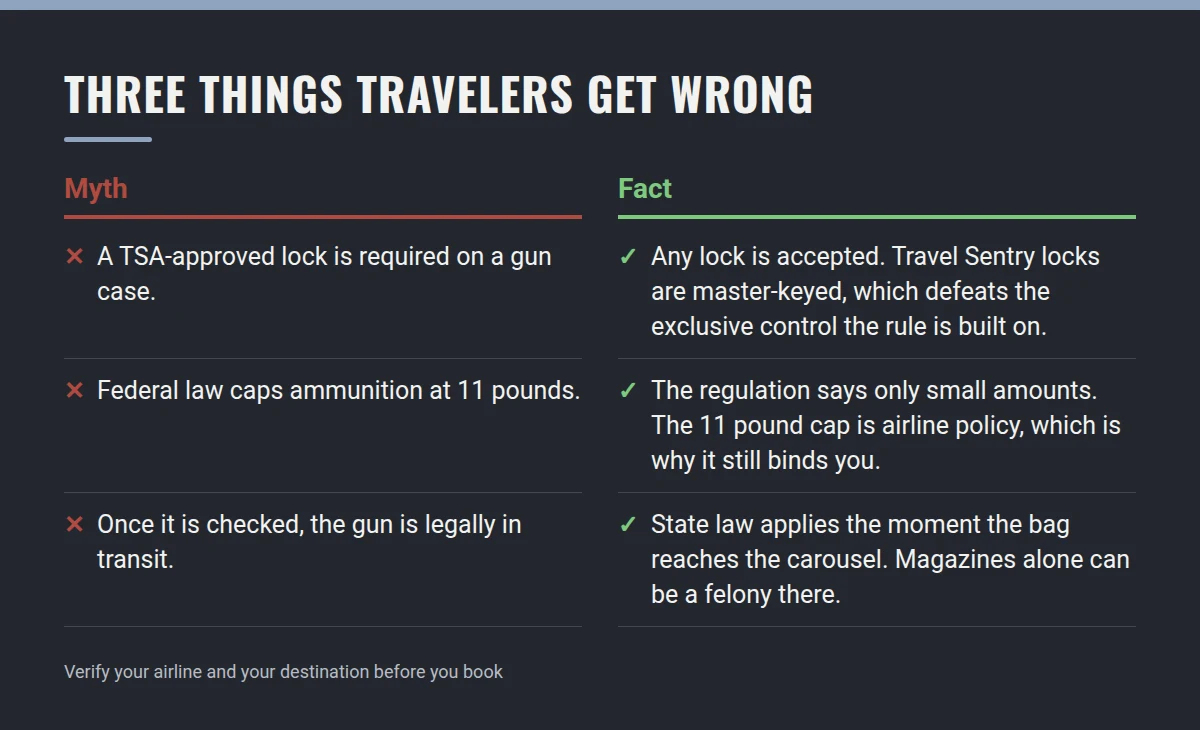
The lock is where people go wrong in the opposite direction. TSA-recognized Travel Sentry locks, the ones with the red diamond, are not banned. TSA’s own guidance says any brand or type of lock is acceptable. But permitted is not the same as correct. A Travel Sentry lock is master-keyed by design, and sets of those master keys have circulated online for years. The entire premise of the regulation is that only the passenger retains the key. Use ordinary non-TSA padlocks or a solid combination lock, and keep the keys in your pocket rather than in the bag they open.
The hard case can go inside an ordinary checked suitcase, and usually should, because a standalone gun case riding a belt advertises itself. Only the gun case has to be locked. The suitcase around it does not.
The Counter Is the Only Part With a Script
Arrive earlier than you otherwise would. Two hours for a domestic flight is not padding: the declaration adds a counter conversation, and at many airports it adds a walk to a separate TSA inspection station with the bag in tow.
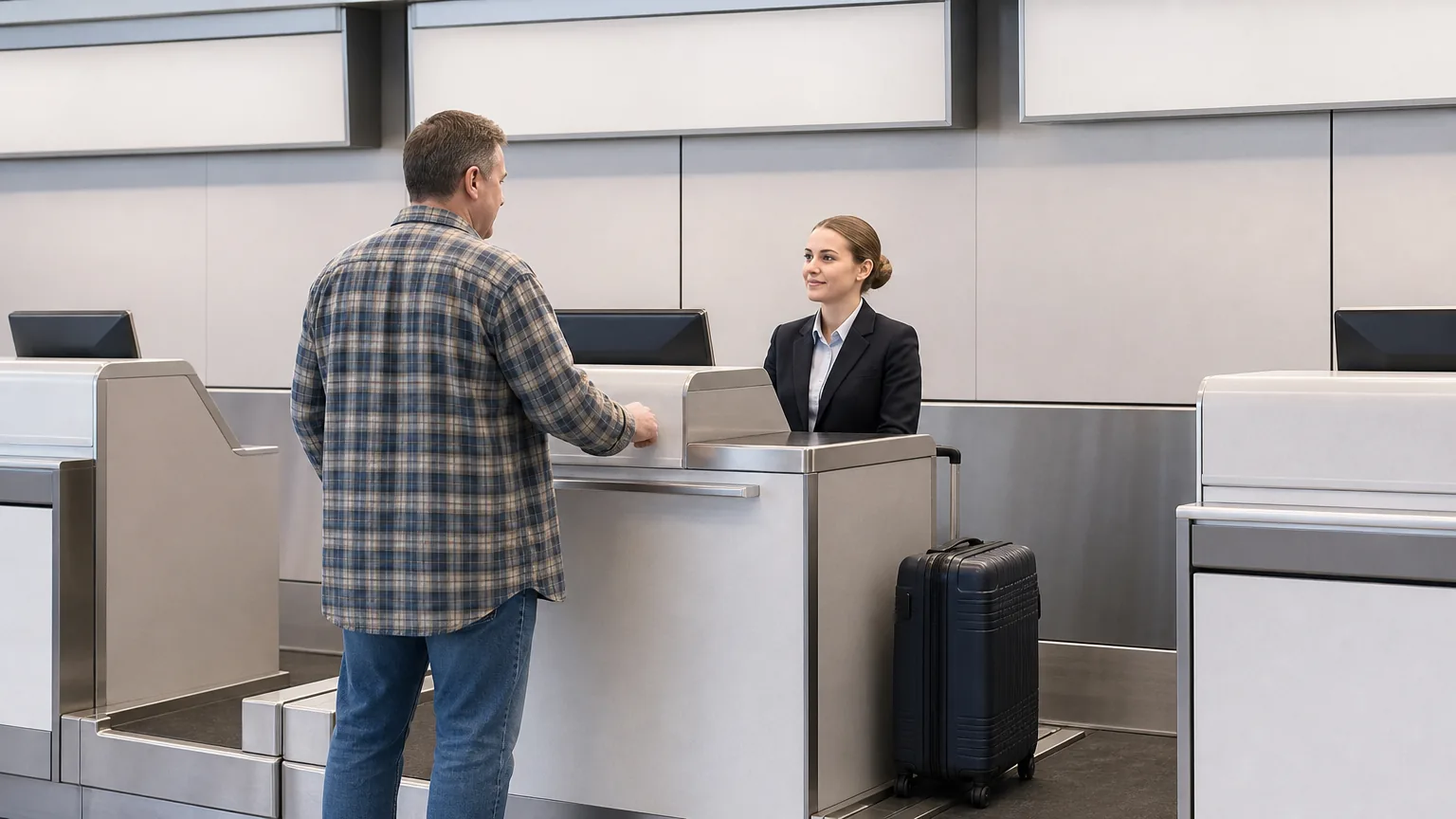
Tell the agent plainly and quietly that you have a firearm to declare in checked baggage. You are not obliged to announce it to the line behind you. The agent hands you a declaration tag or card to sign, and that signed tag goes inside the case with the gun, not dangling from the suitcase handle where it functions as a label for everyone downstream.
Then stay put. Do not leave until the bag has cleared screening or the agent releases you. If TSA needs the case opened, they need you to open it, and they will page you. If you have already walked to security, the bag does not fly, and you may get a phone call you did not want.
Ammunition: The Rule Is Vaguer Than You Think
Everyone quotes an eleven-pound limit. It is worth knowing where that number comes from, because it is not in the federal regulation.
49 C.F.R. 175.10(a)(8) permits small arms ammunition for personal use in checked baggage if it is “securely packed in boxes or other packagings specifically designed to carry small amounts of ammunition.” Small amounts. No pounds, no round count. The 11 pounds (5 kg) figure is the international air transport standard, and essentially every major U.S. carrier has adopted it as policy. Delta, American, and United all cap ammunition at 11 pounds per passenger. The number binds you because your airline says so, not because the government does.
Packaging is the part that gets enforced. Ammunition belongs in a fiber, wood, plastic, or metal box designed to carry ammunition, and original factory boxes are the safest possible answer. Loose rounds rolling around a suitcase are a violation every single time, and a common one.
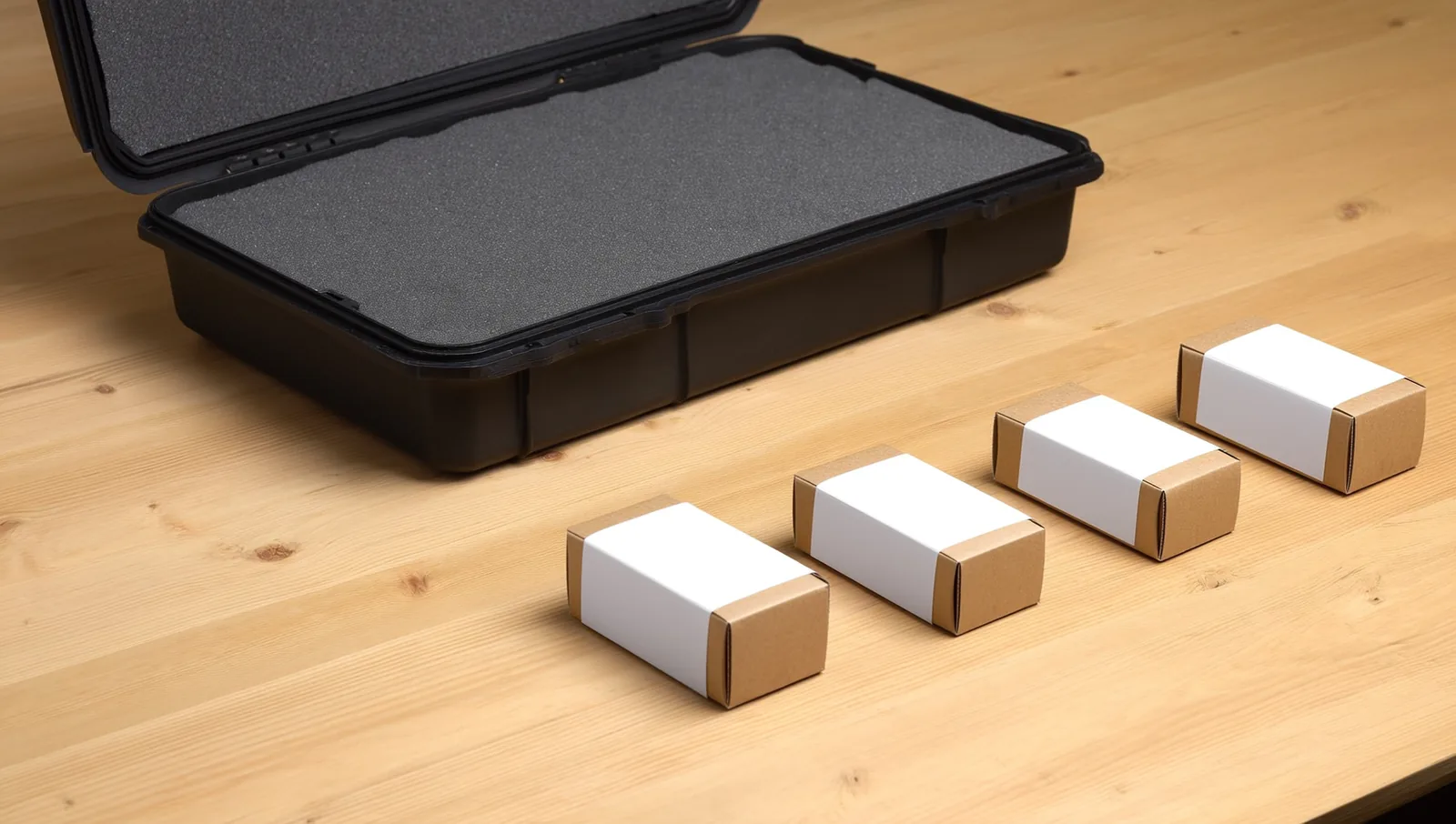
Magazines get their own line. TSA’s rule is that magazines and ammunition clips, loaded or empty, must be securely boxed or inside the hard case containing the unloaded firearm. A loaded magazine does not count as ammunition packaging unless it completely encloses the rounds, and most magazines do not. The clean version, which never causes an argument: unload the magazines, put the rounds back in their factory box, and put the empty magazines in the gun case.
Ammunition may ride in the same locked case as the firearm, and that is how most travelers do it. A few airlines say otherwise. Check yours.
Your Airline Builds on Top of the Federal Floor
The federal rules are a floor, not a ceiling, and carrier policy is real policy with real consequences at the counter.
United caps a single case at five firearms. American requires ammunition in original packaging or a purpose-built container and refuses loose rounds and loaded magazines outright. Various carriers impose weight or dimension limits on the case, count it against your checked allowance, or charge an oversize fee for anything rifle-length. A few decline firearms on particular routes altogether, which becomes important when your itinerary is sold by one airline and flown by another.
Read your airline’s firearms page within a week of flying, and if you booked a code-share, read the operating carrier’s page as well. These policies change quietly, and the version the counter agent is working from is the one that governs your bag.
The Connection That Turns a Trip Into a Case
This is the part most guides skip, and it is the part that ruins people.
The Firearm Owners Protection Act at 18 U.S.C. 926A protects you while transporting a lawfully owned firearm from a place you may legally have it to another such place, so long as it stays unloaded and inaccessible along the way. Every traveling carrier has heard of it. It is considerably thinner than its reputation.
Gregg Revell found that out in 2005. He flew from Salt Lake City toward Allentown, Pennsylvania, missed his connection at Newark, retrieved his checked bag containing a locked, unloaded pistol, and spent the night at an airport hotel. New Jersey charged him. In 2010 the Third Circuit held that once the gun spent a night in his hotel room it was no longer inaccessible and the journey was no longer continuous transportation, so section 926A gave him no protection at all.
Two things follow. First, in New York and New Jersey especially, 926A operates as an affirmative defense rather than immunity from arrest. You can be arrested, the firearm can be seized, and you raise the statute later in a courtroom, after the lawyer and the bail.
Second, this may be changing. On May 6, 2026, ATF published a notice of proposed rulemaking titled “Clarifying Interstate Transportation of Firearms Under the Gun Control Act,” which would rewrite the regulation implementing 926A to cover activities incidental to travel: overnight lodging, meals, fuel, vehicle maintenance, emergencies, medical treatment, and transiting between modes of transportation. ATF cited Revell by name in the proposal. It is a proposed rule and not yet law, so until it is finalized, Revell is still the rule that governs your missed connection.
Until then, protect yourself with routing rather than with statutes. Prefer nonstops into restrictive destinations, and avoid connecting through hostile states when a reasonable alternative exists. If you are stranded overnight with a checked gun somewhere unfriendly, do not collect the bag and take it to a hotel. Ask the airline to hold it in the system and rebook you onward.
Landing Somewhere the Gun Is Illegal
The checkpoint is not what ends careers. Landing is.
Once the bag comes off the belt you are subject to state law, and its checked-baggage status stops meaning anything. A handgun that is unremarkable in Arizona can be contraband at baggage claim, and so can pieces of it.
New Jersey is the sharpest example. Magazines holding more than ten rounds are prohibited, and hollow point ammunition is restricted outside narrow exemptions. The magazines in your case are a violation on their own, independent of the gun they belong to. New York’s capacity limit is also ten rounds, and New York City layers its own licensing regime on top of state law. Massachusetts, California, Illinois, and the District of Columbia each run their own mix of capacity limits, roster restrictions, ammunition rules, and possession licensing.
Hawaii deserves its own warning because the requirement is affirmative rather than prohibitive. Under HRS 134-3, any person arriving in the state who brings in a firearm must register it and physically present it for inspection to the county chief of police within five days of arrival, and be fingerprinted and photographed in the process. Land in Honolulu, put the case in the closet, and do nothing, and you are out of compliance on day six without having touched the gun.
Three questions before you book, then: are my magazines legal at the destination, is my ammunition legal at the destination, and does the destination require me to do something on arrival. Whether you can actually carry once you get there is a separate question that belongs to reciprocity, and our state travel atlas works through which permits are honored where. The federal firearms law reference covers 926A and the rest of the federal overlay in more depth.
Baggage Claim, the Rental Car, and the Rest of the Trip
At most airports a declared firearm rides the normal carousel with everything else. At some it is routed to the airline’s baggage service office and you produce ID to collect it. Ask at check-in which applies at your destination, because half an hour at an empty carousel wondering where the gun went is a bad half hour.
If the bag does not arrive at all, report it in person before you leave the airport and get the report number. Say explicitly that it contains a declared firearm. A missing gun is a police report as well as a lost luggage claim, and the clock on both starts at the counter.
After that the ordinary ground rules resume. How the gun rides in a rental car raises the same questions as any other drive, covered in our guide to carrying a gun in your vehicle, with the added wrinkle that many rental agreements contain firearm clauses of their own. If you do carry at the destination, the federal 1,000-foot school zone rule travels with you, and the license exception inside it only works when the state you are standing in issued the license.
If Something Goes Wrong
The penalties for getting this wrong are published rather than mysterious. TSA’s civil enforcement schedule sets $1,500 to $6,130 plus a criminal referral for an unloaded firearm at a checkpoint, and $3,000 to $12,210 plus a criminal referral for a loaded one, rising to $12,210 to $17,062 for a repeat violation. Expedited screening goes away for a period TSA decides case by case. Local police make the arrest decision separately, and in some jurisdictions that decision is effectively automatic.
If you end up in that conversation, be polite, confirm the firearm is yours, and say nothing further about the circumstances. That is a moment for a firearms attorney licensed in the state you are standing in, not for explaining yourself on a concourse. Whether your self-defense legal coverage plan reaches a transport charge rather than a defensive shooting is worth reading in your own policy before you fly, not after.
The Bottom Line
Flying with a handgun is a procedure, and procedures reward being boring. Unloaded, hard case, non-TSA lock, keys in your pocket, factory ammunition boxes, empty magazines, declared at the counter, and you stay until the bag clears. That is the whole federal part and it is genuinely simple.
The judgment lives in the itinerary. Look at every state your bag will touch, not just the one on your ticket, and look hardest at the one you land in, because magazines and ammunition can be illegal there even while sitting locked inside a case you never opened. Route around the states that treat safe passage as a defense rather than a right, keep the gun in the airline’s custody if a delay strands you somewhere unfriendly, and take anything genuinely uncertain to a firearms attorney in that state rather than to a forum thread at midnight in an airport hotel.
Further reading (sources)
- Transportation Security Administration on how firearms and ammunition must be packed and declared
- TSA publishes the civil penalty ranges for a gun found at a checkpoint
- eCFR for the small arms ammunition exception for passengers
- eCFR with the checked-baggage firearm rule and its locked container language
- Third Circuit issued the opinion that left an overnight hotel stay outside FOPA
- The Reload covering ATF’s move to extend safe passage to travel interruptions
- Hawaii State Legislature sets out the five-day arrival registration requirement
- The Outdoor Wire announced a new padded pistol case line built for range and vehicle use