A Court Struck Down New Jersey's Magazine Ban and It Is Still Illegal: How Stays and Appeals Trap Carriers
Published on September 18, 2026

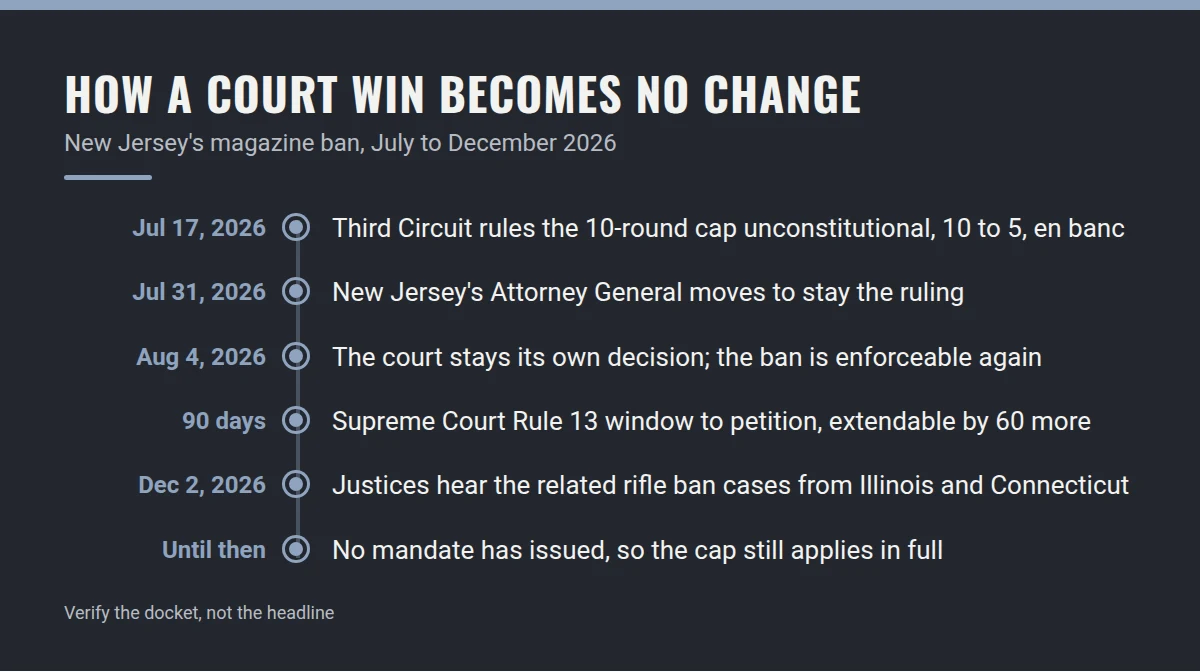
On July 17, 2026, the full Third Circuit held that New Jersey’s ban on magazines holding more than ten rounds violates the Second Amendment. Eighteen days later the same court put its own ruling on hold, and the ban went right back to being enforced. If you drove into New Jersey in August with a fifteen-round magazine in your console because a court had said the cap was unconstitutional, you committed a crime. The ruling was real. The relief was not, at least not yet.
This is one of the most dangerous gaps in how carriers consume gun-law news. A decision gets reported the day it lands, the procedural machinery that decides when it actually binds anyone runs for months afterward, and almost nobody covers that part. Here is what happened in New Jersey, how to read the next one of these without guessing, and the practical drill for magazines before you cross a state line. As always, this is general information and not legal advice, and New Jersey in particular is a state where a wrong guess ends in handcuffs.
What the Third Circuit Actually Held
The case is Association of New Jersey Rifle and Pistol Clubs v. Attorney General New Jersey, three consolidated appeals docketed as Nos. 24-2415, 24-2450, and 24-2506. The Third Circuit heard it en banc, meaning the full court of fifteen judges sat rather than the usual panel of three, and it decided the case 10 to 5 on July 17, 2026. Judge Freeman wrote the opinion of the court. With the concurrences and dissents stacked on, the full package runs about 192 pages.
New Jersey’s statutes draw two separate lines. The “assault firearm” provisions at N.J.S.A. 2C:39-1(w) criminalize possession of a list of named models and of guns with certain features, punishable by up to ten years. The magazine provisions define a “large capacity ammunition magazine” at 2C:39-1(y) and restrict possession at 2C:39-3(j). That cap sat at fifteen rounds until a 2018 amendment dropped it to ten, which turned a great many ordinary factory magazines into contraband overnight.
The court struck down both sets of provisions. Its reasoning followed the framework the Supreme Court laid out in New York State Rifle & Pistol Association v. Bruen: the Second Amendment covers arms in common use for lawful purposes, and a state defending a ban has to point to a historical tradition that matches. The district court had found roughly 24 million AR-15-style rifles in circulation nationwide, and New Jersey offered no competing data. Standard magazines over ten rounds got the same treatment.
That is a substantial win for the challengers. It also changed nothing on the ground.
Then the Court Stayed Its Own Ruling
On July 31, the New Jersey Attorney General asked the Third Circuit to hold the decision while the state petitions the Supreme Court. On August 4, 2026, the court granted the stay. The bans remain enforceable until the Supreme Court acts.
Two rules explain the whole thing. Under Federal Rule of Appellate Procedure 41, a court of appeals decision does not bind anyone the moment it is announced. What does the work is the mandate, the certified order that actually sends the judgment down and fixes the parties’ obligations, and it issues seven days after the window for rehearing petitions closes. A party heading to the Supreme Court can move to stay that mandate, and a granted stay runs up to 90 days, extending automatically if the party tells the clerk it filed a petition or got its deadline pushed.
The second rule sets the clock. Supreme Court Rule 13 gives a losing party 90 days from the judgment to petition for certiorari, and a Justice may extend that by up to 60 days for good cause on an application filed at least ten days out. Stack those together and a state that loses in July can keep a struck-down law enforceable through the following spring without doing anything unusual, purely by using the deadlines the rules already hand it.
None of that is a loophole. It is the ordinary way appellate courts avoid whipsawing people between legal and illegal while a case is still moving. But it means the sentence “a federal court struck down the ban” and the sentence “you may now possess the magazine” are separated by a gap that is frequently measured in seasons.
How to Read a Gun-Law Ruling Without Getting Arrested
When the next decision lands, run these six questions before you change a single habit.
Which court, and does it reach you? A federal district judge binds the parties in that case and, depending on the relief entered, sometimes a whole state. A circuit court binds only the states inside its circuit. The Third Circuit covers New Jersey, Pennsylvania, Delaware, and the Virgin Islands, and nowhere else. A win in the Third does not legalize anything in New York.
Panel or en banc? A three-judge panel can be reheard by the full court, which sometimes reverses the result outright. A ruling that a state has asked the full circuit to rehear is a weak foundation for your travel plans.
Has the mandate issued, and is there a stay? This is the question that matters most and the one coverage almost always skips. Until the mandate issues, the lower court’s judgment is what governs. A stay pending certiorari freezes everything.
Preliminary or final? Much of the reporting on gun cases describes preliminary injunctions, which are provisional by design and phrased around whether a law “likely” violates the Constitution. That is not a final judgment, and it can evaporate.
Who is actually covered by the relief? Some injunctions protect only the named plaintiffs or the members of the organization that sued. Others run statewide. Reading “the ban was enjoined” as “the ban is gone for everyone” is a mistake people make in both directions.
Whose date are you reading? The docket and the press release rarely agree. Handgunlaw.us, one of the more careful trackers, logged the New Jersey ruling on August 1 and the stay on August 5. The court’s own dates were July 17 and August 4. Neither party was wrong; trackers post when they verify. If you are counting days on a 90-day clock, count from the docket.
The same discipline applies to Supreme Court wins. When the Court struck down Hawaii’s private property carry rule earlier this year, the coverage badly outran the holding, which is why we walked through what that Hawaii decision did and did not change rather than the headline version.
Which States Cap Magazine Capacity
Sixteen jurisdictions have magazine capacity restrictions on the books, and the details differ enough that a single number per state is misleading.
Ten rounds is the most common cap: California, Connecticut, the District of Columbia, Hawaii for handgun magazines, Maryland, Massachusetts, New Jersey, New York, Rhode Island, and Washington. Colorado sets its line at fifteen, Delaware at seventeen. Illinois and Vermont split the difference by firearm type, allowing fifteen rounds in a handgun magazine and ten in a rifle magazine.
The distinction that actually decides whether you get arrested is not the number. It is whether the statute reaches possession or only sale and transfer. Maryland, Washington, and Colorado restrict the commercial side, so a magazine you already own is a different legal question there than the same magazine in New Jersey or New York, where possession itself is the offense. Grandfather clauses cut the same way: Connecticut, Illinois, Massachusetts, and Vermont protect magazines owned before a stated date, and none of that protection travels with you across a border. Your lawfully grandfathered Illinois magazine is just a magazine when you reach New Jersey.
Two of those sixteen are frozen right now, and both are worth watching. Virginia’s fifteen-round restriction covers sales and transfers rather than possession, and was set to start on July 1, 2026 before a state circuit judge preliminarily enjoined it. That injunction has no end date attached. It runs until the Supreme Court rules on the Illinois and Connecticut cases, at which point the parties have thirty days to report back on what those decisions mean for Virginia. Oregon’s Measure 114 would impose a ten-round cap. The state Court of Appeals reinstated it as constitutional on March 12, 2025, but that ruling did not switch the law on, because challengers had a window to seek further review, and four years after voters approved it the measure still has not taken effect.
Because those statuses move, treat any list, including this one, as a starting point rather than an answer. Verify each state on your route the week you travel, the same way you verify permit recognition in our state travel atlas.
Why Federal Safe Passage Will Not Save Your Magazines
Carriers often assume the Firearm Owners Protection Act covers this. It does not, and the reason is textual. 18 U.S.C. 926A protects the transport of an unloaded firearm between two places where you may lawfully possess it, with the gun and ammunition kept out of reach of the passenger compartment. It never mentions magazines. A separate magazine is not a firearm, so a capacity charge sits outside the shield entirely.
Worse, 926A functions as a defense you raise in court, not a card you show at the roadside. New York and New Jersey have long treated it that way. You can be arrested, your guns can be seized and held as evidence, and you can still win eventually and be out a year and a large legal bill. Our federal firearms law reference covers how narrow 926A really is, and the vehicle carry guide covers the locked-container mechanics it does require.
The Pre-Trip Magazine Drill
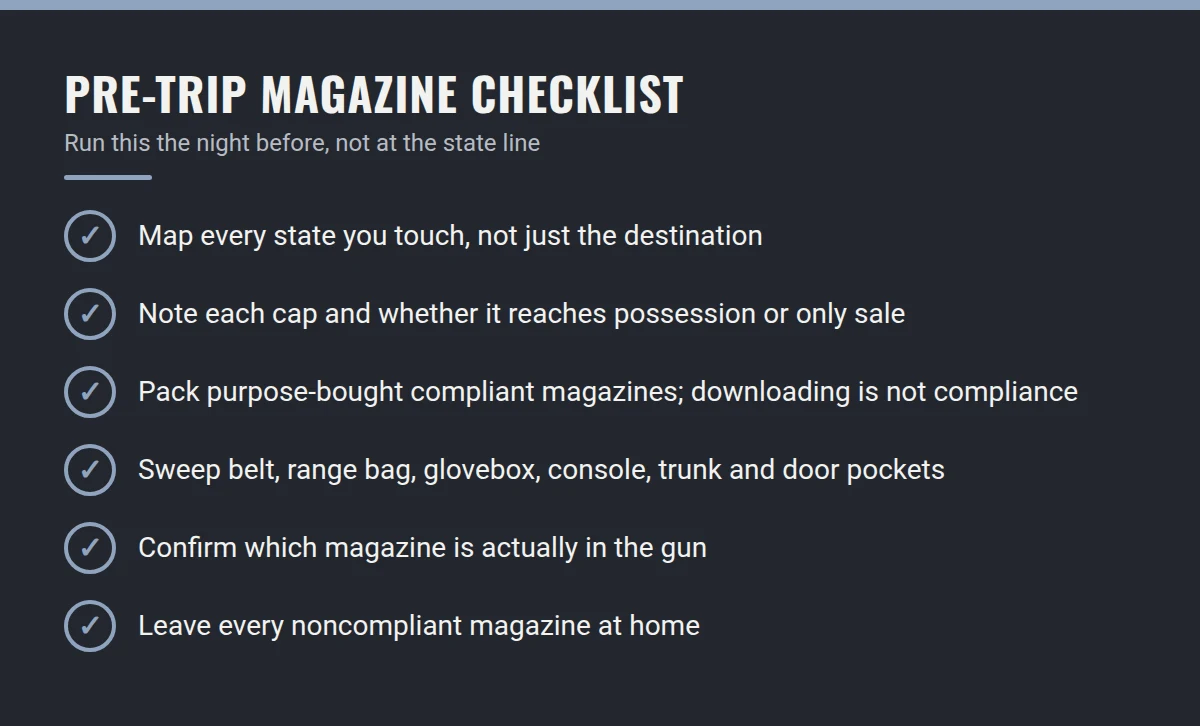
Do this the night before, not at the state line.
Map the route, not the destination. Every state you touch governs you while you are inside it, including the one you only cut across for forty minutes.
Look up the cap and the verb. Write down the round limit and whether the statute reaches possession or only sale. Those are two different trips.
Understand that downloading is not compliance. This is the error that catches careful people. Nearly every capacity statute is written around what a magazine is capable of holding, not how many rounds you put in it. Loading ten rounds into a fifteen-round magazine leaves you holding a fifteen-round magazine. What can work, where a state allows it, is a permanent modification that physically limits capacity, or simply carrying purpose-bought ten-round magazines. Buy a set of compliant magazines for the trip and leave the others home.
Sweep the whole vehicle. Count what is on your belt, in the spare carrier, in the range bag, the glovebox, the console, the trunk, the door pockets, and the bottom of the bag you have not emptied since your last range day. A forgotten magazine under a seat is a depressingly common version of this arrest.

Check the gun itself. Some pistols ship with a flush ten-round magazine and an extended fifteen. Know which one is in the gun and which one is in your pocket.
Plan the permit picture too. Capacity is one layer. Recognition is another, and if you travel a regular route it is worth reading our breakdown of non-resident permits and whether stacking them helps before you rely on a single license.
What Happens Next
New Jersey’s petition goes to a Court that has already taken up the underlying question. On June 30, 2026, the justices granted certiorari in Viramontes v. Cook County, No. 25-238, consolidated with Grant v. Higgins, No. 25-566, challenging rifle bans in Cook County, Illinois and in Connecticut. Oral argument is set for December 2, 2026.
Read the question presented carefully, because it asks whether the Second Amendment protects possession of AR-15s and similar semiautomatic rifles. That is a rifle question. Magazine capacity caps are a closely related fight, and a broad opinion would put pressure on them, but a decision written about rifles does not automatically strike down a ten-round limit in a state that never banned a rifle. Expect the magazine question to take at least one more trip through the courts after that.
The Bottom Line
The New Jersey ruling is significant and may well hold up. It is also, as of today, stayed, which means the assault firearm provisions and the ten-round cap are both fully enforceable in New Jersey and will stay that way until the Supreme Court disposes of the state’s petition. Nothing about your magazines changed on July 17, and nothing changed on August 4 either.
The habit worth building is small. When a ruling lands, find out whether the mandate issued before you find out how you feel about it. Then check the capacity cap of every state on your route, count your magazines, and leave the noncompliant ones at home. A press release has never been a defense.
Further reading (sources)
- U.S. Court of Appeals for the Third Circuit for the en banc opinion striking the assault firearm and magazine provisions
- JURIST on the 10 to 5 vote and how the ruling deepened the circuit split
- NRA-ILA with the August 4 stay order and what it means for residents
- Legal Information Institute on when a court of appeals mandate issues and how it is stayed
- Legal Information Institute for the text of the federal safe passage statute
- Supreme Court of the United States for the 90-day certiorari deadline in Rule 13
- Giffords Law Center with a state-by-state survey of magazine capacity restrictions
- Handgunlaw.us for the running log of state law changes and when they were verified
- VPM News on the injunction that put Virginia’s fifteen-round limit on hold
- Oregon Department of Justice for the appeals ruling that reinstated Measure 114 without switching it on