Getting a New York Concealed Carry Permit in 2026: The 16-Hour Course, NYC's Surge, and the Non-Resident Path
Published on September 23, 2026

Until 2022, a New York City carry license was something business owners, politicians, and celebrities held. Now accountants, teachers, and transit workers are lining up for one. After the Supreme Court’s 2022 Bruen decision struck down the state’s old “proper cause” test, the number of carry applications the NYPD receives each month rose nearly tenfold, according to an analysis of department data by THE CITY and The Trace. By October 2025 more than 17,000 city residents had been approved since the law changed, and over 8,000 more applications were waiting. In 2011, fewer than 4,000 New Yorkers held a permit.
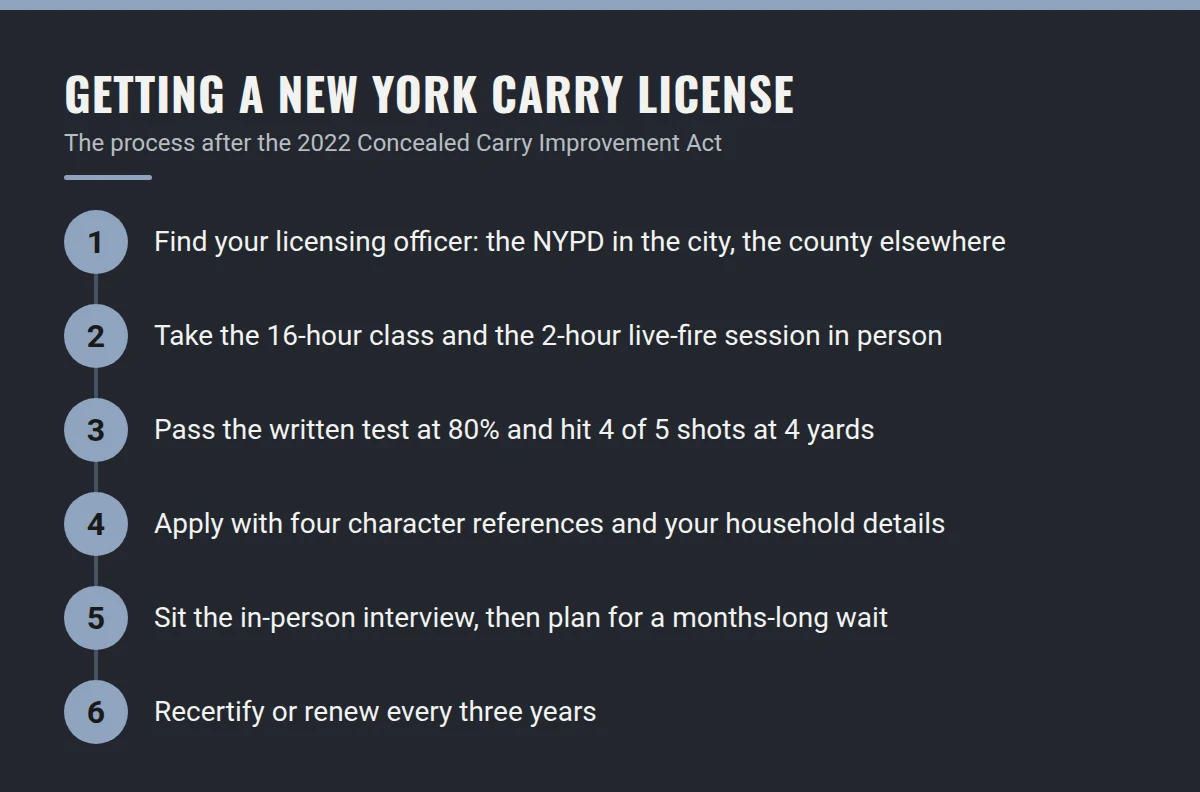
Shall-issue did not mean simple. New York answered Bruen with the Concealed Carry Improvement Act, which took effect on September 1, 2022, and built one of the most demanding permit processes in the country: 18 hours of mandatory training, an in-person interview, four character references, a list of forbidden places that runs to twenty categories, and a three-year clock. And as of early 2026, the door is open to people who neither live nor work in the state. This guide walks through each step for New Yorkers and for non-residents weighing a New York license.
Two Systems: New York City and Everywhere Else
New York has no single licensing office. You apply to the licensing officer where you live or work: the NYPD License Division in the five boroughs, the police commissioner in Nassau County, the sheriff or the police commissioner in Suffolk depending on the town, and a county judge almost everywhere else, with a local pistol permit office handling the paperwork.
Where you apply decides more than the forms. A license issued anywhere outside New York City is valid across the state except in the five boroughs, where you need a separate special carry license from the NYPD. A federal appeals court rejected a challenge to that two-tier arrangement in September 2025 in Frey v. City of New York. A license issued by the NYPD, by contrast, is good statewide.
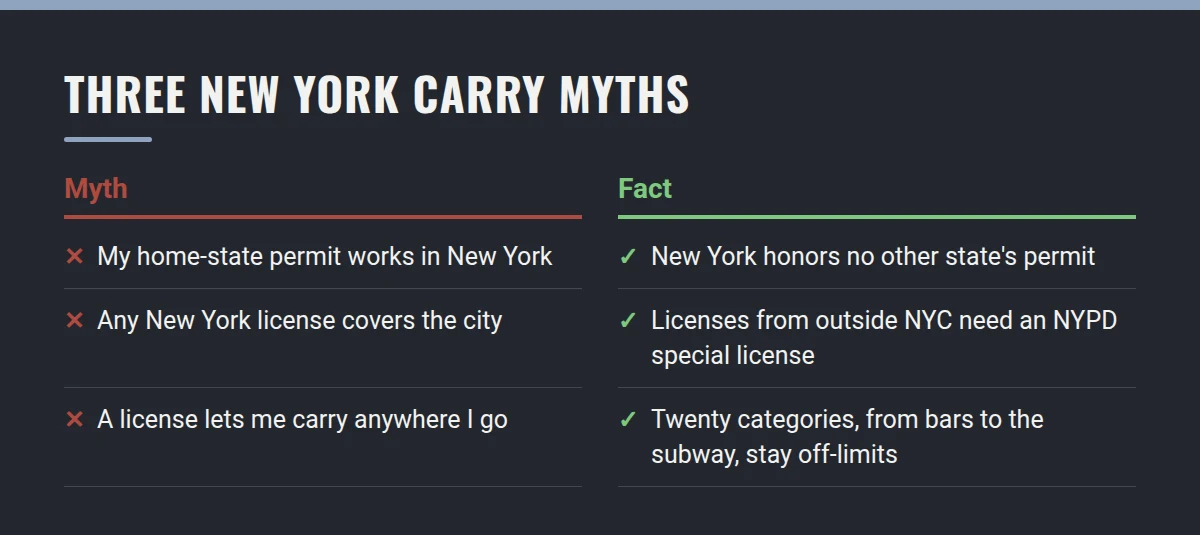
New York also honors no other state’s carry permit. A Pennsylvania, Florida, or Utah license means nothing here, which is why the non-resident change described below matters so much to visitors.
The 16-Hour Course and the Live-Fire Test
Every new carry applicant must finish an in-person course taught by a “duly authorized instructor”: at least 16 hours of live classroom instruction plus a two-hour live-fire session. Online courses do not count. The State Police and the Division of Criminal Justice Services set minimum standards for the classroom, with floor times on some blocks:
- General firearm safety, including holsters and retention (2 hours minimum)
- Safe storage law and best practices (1 hour minimum)
- State and federal gun law, including registration and recertification duties (2 hours minimum)
- Basic marksmanship (1 hour minimum)
- Situational awareness, de-escalation, conflict management, alcohol and drugs, and how to handle a police encounter
- The sensitive and restricted locations covered below
- Use of deadly force, including New York’s duty to retreat
- Suicide prevention, including the 988 crisis line
You must score at least 80 percent on a written test. Then comes the live-fire assessment, which is short and very specific. You show the gun is unloaded, draw it from concealment with no ammunition, acquire a target, and reholster. You then load five rounds and, standing four yards away, fire all five at a paper target 25.5 by 11 inches. Four of the five must hit. Instructors may run the assessment with marking cartridges instead of live ammunition.
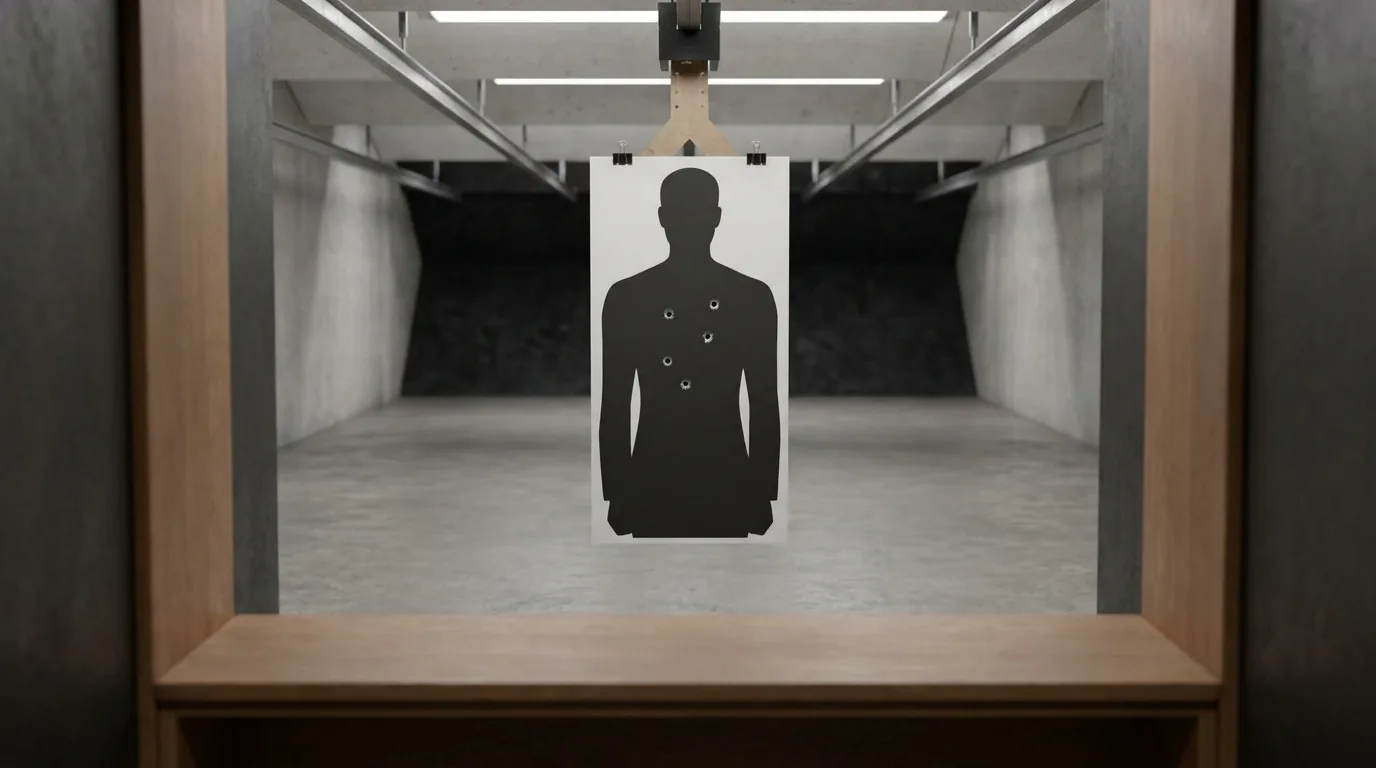
That bar is low. One New York City instructor, quoted by The Trace, put it bluntly: “A blind person can pass this.” Treat it as the floor it is, not proof you can shoot well under stress.
When you pass, the instructor issues a certificate in your name, affirmed under penalty of perjury, and keeps your test records for five years. Veterans and retired police are not automatically exempt, though licensing officers may credit service training that exceeds the state standard. In New York City, the certificate can be no more than six months old when you submit your application, so do not take the class a year before your paperwork is ready.
How to Vet a Class When the State Does Not
New York sets the topics and the minimum hours but does not write the curriculum or approve individual classes; any course that meets the standards is deemed approved. The result, The Trace reported in November 2025, is a growing market run largely by gun enthusiasts. The legal definition of an authorized instructor is broad: commissioned military officers, anyone certified to teach small arms by the military, the state, or the National Rifle Association, and state hunter education and 4-H shooting sports instructors all qualify. One busy city instructor profiled by The Trace charged about $700 for the full package, gave an open-note multiple-choice exam, and covered the mandated suicide prevention block in about ten minutes.
Before you pay, ask:
- Which credential makes you an authorized instructor? You want a specific certification, not “I have taught for years.”
- What does the price include? Range fees, ammunition, a rental gun, and a holster can each be extra.
- Where is the live fire? The class The Trace followed finished at a range on Long Island, which meant a second weekend and a drive.
- Will I draw from concealment? The assessment requires it, so practice with the holster and cover garment you will actually wear.
- How much time goes to use of force, de-escalation, and suicide prevention? These blocks carry no minimum hours, so a rushed class trims them first. New York generally requires you to retreat before using deadly force outside your home if you can do so in complete safety; a good instructor can explain what that means, and why defending a stranger is riskier than defending yourself. Suicide prevention is not filler either: handgun access is strongly linked to suicide risk, the concern behind the firearm questions clinicians now ask.
- Will the certificate show my full legal name? A mismatch with your application is an avoidable delay.
The Application and the Interview
Your application goes to the licensing officer with the course certificate and fingerprints. In the city it is filed online through the NYPD portal, with a $340 application fee plus a fingerprint fee of just under $90. For a carry license, state law requires:
- Good moral character, which the statute defines as “the essential character, temperament and judgement necessary to be entrusted with a weapon and to use it only in a manner that does not endanger oneself or others”
- Four character references (the city requires at least two who are not family)
- The names and contact details of your spouse or partner and every other adult in your home, and whether minors live there
- An in-person interview with the licensing officer or a designee
- Any other information the officer reasonably needs to review the application
Disclose everything. New York City’s rules require a court disposition and a signed statement for every arrest, even one that was dismissed or sealed. The state reports every arrest to the NYPD anyway, and the rules warn applicants not to rely on anyone who says an old one can be left off. The interview is where inconsistencies surface.

What happened to the social media review? The 2022 law also demanded a list of every social media account you had used in the previous three years. It did not survive. A federal appeals court kept it blocked in Antonyuk v. James, New York City deleted it from its rules in January 2025, and in March 2026 the state agreed in the same case to keep the question off the statewide application form. Your licensing officer is still judging your character, though, and nothing you post publicly is private.
Then you wait. The statute gives licensing officers six months to act, but the city has run longer. In late 2025, the NYPD had yet to decide thousands of applications, some filed in the summer of 2024, and pointed to applicants who missed fingerprint appointments or never sent required documents. Ask your county for its current processing time before you plan around a date.
The New Non-Resident Path
Until recently, a visitor with no job in New York had no door to knock on. The licensing statute directs applicants to the office where they live or work, and licensing offices long treated that as a residency requirement. New York City created a non-resident carry license by emergency rule in August 2024 and made it permanent in January 2025. The rest of the state followed after a gun rights group and several Pennsylvania permit holders sued in federal court in late 2024 in Shaffer v. Quattrone, a case settled in stages in September 2025 and February 2026. The state’s official gun safety FAQ now says it plainly: “New York law does not require residency or in-state employment to apply for a firearm license,” and applications from non-residents “should be evaluated under the same standards as all others.”
The path is real, but it is not a shortcut. Non-residents go through the same course, references, fingerprints, and in-person interview as residents, which means several trips to New York before a license arrives. A home-state permit class will not satisfy the training rule, because the curriculum has to cover New York’s own storage, sensitive place, and use of force law. The FAQ also says licensing officers “may accept” non-resident applications, which is permission rather than a mandate, so call the county pistol permit office before you book a class.
New York City adds its own layers. A non-resident applicant needs an NYPD background form completed by the police in every jurisdiction where they have lived during the past five years, must report the status of any other firearm license they hold, and may register only one handgun on the license. Resident carry licensees start with two, and everyone may carry only one at a time. A county license also leaves the city problem untouched: you still need the NYPD special license to carry in the five boroughs.
The path matters most to people who spend regular time in New York without living or mainly working there, such as part-week commuters, owners of a second home or hunting camp, and frequent visitors to family. For how it fits alongside other out-of-state permits, see our guide to stacking non-resident permits.
Where a License Still Does Not Let You Carry
Carrying into a sensitive location is a class E felony in New York, license or not. Penal Law 265.01-e names twenty categories, including:
- Government buildings and courts
- Places providing health, behavioral health, or addiction care
- Places of worship, except for the people responsible for security there
- Libraries, public playgrounds, public parks, and zoos (the state Forest Preserve and privately held land inside a park do not count as a public park)
- Schools, colleges, nursery schools, preschools, summer camps, shelters, and many state-licensed programs for children and people with disabilities
- All public transit, including subways, buses, trains, ferries, airports, and stations
- Any business licensed to serve alcohol on the premises, which covers many sit-down restaurants as well as bars
- Theaters, stadiums, museums, concerts, amusement parks, conference centers, banquet halls, and casinos
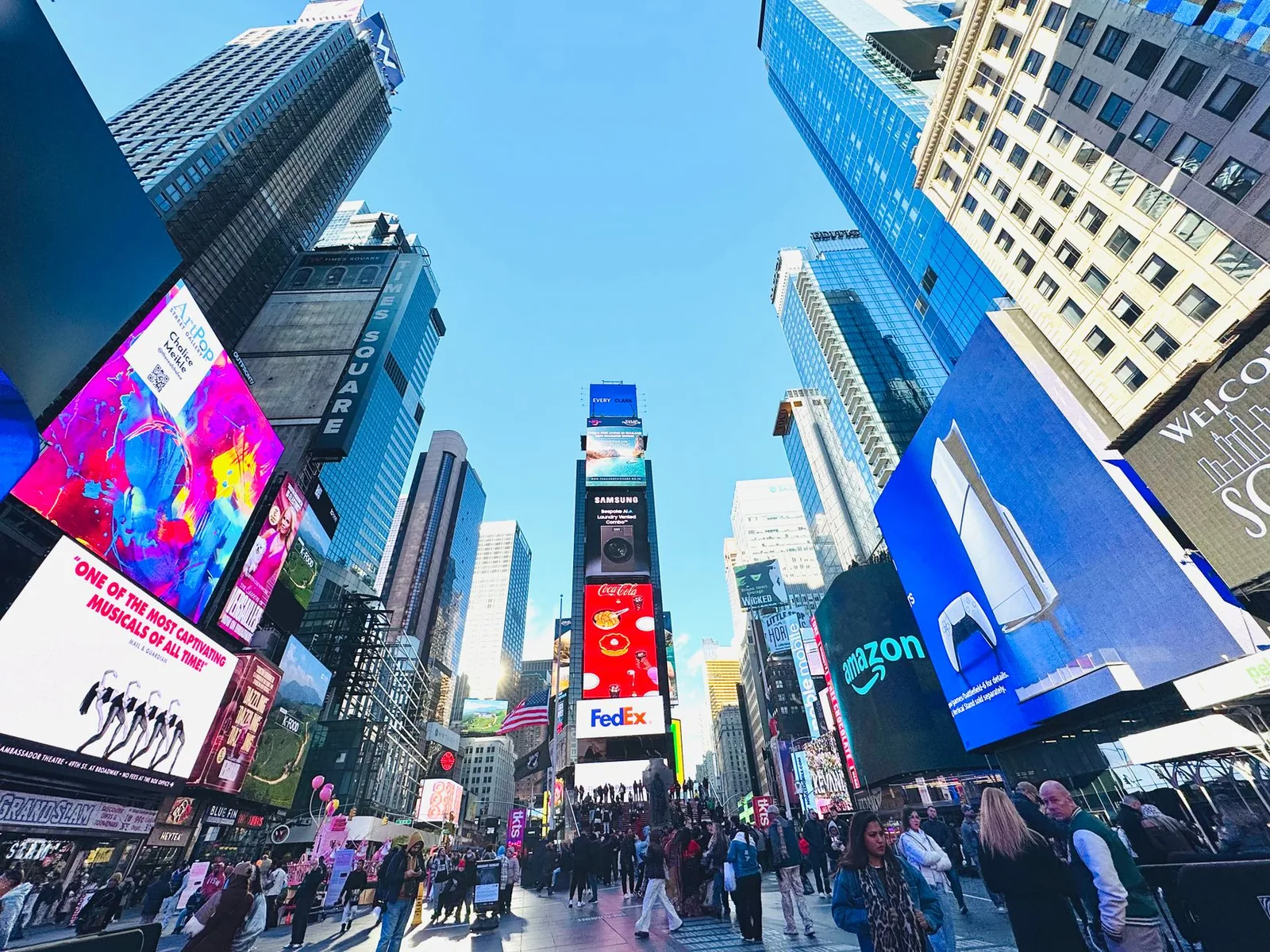
- Polling places, permitted special-event areas, protests and public assemblies, and Times Square
In Antonyuk v. James in October 2024, the Second Circuit left nearly all of these in force, lifting lower-court injunctions against most of them. In Frey, it rejected challenges to the Times Square, subway, and Metro-North bans and to New York’s ban on open carry.
The rule for ordinary stores has moved the other way. The 2022 law also made it a crime to carry onto private property without the owner’s express consent or a sign allowing guns. Federal courts blocked that default as applied to property open to the public, and the State Police say they are not enforcing it there. The Supreme Court’s June 2026 decision in Wolford v. Lopez, striking down Hawaii’s nearly identical rule, makes it very hard to revive (see our breakdown of that ruling). Two limits remain. Private property that is not open to the public, such as a friend’s home, still requires the owner’s consent. And a business can still ask you to leave.
Your car has its own rule. A gun left in an unattended vehicle must be unloaded and locked out of sight in a hard storage container that resists fire, impact, and tampering. A glove box does not count; a lockable hard-sided case does.
Keeping It: The Three-Year Clock
Outside the city and Westchester, Nassau, and Suffolk counties, a carry license does not expire, but you must recertify with the State Police every three years, with no repeat of the course. Inside those four jurisdictions the license expires every three years and must be renewed, so ask your licensing office what training it expects. New York City spells out its answer: each renewal must come with a certificate for a two-hour live-fire course, submitted within six months of the renewal. Treat that as the least practice you do in three years, not the most.
Keep the license itself current, too. Every handgun you carry must be listed on it, and the course covers the reporting duties that come with it. Our use of force primer is a good way to keep the legal side fresh between renewals.
The Bottom Line
New York became shall-issue in 2022, but it did not become simple. Plan for 18 hours of in-person class, an interview where candor matters more than anything you say, and a wait that has stretched past a year in the city. Learn the sensitive location list well, because a valid license is no defense inside one of them. Non-residents finally have a way in, but it runs through the same process, with extra paperwork in the city. For anything specific to your record, your county, or a pending application, talk to a New York firearms attorney before you file.
Further reading (sources)
- The Trace on New York City’s carry application surge and its loosely regulated class market
- New York State Police and DCJS for the minimum standards behind the 16-hour course, written test, and live-fire assessment
- New York State with its concealed carry FAQ on non-residents, recertification, and vehicle storage
- New York State Senate on Penal Law 400.00, the licensing and training statute and Penal Law 265.01-e, the sensitive locations list
- NYPD for the 2025 rule creating a non-resident carry license and dropping the social media requirement
- U.S. Court of Appeals for the Second Circuit in Antonyuk v. James, the 2024 ruling on the carry law’s licensing and location rules
- Second Circuit again in Frey v. City of New York, rejecting challenges to the Times Square, subway, and open carry bans
- The Reload with the March 2026 agreement dropping the social media question
- CourtListener has the federal docket in Shaffer v. Quattrone, the non-resident challenge
- Supreme Court of the United States on Wolford v. Lopez, the private property ruling