Is an RV a Vehicle or a Residence? Carrying and Storing a Handgun in a Motorhome, Camper, or Van
Published on October 24, 2026
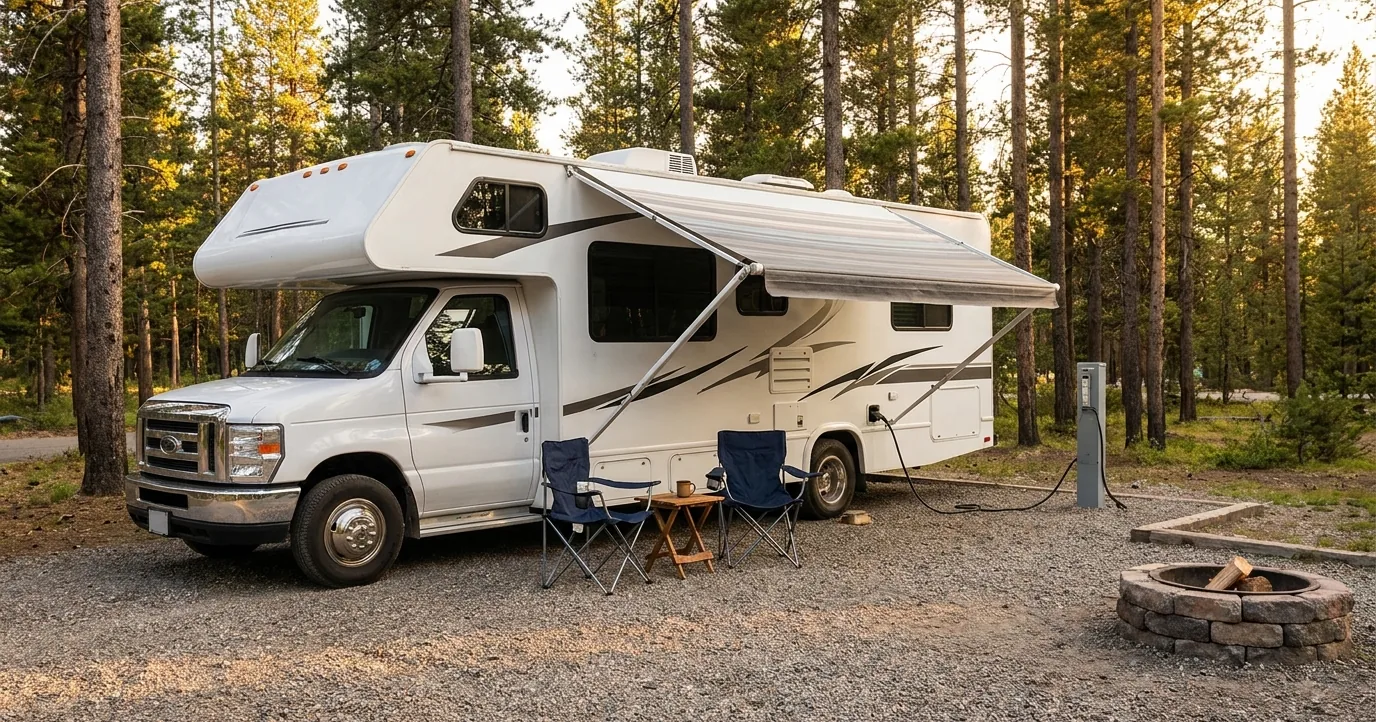
Around 11 p.m. on August 20, 1982, a Los Angeles police officer walked up to a tan Dodge van stopped in a red zone on Sunset Boulevard and found the driver with his hand on a handgun. Officers recovered two loaded pistols within his reach. At trial the driver argued that the van was his home: he had given up his apartment two years earlier, the van was registered as a motor home, and it held a bed, a refrigerator, a shower, and a kitchen. California’s loaded-gun law did not reach a person’s “place of residence, including any temporary residence or campsite,” he said. In People v. Foley, the appellate court disagreed. A house car has “two essential functions,” it wrote, and on a public street it is “a means of transportation or a motor vehicle.”
More than a quarter century later, a federal judge in San Diego looked at another motor home. Edward Peruta and his wife lived in theirs full time and had booked five months at a San Diego RV park. Ruling on his challenge to the county’s permit policy, the judge noted that California’s residence exemption covers anyone “temporarily within this state,” so “nothing prevents Plaintiff from carrying a gun while inside of his motor home.” Same state, same family of statutes, two answers. The difference was not the rig. It was what the rig was doing.
Carry laws are written around three places: your body, your vehicle, and your home. An RV can be two of them in one afternoon, which is why Handgunlaw.us keeps a separate RV and car carry reference and revised it eight times between May and September 2026. This guide covers where states and courts draw the line, what changes when you tow instead of drive, the campground rules layered on top, and how to store the gun when you leave the rig.
Why the Same Rig Gets Two Answers
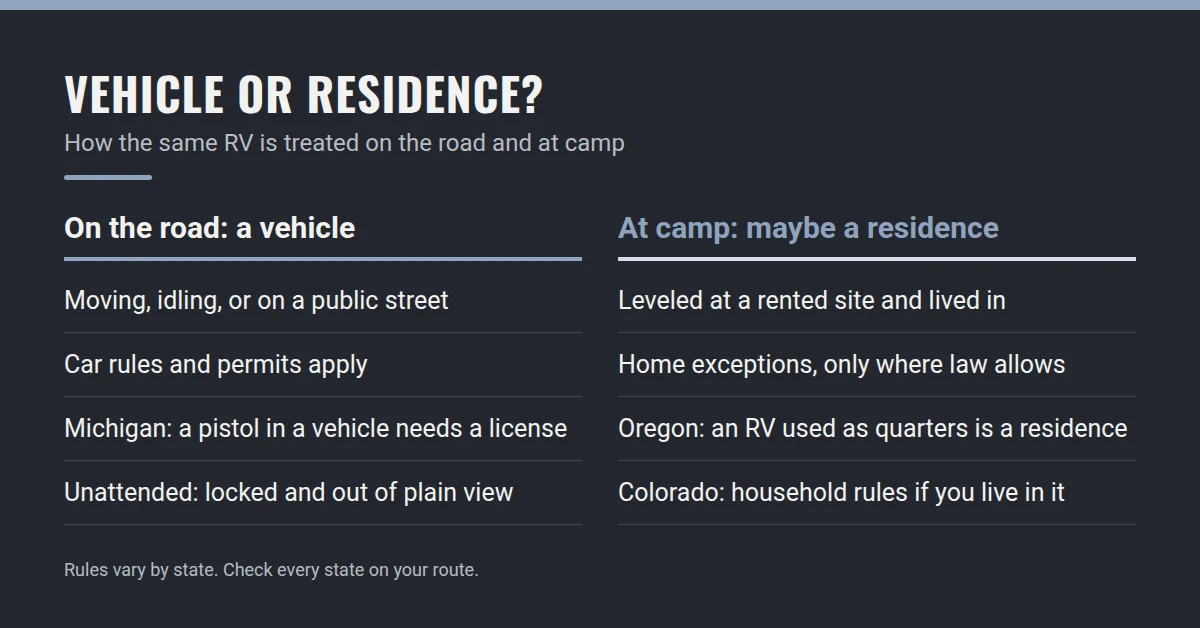
Permit-required states usually make it a crime to have a handgun in a vehicle without a license, then carve out your home. Michigan makes it a felony to carry a pistol “in a vehicle operated or occupied by the person, except in his or her dwelling house, place of business, or on other land possessed by the person” without a license. Rhode Island and Washington carve out a “dwelling house” and a “place of abode.” A motorhome parked for the night fits both halves of Michigan’s sentence: it is a vehicle you occupy, and it is where you sleep. Most of these statutes never say which description wins.
How much that matters depends on where you are and who you are.
- In permitless carry states, an adult who may legally carry can generally keep a loaded handgun in a car or a camper alike, so the label rarely changes the answer (age limits and posted property aside).
- In permit-required states, it can decide whether you are lawfully armed at your campsite or committing a crime there, especially if you live in a permitless state and never got a permit, or hold one the state does not honor.
- Everywhere, it changes the storage rules when you walk away and how self-defense law treats someone forcing your door.
The States That Wrote the Answer Down
Oregon answers the question in its statute book. Any U.S. citizen over 18 who lives in Oregon or is “temporarily sojourning” there may keep a handgun at a residence or place of business without a license, and “residence includes a recreational vessel or recreational vehicle while used, for whatever period of time, as residential quarters.” That matters because Oregon honors no other state’s permit and licenses almost no visitors, as our guide to the closed states explains. Handgunlaw.us reads “while used … as residential quarters” as describing a parked rig and warns that a moving one may be treated as a vehicle, where a concealed, readily accessible handgun needs an Oregon license. Cities and counties may also ban loaded firearms in public places, with an exemption for concealed handgun licensees and none for RVs, so check the local ordinance wherever you camp inside city limits.
California gets to a similar place through two statutes and the two cases above. Penal Code 26055 says the loaded-gun ban does not stop anyone from having a loaded weapon “at the person’s place of residence, including any temporary residence or campsite,” and Penal Code 25605 lets a citizen or legal resident who is even temporarily in California carry a handgun inside their residence without a license. The working rule from Foley and Peruta: parked at camp and living in the rig, the residence exemption is your argument; on the road or a public street, you are a driver, and without a California license the handgun rides unloaded in a locked container that is not the glove box. State parks narrow it again, allowing firearms in “temporary lodging or mechanical mode of conveyance” only unloaded and “packed, cased, or stored in a manner that will prevent their ready use.”
Colorado wrote the lived-in vehicle into its storage law. Since January 1, 2025, a handgun left in an unattended vehicle must be in a locked, hard-sided container out of plain view, inside a locked vehicle, a locked trunk, or “a locked recreational vehicle” (a locked glove box or console counts as the container), or the owner faces a civil infraction. The law then exempts “a person who lives in a vehicle or in a recreational vehicle” and applies Colorado’s household storage law instead, which centers on keeping guns away from children and from anyone barred from having them. Full-timers and van dwellers there store like a household, not like a commuter.
Washington takes a narrower route. Its vehicle rule has no home exception: a loaded pistol may be in any vehicle only if you are licensed and keep it on you, stay with the vehicle, or lock it inside out of view when you leave. Campers get an exception for lawful outdoor recreation “such as hunting, fishing, camping, hiking, or horseback riding,” but only if, “considering all of the attendant circumstances,” it is reasonable to conclude you are camping or traveling to or from a legitimate recreation area. That is a judgment an officer makes at your window, not a status your rig carries.
Everywhere Else, Think Like a Court
Where a statute is silent, the best guide is a search case rather than a gun case. In California v. Carney in 1985, the Supreme Court let police search a motor home parked in a downtown San Diego lot without a warrant. A vehicle “being used on the highways, or if it is readily capable of such use and is found stationary in a place not regularly used for residential purposes,” the Court said, is treated as a vehicle. It expressly left open a motor home “situated in a way or place that objectively indicates that it is being used as a residence,” and listed the facts that might matter: location, whether it is readily mobile or “elevated on blocks,” whether it is licensed, whether it is “connected to utilities,” and whether it has “convenient access to a public road.”
Those factors line up with Foley’s two functions and sort most situations.
- Rolling, idling, fueling, or parked on a street or shoulder: a vehicle. Every rule written for cars applies in full.
- Overnight in a store lot, a rest area, or a casino lot: a gray zone, so assume vehicle. Casino lots on tribal land add a separate sovereign with its own code, covered in our guide to carrying on tribal land.
- Leveled at a site you have rented, plugged in, slides out, living in it: the strongest case for residence, but it helps only in a state whose law recognizes it, and only while you stay put.
No residence rule we found covers a coach on the move. Plan as though the label flips the moment the leveling jacks come up.
Motorhome, Trailer, or Van: Where the Gun Rides
Crossing a state where you cannot lawfully carry, federal safe passage under 18 U.S.C. 926A protects you only if the gun is unloaded and neither it nor the ammunition is “readily accessible or is directly accessible from the passenger compartment.” For a vehicle “without a compartment separate from the driver’s compartment,” the statute adds, the gun or ammunition must be in “a locked container other than the glove compartment or console.” In a motorhome or camper van, the whole coach is the passenger compartment. If your rig has no storage outside the living space, as in many camper vans, the unloaded gun and its ammunition go in a locked container, and the dinette drawer does not qualify. If it has exterior bays that open only from outside, the safest reading puts the gun there, since a bay is the closest thing a motorhome has to a trunk. Treat the bay’s factory lock as a latch, though, and keep the gun in its own locked case inside it.
A towed rig changes the geometry. A travel trailer or fifth wheel is not part of the truck’s passenger compartment, so a locked case in the trailer keeps the gun out of reach of everyone riding up front, the cleanest way to meet the federal standard.
Safe passage covers the trip, not the stay. In Revell v. Port Authority in 2010, a Utah permit holder missed an airline connection, spent the night in a Newark hotel with his locked gun case, and was arrested back at the airport the next morning. The Third Circuit held that the federal protection did not apply because his firearm and ammunition “were readily accessible to him during his overnight stay in New Jersey.” An RV makes that problem worse, since you sleep a few feet from the case. Plan the overnight stops before the route, and end each day in a state where you may lawfully possess the gun.
Rhode Island shows how sharp that line can be. A visitor with another state’s permit may have a pistol in a vehicle there only while “merely transporting the firearm through the state” and “without any intent on the part of the person to detain him or herself or remain within the state of Rhode Island.” A campground reservation is hard to square with that wording, and the penalty runs up to ten years in prison.
Illinois runs the other way. A nonresident who is eligible to carry at home, shown by a home-state permit where the home state issues one, may keep a concealed firearm in their vehicle as long as it stays there, and State Police rules define “within a vehicle” as “within the passenger compartment of a passenger or recreational vehicle.” Your motorhome’s coach counts. A camp chair by the fire ring does not, and when you leave the rig unattended the gun stays locked inside.
At the Campground: Rules on Top of State Law
Even where state law treats your coach as a home, the ground under it can carry its own rules.
- Private RV parks and resorts are private property. Many put a firearms rule in the registration agreement, and breaking it can end your stay. Whether a posted sign is also a crime depends on your state, which our piece on whether no-guns signs carry the force of law works through. Read the rules before you book.
- National parks follow the law of the state they sit in: federal law bars the Interior Department from enforcing any rule against possessing a firearm in a park unit when the possession complies with state law. Visitor centers, ranger stations, and other buildings where federal employees regularly work stay off limits under 18 U.S.C. 930, which requires notice at each public entrance.
- Army Corps of Engineers lakes are the big exception. On Corps-managed land, 36 CFR 327.13 prohibits possessing loaded firearms or ammunition unless you are hunting or fishing where allowed, using an authorized range, or holding written permission from the District Commander. A state permit does not change that, the rule draws no line around your camper, and it remains in force as of October 2026.
- State parks range from full carry under state law to rules like California’s unloaded-and-cased regulation, so check the park agency’s rules for each stop.
- Campground hosts can explain the park’s policy, not the state’s law, so get the second from the statute.
Leaving the Rig for the Day
An RV spends long hours unattended at trailheads, overlooks, and campsites, and several states regulate exactly that moment.
- California requires a handgun left in an unattended vehicle to be in a locked trunk, a locked container out of plain view, a locked container permanently fixed inside the vehicle, or a locked toolbox or utility box. “Plain view” includes anything visible through the windows, tinted ones included, and a violation is an infraction with a fine of up to $1,000.
- Colorado names “a locked recreational vehicle” in its unattended storage rule, with the exemption above for people who live in theirs.
- Oregon counts a handgun as unsecured if it “is left unattended in a vehicle and is within view of persons outside the vehicle.”
- Washington requires a pistol left in a vehicle, loaded or not, to be locked inside and concealed from view from outside.
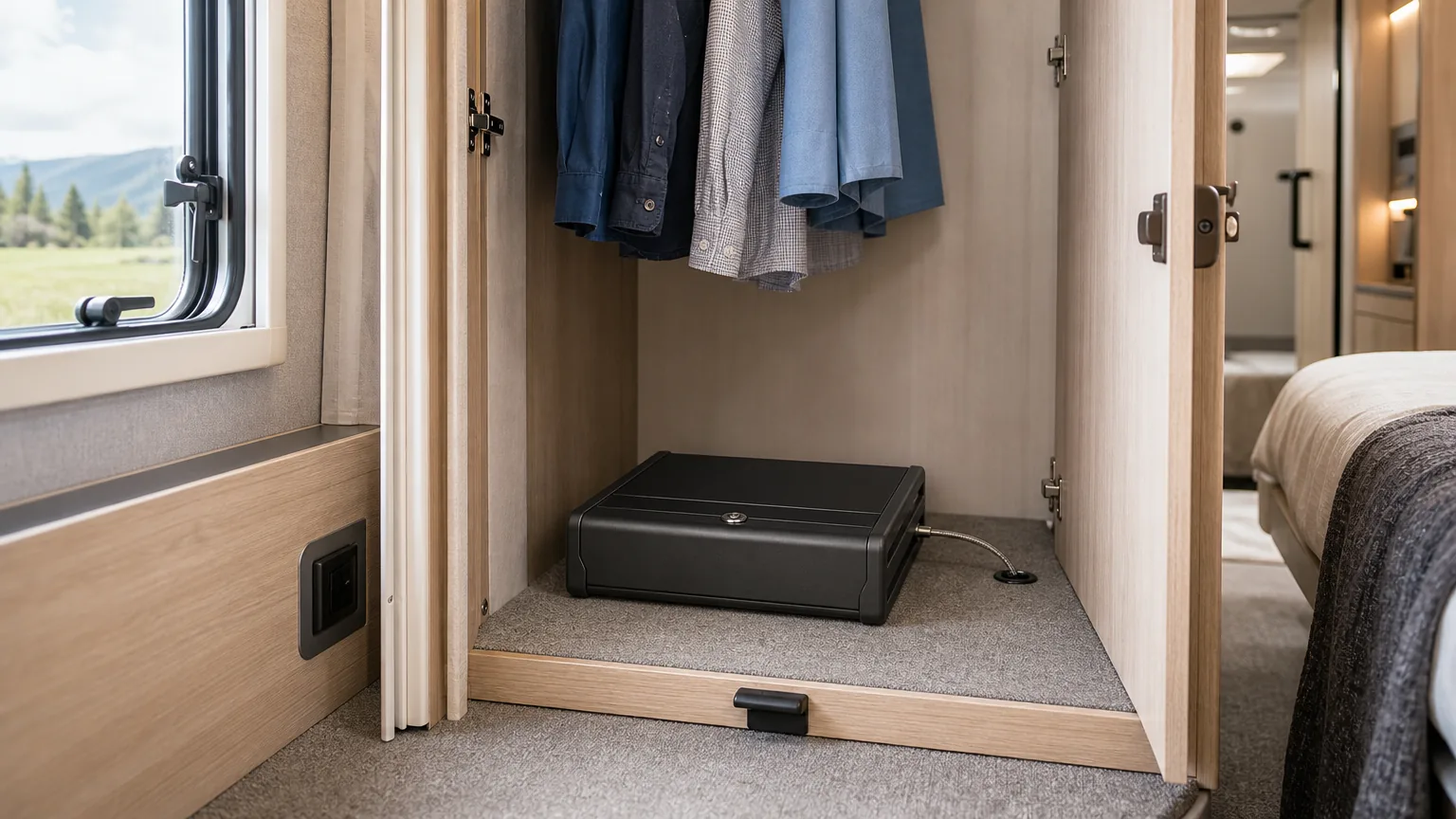
The physical setup matters as much as the statute. Bolt the lockbox through the floor into the frame or another structural member, or cable it to something that cannot be unscrewed, since a box fastened only to cabinet paneling comes out with a pry bar. Check every sightline through the windshield and side windows, and close the blinds when you leave. Count who else holds a key while you are gone, from campground staff to a dog sitter, and make sure the box opens only for you. When grandchildren or friends visit, lock the gun up before they arrive, as you would at home. For the national picture on thefts from parked vehicles and why consoles and glove boxes fail, see our guide to carrying in your vehicle.
Self-Defense Inside the Coach
Self-defense law often treats an RV as a home even where carry law does not. Texas defines a “habitation” for its self-defense statutes as “a structure or vehicle that is adapted for the overnight accommodation of persons,” and presumes your fear was reasonable when someone unlawfully and with force enters, or tries to enter, your occupied habitation or vehicle, as long as you did not provoke it and were not committing a crime. Florida’s castle doctrine defines a “dwelling” as “a building or conveyance of any kind,” whether “temporary or permanent, mobile or immobile,” with a roof, “including a tent,” designed for people to lodge in at night.
Two different questions are hiding here. Castle doctrine decides whether using force inside the coach was justified. Carry law decides whether you could have the gun there at all, and a clean answer to the first does nothing for the second, as our piece on justified self-defense and unlawful carry charges explains. A state can call your RV a home when someone kicks in the door and still call it a vehicle when it asks whether you needed a permit.
Before You Pull Out
- Plan the nights, not just the miles. For every overnight stop, know whether you may lawfully possess the gun in that state and whether it treats a lived-in RV as a residence.
- Decide where the gun rides while moving. On your body where your permit or the state’s law allows it; otherwise unloaded, in a locked container, with the ammunition locked up too.
- Decide where it lives at camp. An anchored lockbox inside the coach, out of every sightline, that opens only for you.
- Read the ground rules. Private park rules, state park regulations, Corps of Engineers land, national park buildings, and tribal land can each override what state law alone allows.
- Recheck before every trip. These rules change several times a year.
The Bottom Line
Treat your RV as a vehicle whenever it is moving or sitting on a public street, because no residence rule we found covers a rig on the move. Treat it as a residence only where a state’s statute or courts say so, which in practice means a rig parked at a site and lived in, and never assume the label crosses a state line with you. Store the gun like a householder while you are inside and like a careful driver when you walk away. When a trip turns on a question this guide cannot settle, ask a firearms attorney licensed in that state. Whatever you drive or tow, an in-person course with a certified instructor is still where safe carry starts.
Further reading (sources)
- Handgunlaw.us keeps its state-by-state guide to carrying in a car or RV and a dated log of its 2026 revisions
- CourtListener hosts the People v. Foley ruling on a house car in transit
- U.S. District Court for the Southern District of California in the 2010 Peruta order on carrying inside a motor home
- Oregon Legislature with the firearms chapter covering the RV residence rule and unattended vehicle storage
- FindLaw reproduces Penal Code 26055, the temporary residence and campsite exception and Penal Code 25140 on handguns in unattended vehicles
- California Department of Justice on how visitors may transport a handgun by vehicle
- Legal Information Institute for the Carney motor home decision and California’s state park weapons regulation
- Legal Information Institute with the federal statutes on safe passage, firearms in national parks, and weapons in federal facilities
- Colorado General Assembly with the 2024 law on firearms in unattended vehicles and RVs and the household storage law it points RV dwellers to
- Washington State Legislature on the license and vehicle rules in RCW 9.41.050 and the camping exception in RCW 9.41.060
- Michigan Legislature for the pistol-in-a-vehicle felony and its dwelling house exception
- Rhode Island General Assembly with the transit-only exemption for out-of-state permit holders
- Illinois General Assembly on nonresident carry inside a vehicle and the State Police rule that counts an RV’s passenger compartment
- Third Circuit on the Revell ruling that an overnight stop fell outside safe passage
- Electronic Code of Federal Regulations with the Army Corps of Engineers weapons rule
- Texas Legislature for the definition of a habitation and the self-defense presumptions that use it
- Florida Legislature on the castle doctrine’s definition of a dwelling