Your Permit Stops at the Reservation Line: Concealed Carry on Tribal Land and in Indian Country
Published on September 26, 2026
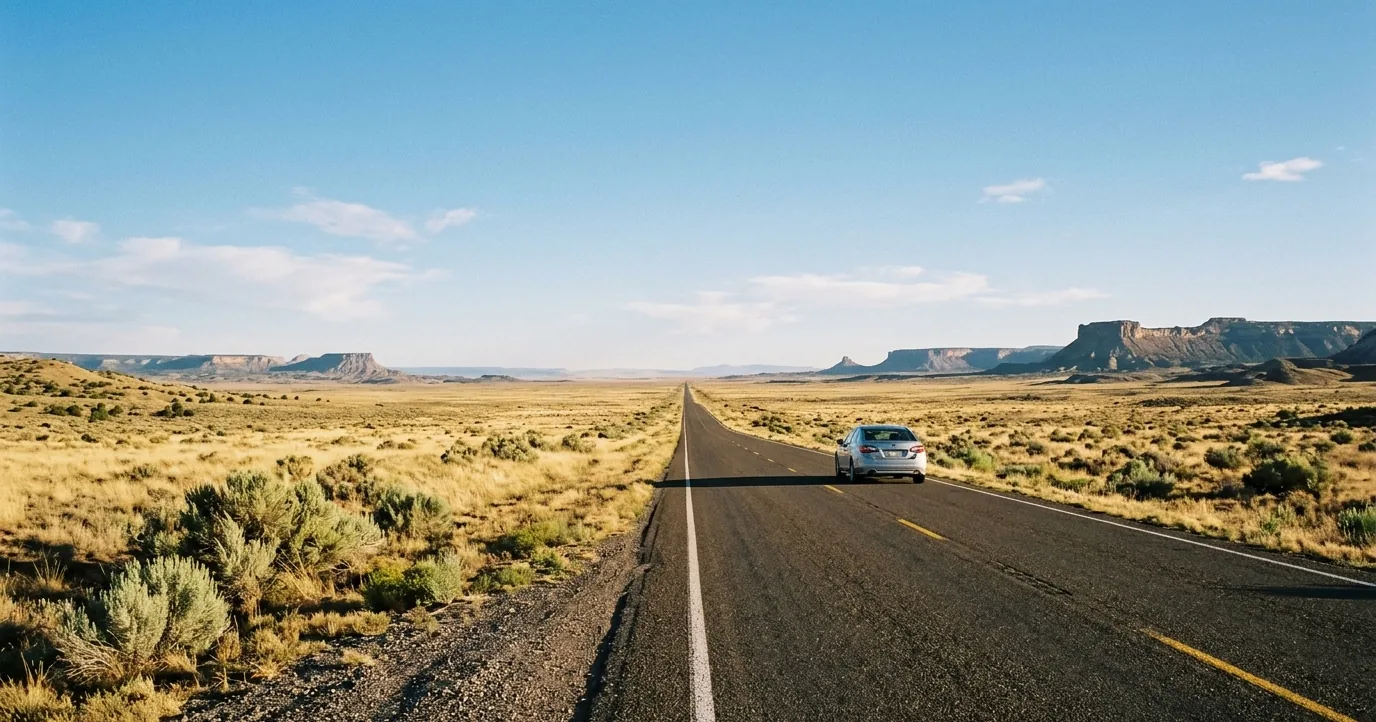
Most carriers plan an armed road trip one state at a time. They check which states honor their permit, read each state’s list of no-carry places, and learn its rules for guns in cars. That map has holes in it. The United States recognizes 575 tribes as sovereign governments. Highways cross their reservations for mile after mile in the Southwest, the Plains and the Pacific Northwest, and none of those tribes is bound by the agreements that make a permit work across state lines.
Handgunlaw.us, the long-running reference many carriers use for those agreements, keeps its tribal material in a separate Indian Nations section, apart from its state pages, and its two-part guide to tribal carry opens with a blunt instruction: talk to the tribal police or administration before carrying on any reservation. This guide explains why, what tribal gun codes actually say, where carriers really run into tribal land, what Public Law 280 does and does not change, and how to check a specific tribe before you go.
Why Reciprocity Stops at the Reservation Line
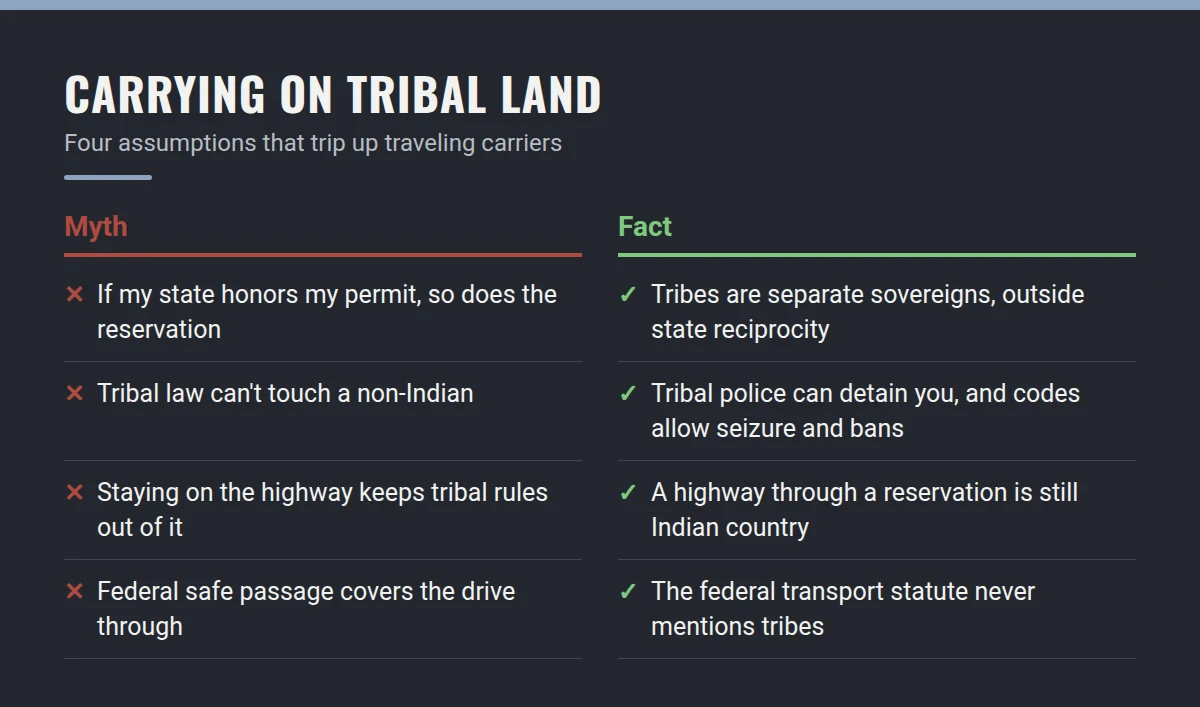
A reciprocity agreement is a promise between states. A tribe is a separate sovereign with its own government, courts and criminal code, and no state can promise on a tribe’s behalf that the permit it issued will be honored. Your permit answers to state law. Whether it counts for anything under tribal law is the tribe’s decision. (For the state-to-state rules themselves, see our state travel atlas.)
What a tribe can do to you depends partly on who you are. In 1978 the Supreme Court held that tribes cannot criminally prosecute non-Indians, to use the legal term, and it restated that rule in 2021. Congress has since carved out narrow exceptions for tribes that opt in, chiefly for domestic violence. That sounds like a shield. It is not, for three reasons.
State law still follows you. An offense by a non-Indian on a reservation with no Indian victim generally belongs to the state, so the state’s carry rules, including whether your permit is valid in that state at all, apply on the reservation too.
Tribal police can stop and hold you. In Strate v. A-1 Contractors (1997), the Court said it was not questioning the authority of tribal police “to detain and turn over to state officers nonmembers stopped on the highway for conduct violating state law.” In United States v. Cooley (2021), it ruled unanimously that a tribal officer may temporarily detain and search a non-Indian on a public highway through a reservation for possible violations of state or federal law. The stop in that case, on US Highway 212 across the Crow Reservation in Montana, ended with the tribal officer holding the driver until backup, including a federal Bureau of Indian Affairs officer, arrived.
Tribes have civil remedies that need no criminal case. Tribal codes routinely provide for confiscating the weapon, imposing civil fines, and banning a violator from tribal property or from the reservation itself. Handgunlaw.us describes the usual outcome plainly: tribal police “will most likely take the firearm and tell you that you can go to Tribal Court to get it back.”
If you are an enrolled member of a federally recognized tribe, the picture changes again. Federal law affirms every tribe’s criminal jurisdiction over all Indians, so another tribe’s code can reach you directly on its land.
What Tribal Gun Codes Actually Say
There is no standard tribal gun law. A code can be stricter than any state’s, looser, or silent on the subject, and most are not online at all; Handgunlaw.us, which has combed through the ones that are, found that a majority of tribes do not publish theirs. Tribes that do honor state permits, it adds, keep their own lists of off-limits places, just as states do. Four real codes show how wide the range runs:
- No weapons at all. The Havasupai Tribe, whose reservation holds the famous waterfalls of Havasu Canyon, states flatly that “weapons and fireworks are not allowed.” Its tourism terms warn that a violation can cancel the permits of everyone on the booking and bring fines, exclusion from the reservation, seizure of property, and prosecution.
- A tribal permit or nothing. The Spokane Tribe in Washington requires a non-member who does not live on the reservation to hold a permit signed by a Spokane Tribal Court judge before going about in public with any firearm, openly or concealed, and the weapon can be confiscated.
- No concealed carry, strict transport. The Prairie Island Indian Community in Minnesota bans concealed carry anywhere in the community outside your own home, bans carrying a firearm into community-owned buildings and parking lots, and allows a pistol in a vehicle only unloaded and “fully contained in a locked gunbox.”
- Loaded carry restricted, with a traveler’s exception. The Navajo Nation, the largest reservation in the country, makes it an offense to carry a loaded firearm, with exceptions that include a weapon kept in a closed trunk, luggage or glove compartment while traveling.
The Navajo example carries a second lesson. Bills to add an exception for state permit holders were introduced in 2022 and again in 2025, and an earlier amendment to the same section was proposed in 2018. The Navajo Nation’s own legislative tracker shows that none became law: the 2018 and 2022 bills expired and the 2025 bill was withdrawn. Yet some reference compilations print the permit exception as if it had passed. Secondhand summaries of tribal law drift out of date, and the only reliable answer comes from the tribe itself.
Highways Through Reservations Are Still Indian Country
The most common assumption is that staying on a state or US highway keeps you under state law alone. State law does follow you onto that highway. The word “alone” is the problem.
Federal law defines Indian country to include “rights-of-way running through the reservation,” so the highway is still inside the reservation. Strate did limit a tribe’s civil authority over non-members on a state highway right-of-way, treating it like land the tribe does not own, and some travelers read that as a safe corridor. It is not one. Some tribal codes restrict guns in vehicles on reservation roads anyway, as Prairie Island’s does, and Cooley settles that tribal officers can stop and detain you on that highway regardless.
The corridor is also narrower than the pavement. Pull off for fuel, a scenic overlook, a trading post or a roadside stand, and you may be standing on tribal land, where the tribe’s own rules and its power to remove you apply. Many reservations are checkerboards of tribal and privately owned parcels, and nothing at the roadside tells you which is which. When a trip only crosses a reservation, plan fuel and meal stops outside it where you can, and keep the gun stored as described in the fallback section below.
Tribal Casinos and Resorts
For most carriers, a casino is the only tribal land they set foot on deliberately, and it is the easiest call on this list: assume no guns inside.
Tribal gaming runs under compacts negotiated with the state, and firearm bans are often written straight into them. California’s compacts have long included a clause stating that “the possession of firearms by any person in the Gaming Facility is prohibited at all times,” with exceptions only for law enforcement and security, and the clause appears again in a compact the governor signed in July 2026. That compact defines the facility as the buildings where gaming takes place, so a hotel tower, garage or parking lot falls under the tribe’s own rules and posted policy instead.
Elsewhere the ban comes from tribal law. The Ho-Chunk Nation in Wisconsin prohibits weapons, concealed or in plain view, in its gaming and non-gaming facilities and public spaces. Violators face a forfeiture of $100 to $1,000, and the Nation’s attorney general can seek a temporary or permanent ban from its facilities. Its code does let concealed carry permit holders leave a gun in their own vehicle in its parking lots, though never inside the buildings, and the parking lot is exactly where tribes differ most.
Whether a casino’s sign carries criminal weight under your state’s trespass law is a state question, which we cover in our look at whether no-guns signs have the force of law. A tribe does not need that law to act, though. It owns the property, and it can remove you and ban you. Check the property’s posted weapons policy before you leave home, not at the door.
Hunting, Fishing, and the Backcountry
A state hunting or fishing license is a state regulatory permit, and as a rule it does not reach tribal land. North Dakota’s tourism office spells out the split for its reservations: hunting exclusively on tribal land requires a tribal license and no state license, while hunting non-tribal land inside the same reservation still requires a state license. Public Law 280, covered below, expressly preserved federally protected tribal hunting, trapping and fishing rights, including the tribe’s power to license and regulate them.
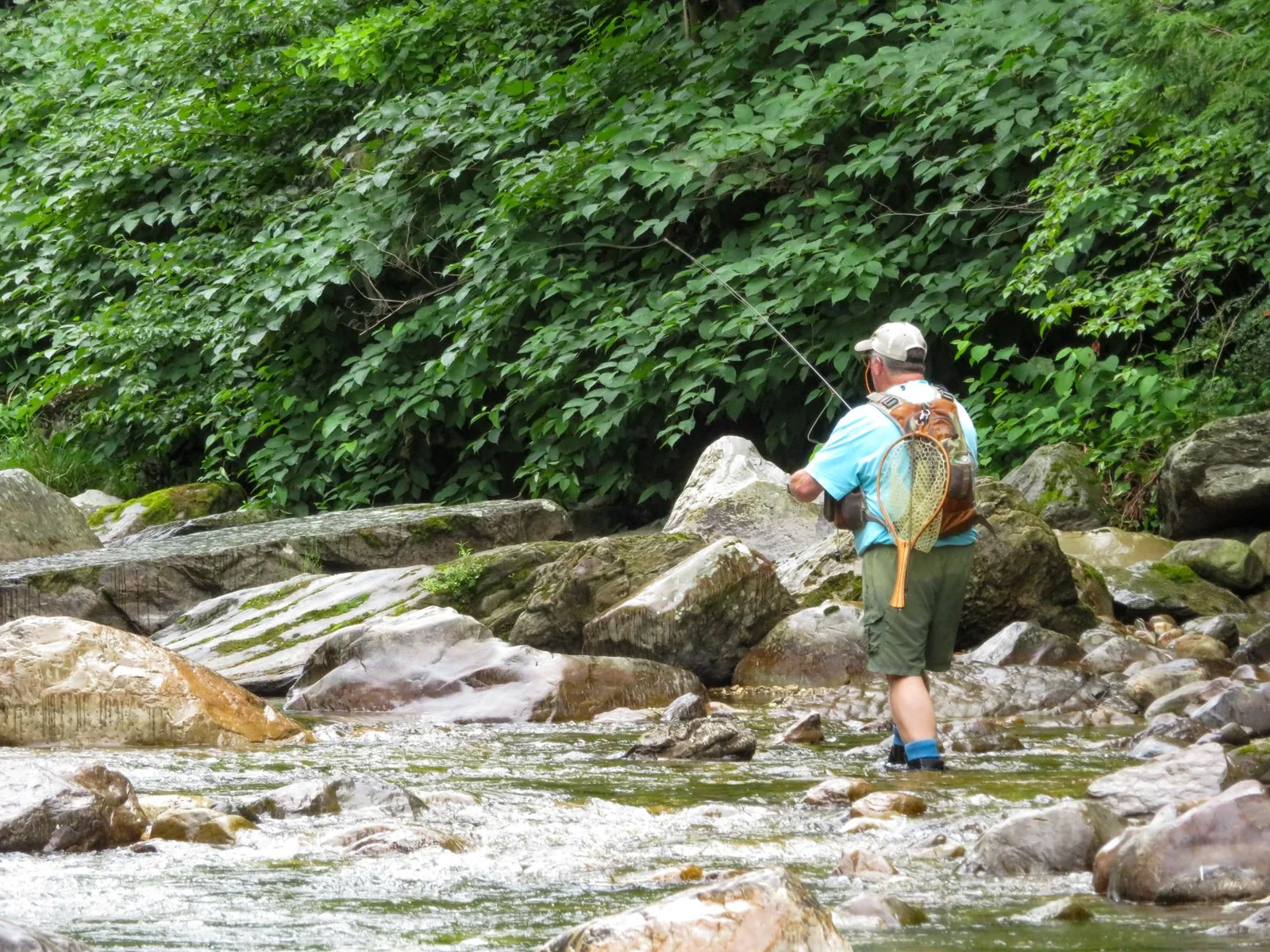
For a carrier, the tribal rules matter in two more ways. Tribal codes often decide where a firearm may go for hunting and how it rides in the truck. Ho-Chunk bars weapons from its parks and other public spaces except areas its natural resources department designates for hunting, and Prairie Island’s transport rules relax for someone actually hunting under a community permit in a designated area. And a fishing, hiking or camping permit is not a carry permit. If your plan includes a handgun for protection on the trail or at a lake, ask the tribe’s game and fish or natural resources office directly, and get the answer in writing.
What Public Law 280 Changes, and What It Does Not
In 1953 Congress gave certain states criminal jurisdiction over the reservations inside their borders. Public Law 280 made that mandatory in six states (Alaska, California, Minnesota, Nebraska, Oregon and Wisconsin), with a few exceptions such as the Red Lake Reservation in Minnesota and the Warm Springs Reservation in Oregon. Ten more states, among them Arizona, Idaho, Montana, Nevada, Utah and Washington, took on some or all of that jurisdiction by choice, often only in part, and several have since handed some of it back. New York, which honors no out-of-state permit at all, holds similar criminal jurisdiction under a separate 1948 statute, so a visitor there has a state problem before a tribal one; our guide to getting a New York carry permit covers that side.
Where Public Law 280 applies, state criminal law has the same force on the reservation as anywhere else in the state, and state and county officers enforce it. Across much of the Southwest and the Plains it does not apply, so crimes involving Indians fall mainly to tribal and federal authorities, while the state still handles offenses by non-Indians with no Indian victim.
What the law does not change matters more to you. The Bureau of Indian Affairs is explicit that Public Law 280 gave states no regulatory power over tribes or trust land, and none over gambling or licensing on reservations. A tribe in a Public Law 280 state keeps its own gun ordinance: Prairie Island’s is in Minnesota, one of the six mandatory states. For a traveler, the law mostly changes who arrives at a traffic stop, not whether the tribe can keep guns off its land.
How to Check a Tribe Before You Go
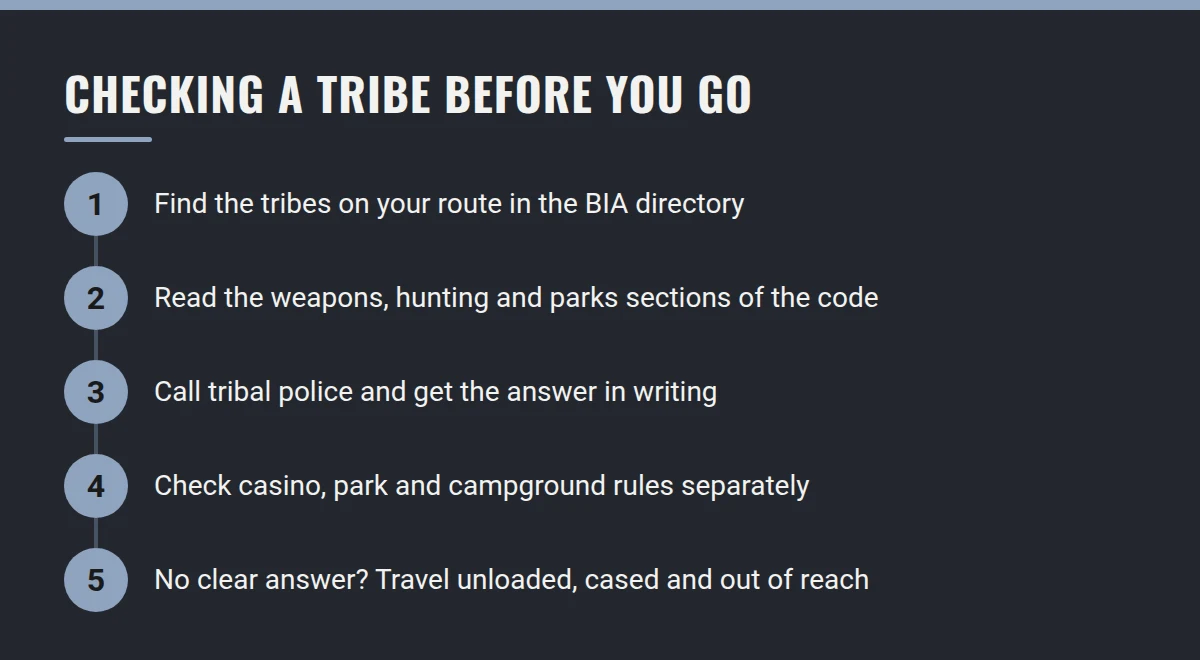
- Find out whose land is on your route. The Bureau of Indian Affairs’ Tribal Leaders Directory lists contact details for all 575 federally recognized tribes and includes a map.
- Read the code itself. The National Indian Law Library’s Tribal Law Gateway, run by the Native American Rights Fund, collects codes tribe by tribe, though only those a tribe has agreed to share, and many tribes post theirs on their own websites. Search for “weapon,” “firearm,” “deadly weapon” and “concealed,” and check the hunting and parks chapters too. Handgunlaw.us’s two-part guide is a useful index organized by state, but it calls itself “a place to start,” and the Navajo example shows why.
- Call ahead. Handgunlaw.us recommends talking to the tribal police or administration and, if possible, getting the answer in writing. Ask specifically about vehicles, since some codes treat a gun in a car differently from one on your belt.
- Check each destination separately. A casino, a tribal park, a campground and a marina can each post their own rules on top of the code.
- If you cannot get a clear answer, use the fallback below.
The Fallback: Unloaded, Cased and Out of Reach
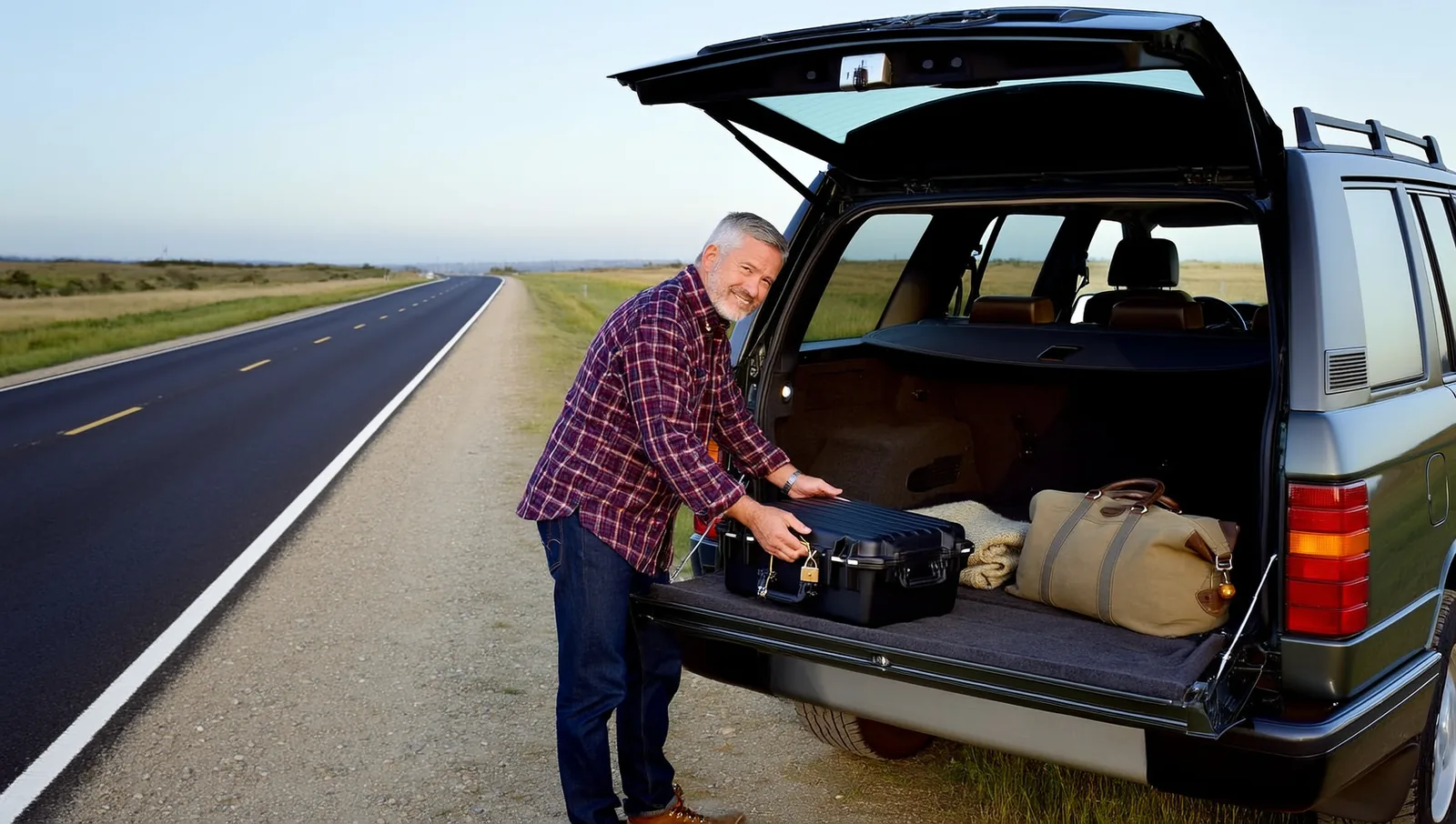
When the rules are unclear, Handgunlaw.us’s default is the right one: keep the gun “unloaded and secured in your trunk or locked box in the back of a vehicle that does not have a trunk.” It will not satisfy every code (Prairie Island specifies its own locked gunbox, and Havasupai allows no weapons at all), but it matches the traveler exceptions written into many tribal codes, and it is the setup most likely to keep a routine stop routine. Use a locked hard case in the trunk, or, in a vehicle without one, a lockbox in the cargo area rather than the glove box or console, and store the ammunition separately. Our vehicle carry guide covers lockbox options.
Do not count on federal safe passage to cover you. The transport provision of the Firearm Owners Protection Act, 18 U.S.C. 926A, overrides “any law or any rule or regulation of a State or any political subdivision thereof.” It never mentions tribes, and we could find no court decision applying it to a tribal code. Our federal firearms law reference explains how narrow that protection is even between states.
If a tribal officer stops you, treat it like any other stop: stay calm, keep your hands on the wheel, and follow the duty-to-inform rule of the state you are in, telling the officer where the firearm is stored if you are unsure. If the officer seizes the gun, do not argue at the roadside. Ask for a receipt and how to reclaim it, then call a firearms attorney with tribal court experience.
The Bottom Line
Treat every reservation as its own jurisdiction, because it is one. Your permit, and every reciprocity chart built on it, speaks only for states. Before a trip, find the tribes on your route and check their codes or call; do not carry into a tribal casino unless the tribe tells you in writing that you may; and when you cannot get a clear answer, travel unloaded, cased and out of reach. If you live beside a reservation, commute across one or hunt on tribal land regularly, an hour with a firearms attorney who practices federal Indian law is worth more than any chart. And none of this replaces hands-on training: an in-person course with a certified instructor is still where safe carry starts.
Further reading (sources)
- Handgunlaw.us with its two-part guide to tribal carry codes, covering Alabama through Nevada and New Mexico through Wyoming
- U.S. Supreme Court, in United States v. Cooley, on tribal police authority to detain non-Indians on reservation highways
- U.S. Supreme Court, in Strate v. A-1 Contractors, for treating a state highway right-of-way like non-tribal land
- United States Code sections on the definition of Indian country, Public Law 280 state jurisdiction, New York’s reservation jurisdiction, tribal criminal jurisdiction over all Indians and the federal firearm transport provision
- Tribal Law and Policy Institute with a guide to who prosecutes which crimes in Indian country
- Bureau of Indian Affairs on what Public Law 280 did and did not give the states
- BIA for its directory and map of federally recognized tribes
- National Indian Law Library with its tribe-by-tribe gateway to tribal codes
- Havasupai Tribe on its visitor weapons ban and the penalties for breaking it
- Spokane Tribe of Indians for its permit rule for non-members carrying firearms
- Prairie Island Indian Community with its firearm ordinance on carry and vehicle transport
- Navajo Nation Council on a bill to recognize state carry permits, quoting the weapons law it would amend
- Navajo Nation Office of Legislative Services for the tracker entry showing the latest permit bill withdrawn
- Ho-Chunk Nation with its weapons code for casinos, parking lots and hunting areas
- Office of the California Governor with a tribal-state gaming compact barring firearms from the gaming facility
- North Dakota Tourism on when hunters need a tribal license rather than a state one