The Closed States: Where a Visiting Concealed Carrier Has No Legal Option at All
Published on October 12, 2026
Cynthia Ladd holds an Arizona carry permit and a nonresident Utah permit, which together let her carry across most of the country. Her job as Oregon state director for Gun Owners of America calls for regular trips to Salem, so this summer she phoned two Oregon sheriff’s offices to ask how to get an Oregon license. Marion County told her the state does not license nonresidents unless they live “in a border county.” Lane County told her to find a county bordering her own state, then, once she explained that she lives in Arizona, that she did not qualify at all. “That’s it? I have no other options?” she asked. “Yes ma’am, you do not qualify. You have no other options.”
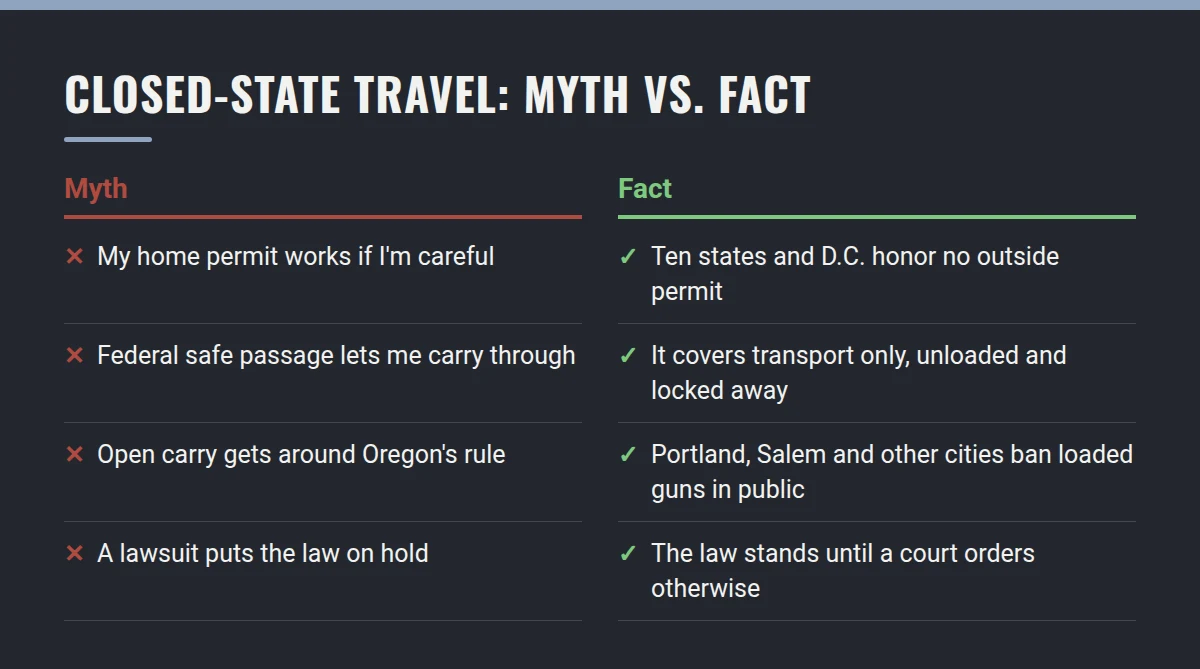
The exchange is quoted in the federal lawsuit Ladd filed on September 11 with Gun Owners of America and the Gun Owners Foundation, and it captures the trap exactly. In a state that requires a permit, a visitor can carry lawfully in only two ways: the state honors a permit the visitor already holds, or it issues one of its own. Ten states and the District of Columbia honor no outside permit at all. Most of them will at least take a visitor’s application, and in the last two years courts and lawmakers have forced California and New York open and pried Hawaii’s door ajar. This guide covers the places where both doors are still shut, the narrow exceptions that survive there, the lawsuits aimed at them, and how to plan a trip into one.
Two Doors, and Where Both Are Shut
The first door is reciprocity, and in these eleven jurisdictions it does not exist: California, Connecticut, Hawaii, Illinois, Maryland, Massachusetts, New Jersey, New York, Oregon, Rhode Island, and the District of Columbia. A permit from your home state, a nonresident permit from Utah or Florida, or a wallet holding all three counts for nothing there, which is why stacking nonresident permits cannot help. None of them allows permitless carry, either. Our state travel atlas explains how recognition works everywhere else.
The second door is a license from the state itself, and that map has changed quickly. As of October 2026 the eleven fall into three groups.
- Open to most visitors. New Jersey and Maryland license visitors who meet the same standards as residents, including each state’s own training course, and Massachusetts issues a one-year nonresident license for $100. Connecticut, Rhode Island, and the District of Columbia license visitors who already hold a permit from home, and D.C. also accepts residents of permitless states (any pistol you carry there must be registered in D.C.). New York’s door opened in stages through 2025 and early 2026, as our New York permit guide explains. California joined the group on January 1, 2026. After a federal judge struck down its residency rule, the legislature rewrote the law, and county sheriffs must now license qualified nonresidents who complete California’s own training, qualify with live fire for each gun on the license, and swear that the county is their main destination in the state.
- Open a crack. Illinois licenses nonresidents from only six states: Arkansas, Idaho, Mississippi, Nevada, Texas, and Virginia. Hawaii’s statute still requires residency, but an April 2026 consent judgment bars the state from enforcing that rule against the plaintiffs and members of the Hawaii Rifle Association, so in practice a visitor applies by joining the club. The judgment is conditional and falls away if state officials decline to approve the $35,000 fee award attached to it.
- Shut for almost everyone. Oregon licenses its own residents, residents of its four neighboring states at a sheriff’s discretion, and almost no one else.
Every open door has a price: months of lead time, in-state training, fingerprints, fees, and in several states an interview. Maryland, for one, does not accept fingerprints taken by out-of-state providers. For a once-in-a-decade visit, the honest answer is usually to leave the gun at home. For anyone who returns to the same state regularly, that state’s own license is the only door that leads to lawful carry there.

Oregon: The Door That Stayed Shut
Start with recognition, because there is none. “Oregon does not recognize any other state’s concealed handgun license/permit at this time,” the Yamhill County Sheriff’s Office tells applicants. Carrying a concealed firearm without an Oregon license, or keeping a concealed handgun in a vehicle’s passenger compartment, is a Class A misdemeanor.
The license is issued county by county, and one line in the eligibility list does most of the work: the applicant “is a resident of the county.” A sheriff may waive that only “for a resident of a contiguous state who has a compelling business interest or other legitimate demonstrated need,” which limits the waiver to people from Washington, Idaho, Nevada, and California. Even for them it is a favor, not a right. Marion County, home to the capital in Salem, says it is not its policy to license anyone who does not live in the county. Umatilla County, on the Washington line, considers waivers but wants a need “specific to Umatilla County” and reserves the right to refuse any request.
One quirk matters if you spend part of the year in Oregon. For licensing purposes, a person counts as a resident of a county if they hold an Oregon driver license or voter registration there, filed their latest Oregon tax return from an address there, or have documentation showing that they currently own or lease real property in the county. Umatilla County’s waiver form tells out-of-state applicants who own or lease property there to stop, because they can apply as residents. A snowbird with a cabin or a lease may therefore have a door that a hotel guest does not. Ask that county’s sheriff before you assume either way.
On paper, open carry looks like a way around all of this, since Oregon law says firearms “carried openly in belt holsters are not concealed.” In practice it is not much of one. A separate statute lets any city or county ban loaded firearms in public places, exempting people “licensed to carry a concealed handgun,” which the lawsuit reads as the Oregon license a visitor cannot get. Ladd’s complaint lists eleven cities and Multnomah County that have done so, among them Portland, Salem, Beaverton, and the coastal towns of Astoria, Newport, and Yachats. Portland’s ordinance reaches a loaded gun or loaded magazine “while in a vehicle in a public place,” with a 30-day mandatory minimum sentence when the loaded gun is in a vehicle. With the rule changing at city limits, open carry is not a plan a visitor can count on.

What Ladd v. Hunter Asks For
Ladd filed in the federal District of Oregon, in Eugene, against the Marion County sheriff and the City of Salem. The suit raises a single claim under the Second and Fourteenth Amendments and asks the court to do three things: strike the residency rule and its neighbors-only waiver, strike the statute that lets cities ban loaded guns in public along with Salem’s ordinance under it, and order Oregon either to license nonresidents or to honor every other state’s permit. It leans on the cases that opened the other doors, including the California ruling and the Hawaii consent judgment.
The case is at the very start. The court has given the state until November 10 to intervene if it wants to defend its statutes, and an answer is due November 13. Until a court rules, and quite possibly through an appeal after that, every Oregon law described here stays in force. A complaint on file changes nothing at a traffic stop.
What a Visitor Can Still Do Legally
Closed does not mean a handgun can never cross the line. It means you cannot carry it the way you do at home, loaded and on your person. A handful of narrower rules still matter.
Passing through. Federal safe passage, 18 U.S.C. 926A, protects a traveler moving between two places where they may lawfully possess and carry the gun, provided it is unloaded and neither it nor the ammunition is readily accessible from the passenger compartment. In a vehicle without a trunk, it must sit in a locked container other than the glove box or console. The statute covers the trip, not the stay: a closed state as your destination falls outside it, and a federal appeals court has held that an overnight hotel stop on the way can too.
Oregon’s vehicle and residence rules. Oregon treats a handgun outside the passenger compartment as not readily accessible, and in a vehicle with no trunk, a closed and locked glove box, console, or other container (with the key out of the lock) also qualifies. The same statute lets a U.S. citizen over 18 who is “temporarily sojourning” in the state keep a handgun at their residence or place of business, and it counts an RV or boat as a residence while it is used as living quarters. None of that overrides a city’s loaded-firearm ban in a public place, so the cautious way to drive through Oregon is the federal standard: unloaded, locked, and out of reach.
Illinois’s vehicle exception. Illinois lets a nonresident have a concealed firearm in their vehicle if they are not barred from owning guns under federal law and are eligible to carry at home, shown by a home-state permit where their state issues one. The gun has to stay in the vehicle, and when you leave the car unattended it goes in the locked vehicle or a locked container inside it. Nonresidents also need no FOID card when their firearms are unloaded and cased, or when they are licensed or registered to possess a firearm at home. Step out of the car with the gun, though, and you are carrying without a license.
Massachusetts’s travel-through rule. Massachusetts law now lets a nonresident carry a firearm on their person while in a vehicle lawfully traveling through the state. The gun must stay in the vehicle, and whenever it is out of the owner’s direct control it must be stored the way state law requires.
California’s locked-container rule. Without a California license, a visitor may still transport a handgun unloaded and locked in the trunk or in a locked container in the vehicle, under Penal Code 25610. The Attorney General’s office notes that a glove compartment does not count as a locked container.
A Decision Tree for the Trip
Work through these in order before the gun goes in the car.
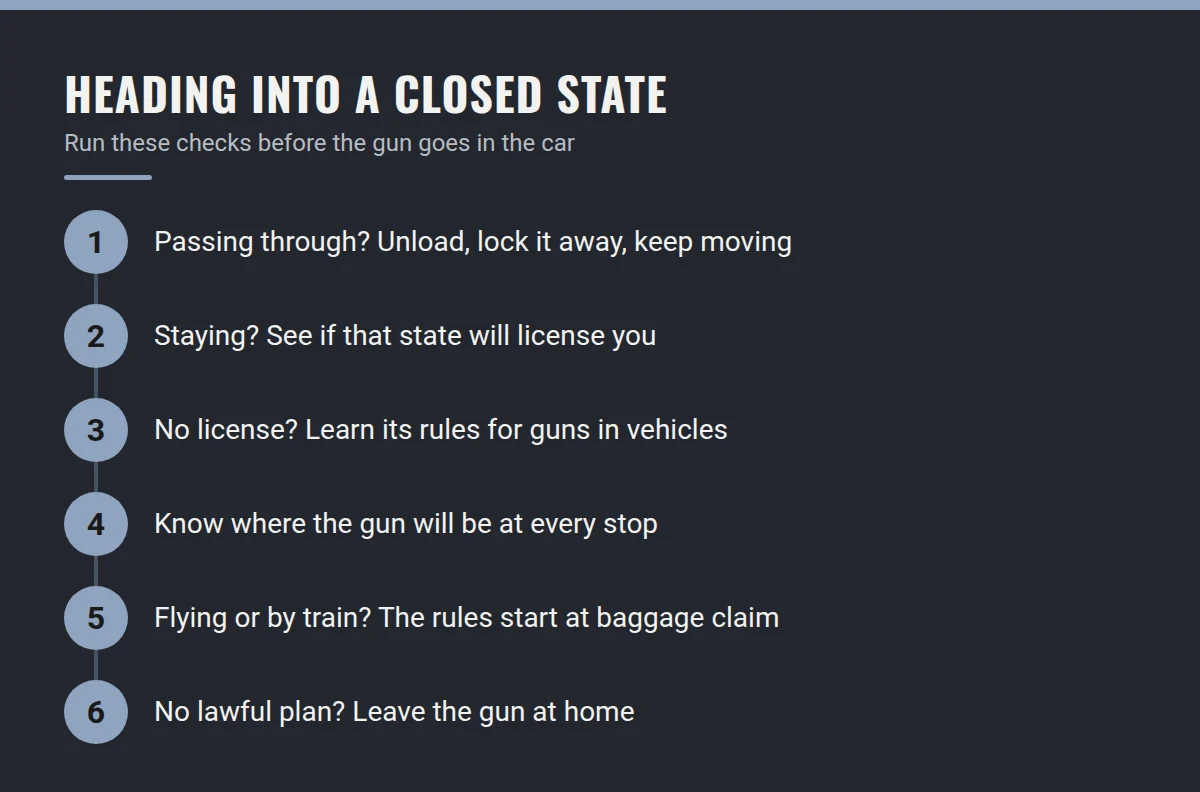
- Destination or corridor? If you are only crossing the closed state on the way to a place where you can lawfully carry, use federal safe passage: unloaded, locked up, out of reach, and keep moving. Plan fuel and meals so that you are not stopping overnight.
- Will the state license you? Check the three groups above. If you qualify and visit often, start the application months before the trip, because none of these states issues quickly.
- If not, what will it let you do? Read the state’s transport rules, such as Oregon’s vehicle and RV provisions, Illinois’s vehicle exception, or California’s locked-container rule. Then read the ordinances of the cities you will pass through, since local rules can be stricter.
- Where will the gun be when you leave the car? A hotel lobby, a restaurant, or a day of sightseeing is where most plans fall apart. If you cannot name a lawful place for the gun at every stop, you do not have a plan yet.
- Arriving by air or rail? The same rules apply from the moment you claim the bag. Our guides to flying with a handgun and to Amtrak’s checked firearm program cover the airport and station versions of this problem.
- No lawful path? Leave the gun at home. Carrying anyway turns a self-defense tool into a criminal charge, and even a justified act of self-defense does not erase an unlawful carry charge.
Will the Courts Open the Rest?
The legal current runs toward opening. Bruen did not decide this question, but it warned that even a shall-issue system can be challenged where “lengthy wait times in processing license applications or exorbitant fees deny ordinary citizens their right to public carry.” A flat residency bar does not slow an application down; it forbids one. In July 2025 a federal judge in San Diego ruled that California’s “provisions barring nonresidents from applying for CCW licenses violate the Constitution,” and the legislature rewrote the law within months. New York settled a challenge to its own practice. Hawaii consented to judgment.
None of that binds Oregon. Each result came from a different court applying a different statute, and the Hawaii judgment protects only the parties and the members of the group that sued. Ladd’s suit also raises a question the others did not, whether a state may let its cities ban the open carry of loaded guns, and a court could answer that separately from the licensing question. Expect months before any ruling, and longer if it is appealed. Until then, plan around the law as written, not the law as it may soon be.
The Bottom Line
Most of the closed states have become hard rather than closed. A visitor who plans months ahead can get a New Jersey, Massachusetts, or now a California license and carry there lawfully. Oregon is the clearest exception. Unless you live next door and find a willing sheriff, or own or lease property in an Oregon county, there is no license for you to get, no outside permit it will honor, and in many of its cities no lawful way to carry a loaded handgun at all. Illinois and Hawaii leave narrower gaps.
Plan those trips around transporting the gun rather than carrying it, check each state’s statutes and the cities on your route before you leave, and when a trip leaves you genuinely unsure, ask a firearms attorney licensed in that state. Wherever you carry, an in-person course with a certified instructor is still where safe carry starts.
Further reading (sources)
- Gun Owners Foundation publishes the Ladd v. Hunter complaint, including Ladd’s calls to two sheriff’s offices
- CourtListener tracks the Ladd v. Hunter docket and its November deadlines
- Oregon Legislature with the firearms chapter covering license residency, vehicle carry, and local loaded-gun bans
- Yamhill County Sheriff’s Office on Oregon’s refusal to recognize any other state’s license
- Marion County Sheriff’s Office for its policy of licensing only county residents
- Umatilla County Sheriff’s Office with its residency waiver form and the property owner rule
- City of Portland code on possessing a loaded firearm in a public place
- Handgunlaw.us keeps a chart of which permits each state honors and a guide to which states license nonresidents
- U.S. District Court for the Southern District of California in the Hoffman v. Bonta order striking the nonresident bar
- California Department of Justice on licensing nonresidents under AB 1078 and how visitors may transport a handgun
- California Legislative Information for Penal Code 25610, the locked-container transport rule
- U.S. District Court for the District of Hawaii with the Solinsky v. Lopez consent judgment
- Hawaii News Now reporting that visitors must join the Hawaii Rifle Association to apply
- Illinois State Police on the six states whose residents can get an Illinois license
- Illinois General Assembly with the nonresident vehicle carry rule and the FOID card exemptions for nonresidents
- Massachusetts Legislature for the nonresident license and the travel-through vehicle exemption
- New Jersey State Police with instructions for out-of-state carry permit applicants
- Maryland State Police on its wear and carry permit, fingerprinting included
- Connecticut General Assembly for the statute letting other states’ permit holders apply
- Rhode Island General Assembly with the statute on licenses for holders of other states’ permits
- Council of the District of Columbia on who may apply for a D.C. carry license
- Metropolitan Police Department listing the D.C.-registered handgun requirement
- U.S. Supreme Court in Bruen, on wait times and fees that can make licensing unconstitutional
- Legal Information Institute with the federal safe passage statute, 18 U.S.C. 926A
- Third Circuit on the Revell ruling that an overnight stop fell outside safe passage