Justified in the Act, Convicted for the Carry: Why Self-Defense Does Not Excuse an Illegal Gun
Published on October 7, 2026

On July 3, 2026, a fight at Fairlane Town Center in Dearborn, Michigan turned into a shooting. Cameron Watkins shot and killed 19-year-old Keonte Seaborn, wounded a second person during a struggle and kept firing inside the crowded mall. Martinez Long, a 19-year-old from Oak Park, drew a handgun and shot Watkins, killing him and ending the attack. He was never charged for that. The lawyers on both sides agreed he had acted in self-defense or in defense of others.
He was charged with carrying a concealed weapon without a license instead, and on September 8 a judge sentenced him to two years of probation. “I know there was a gun fight at the Fairlane mall, and the lawyers have agreed, according to this court’s evaluation, that you were acting in self-defense or the defense of others, so that’s a valid legal defense,” the judge told him, according to FOX 2 Detroit. In the next breath: “Why did you walk into the mall with a gun in the first place?”
Both halves of that are correct, and the gap between them is the part most carriers get wrong. Being right in the moment answers the shooting. It does nothing about the carry. If your age, your permit, the place you were standing or your own legal status made carrying that gun a crime, a flawless defensive shooting leaves that crime exactly where it was.
Two Charges, Two Different Questions
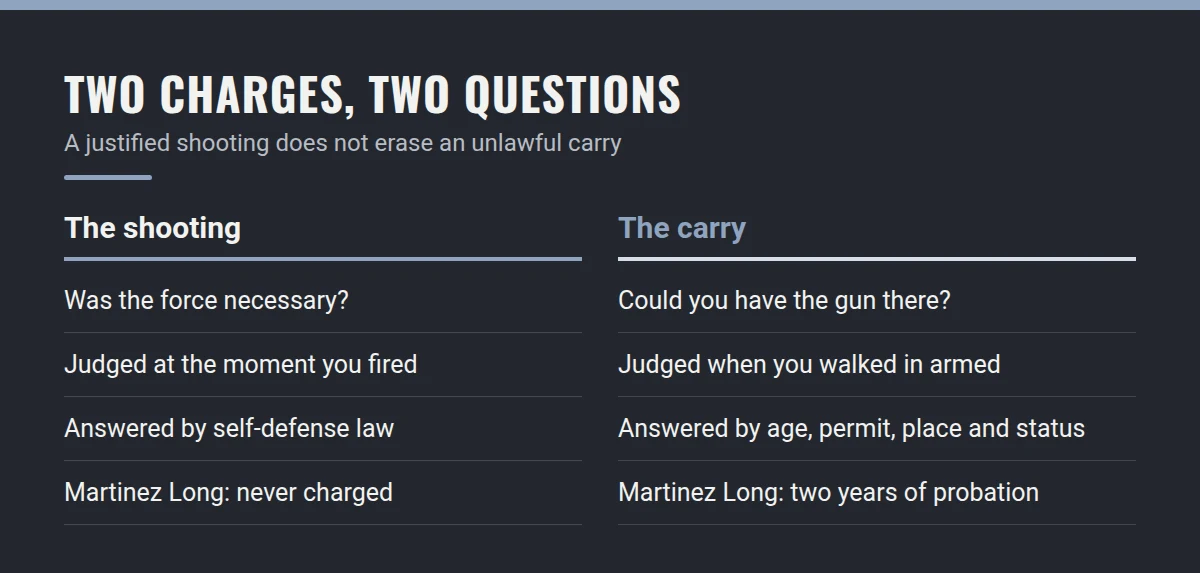
Self-defense is a justification for using force. It asks whether, at the moment you fired, you reasonably believed deadly force was necessary to stop an imminent threat of death or great bodily harm to you or someone else. A carry or possession charge asks something else: whether you were allowed to have that gun, in that place, on that day. The two have different elements, turn on different evidence and are decided separately.
Timing keeps them apart. Long’s carry offense was complete the moment he walked into the mall with a concealed pistol and no license, before anyone fired a shot. His justification for shooting did not exist until Watkins opened fire. A defense that comes into being in the middle of an attack cannot reach back and excuse a decision made before the attack began.
The statute leaves no opening either. Michigan’s carry law, MCL 750.227, makes it a crime to carry a pistol concealed, or in a vehicle, without a license, and its only exceptions are your dwelling house, your place of business and other land you possess. A violation is a felony punishable by up to five years in prison. Self-defense appears nowhere in it. Lawmakers know how to write that exception when they want one: the federal law barring juveniles from possessing handguns, 18 U.S.C. 922(x), exempts a juvenile’s possession of a handgun taken “in defense of the juvenile or other persons against an intruder into the residence.” Michigan’s carry statute has no such clause.
None of this is new. In 1987 a New York jury acquitted Bernhard Goetz of attempted murder, assault and reckless endangerment for shooting four young men on a subway train, and convicted him of criminal possession of a gun. He served just over eight months of a one-year sentence on that count alone.
The separation runs in both directions. In September a 38-year-old man carrying two handguns pushed his way toward a candidate for governor at Ohio’s Canfield Fair, knocking two older people down. Ohio law does not let fairs ban attendees from bringing their own guns, and he was booked on assault and disorderly conduct offenses. A lawful carry does not excuse unlawful conduct, and lawful conduct does not excuse an unlawful carry.
The Narrow Exception: A Gun You Did Not Bring
Courts do sometimes excuse possession itself, and the cases show exactly where the line sits. In People v. Dupree (2010), the Michigan Supreme Court held that a man charged as a felon in possession of a firearm could raise self-defense against that charge. His evidence was that the man fighting him was the one carrying the gun, and that he took hold of it only during the struggle.
Federal courts frame the defense even more narrowly and make the defendant prove it. In Dixon v. United States (2006), a federal gun case, the jury was told the defendant had to show an unlawful and imminent threat of death or serious bodily injury, that she had not recklessly or negligently put herself in the situation, that she had no reasonable legal alternative to breaking the law, and a direct causal link between her crime and avoiding the harm. The Supreme Court upheld putting the burden of proving it on her.
Run a carrier who left the house armed through either test and it fails at the first step. When the gun went on that morning there was no imminent threat, only the possibility of one someday, and arming yourself against a possible future threat is exactly what these defenses do not cover. The exception protects the gun you grabbed in the fight. It does not protect the one you brought to it.
Where Ordinary Carriers Get Caught
Long’s problem was his age. The same split shows up anywhere the carry, rather than the shooting, is the weak link, and most of these traps catch people who think of themselves as careful, lawful carriers.

Age. Michigan issues concealed pistol licenses only to applicants who are at least 21. At 19, Long had no lawful way to carry a pistol concealed outside his home, business or land, whatever his reasons. Plenty of states let young adults own a gun years before they can carry one, and our explainer on buying at 18 versus carrying at 21 separates those two ages.
Off-limits places. A valid permit does not cover every address. In Texas, carrying on the premises of a racetrack, or of a business that earns 51 percent or more of its income from alcohol served for drinking on site, is a third-degree felony under Penal Code 46.03, and carrying where a high school, college or professional sporting event is under way is a Class A misdemeanor. A federal judge upheld all three bans in March 2026. On appeal, the director of the Texas Department of Public Safety, the official being sued, told the Fifth Circuit he agrees with the challengers that the bans are unconstitutional and should not be enforced. He still asked the court to dismiss the case rather than block them, and his brief notes that local officials and private parties would remain free to stop people carrying in those places even if he were enjoined. A statute you believe is unconstitutional is still the statute, and our Second Amendment case law guide explains why a ruling does not change the law where you stand until it is final. Tribal land is its own category, because your state permit stops at the reservation line.
Posted buildings. Where a compliant sign carries the force of law, walking past it armed is an offense in its own right, committed at the door and separate from anything that happens inside. Our guide to whether no-guns signs have the force of law sorts the states that make it a crime from those that treat a sign as a request.

An expired permit. A license that lapsed last month is not a weaker license. In a state that requires one, it can leave you carrying with no license at all. Michigan keeps a license valid while a renewal application filed before the expiration date is pending (MCL 28.425l), which is the whole argument for renewing early rather than on the last day.
Prohibited status. A felony record, a domestic violence misdemeanor, a qualifying protective order, or being an unlawful user of a controlled substance (which under federal law includes users of state-legal marijuana) makes possessing any gun a federal crime under 18 U.S.C. 922(g). A local decision not to charge the shooting does not bind federal prosecutors.
An Unlawful Gun Can Also Shrink the Self-Defense Claim
The illegal carry does more than add a count. In several states it strips away protections the shooting would otherwise have had.
Michigan’s Self-Defense Act lets a person use deadly force with no duty to retreat anywhere they have a legal right to be, but only for “an individual who has not or is not engaged in the commission of a crime at the time he or she uses deadly force.” Carrying a concealed pistol without a license is a felony, so an unlicensed carrier who has to shoot may be left arguing under Michigan’s older common law rules instead. Florida attaches the same condition to its stand-your-ground rule, which covers a person who “is not engaged in a criminal activity and is in a place where he or she has a right to be.” Texas withholds both its no-retreat rule and its presumption that deadly force was reasonable from anyone engaged in criminal activity at the time.
Georgia goes furthest. Its immunity statute does not apply when a person uses deadly force with “a weapon the carrying or possession of which is unlawful by such person,” and in State v. Burks (2009) the Georgia Supreme Court applied that exclusion to reverse the dismissal of an indictment against a convicted felon who had claimed immunity.
Long’s facts, an active shooter firing inside a crowded mall, were strong enough that none of this decided anything. Most defensive shootings are murkier: an argument in a parking lot, a disputed sequence of events, one surviving witness on each side. Those are the cases where the no-retreat rule and the presumption of reasonableness do the heavy lifting, and they are exactly the cases where an unlawful gun can take both away. Our use of force legal primer covers how retreat rules differ from state to state.
What the Carry Count Costs
Strictly speaking, Long was not convicted. He was sentenced under Michigan’s Holmes Youthful Trainee Act, which lets a judge accept a guilty plea from someone who was 18 to 25 at the time of the offense without entering a conviction. If he completes probation, the court discharges him and dismisses the case. “This gives you a clean slate,” the judge told him. Until then, he must complete cognitive behavioral therapy and handgun safety classes, and he cannot possess guns or ammunition. The man who stopped a mall shooter cannot lawfully have a gun for the next two years.

That break is discretionary. It needs the prosecutor’s consent for anyone who was 21 or older at the time of the offense, and it is not available at all for an offense committed at 26 or older. Without it, the same count under MCL 750.227 is a felony conviction. Federal law bars anyone convicted of a crime punishable by more than a year in prison from possessing a firearm or ammunition, so the carry charge that rides along with a justified shooting can end gun ownership altogether. Getting that right back, where it is possible at all, is a separate legal project.
Check the Carry Before You Ever Need the Defense
Each of these is settled before you leave the house, which is the only time you can still fix it.
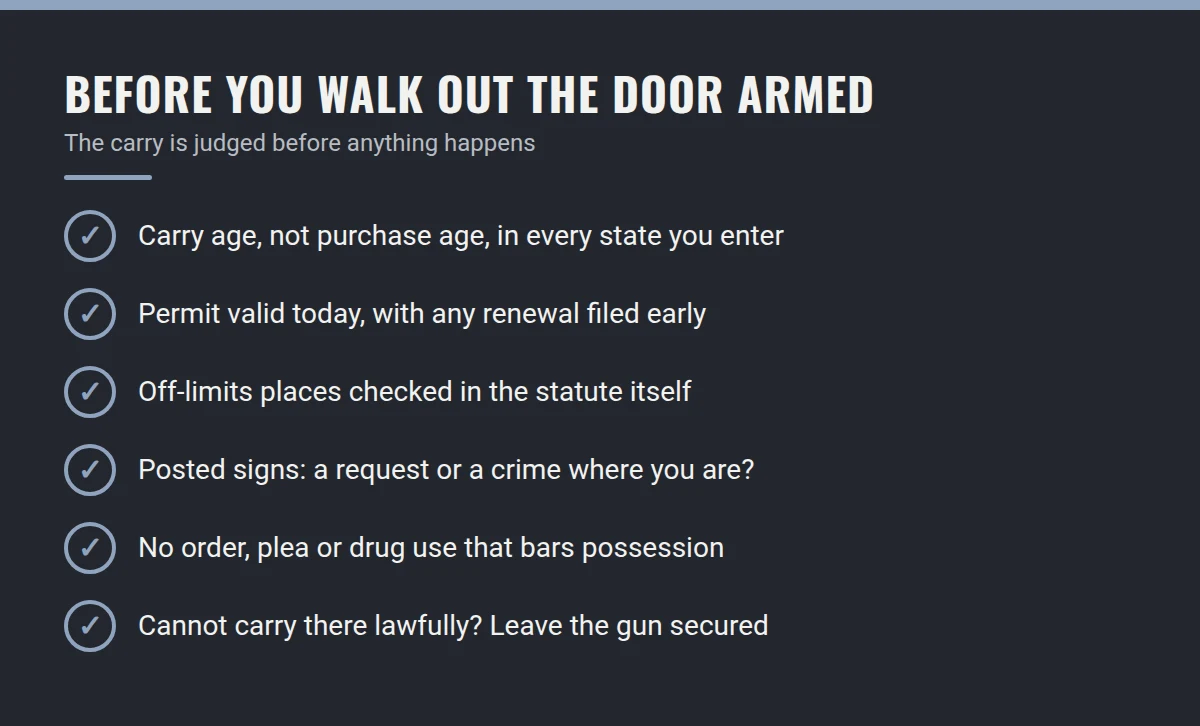
- Know your carry age, not your purchase age, in your state and in every state on your route.
- Track your permit’s expiration date and renew early, so a pending application keeps you covered where your state allows that.
- Read your state’s off-limits list in the statute itself, not a summary of it: bars, sporting events, schools, government buildings, polling places, tribal land.
- Learn whether posted signs carry the force of law where you live and wherever you travel.
- Recheck your status after any change. A new protective order, a plea to a domestic violence misdemeanor or regular marijuana use can make possession itself a crime.
- When you cannot carry somewhere lawfully, do not carry there. Leave the gun at home, or secure it the way your state’s vehicle rules require.
The Bottom Line
Self-defense law judges what you did with the gun in the seconds that mattered. Carry law judges whether you should have had it there at all, and it answers that question before anything happens. A clean defensive shooting will not cure an unlawful carry, and in some states the unlawful carry makes the shooting harder to defend. Settle the second question every morning so the first is the only one you ever have to answer. When your own state, your own status or a charge you already face is the issue, take it to a firearms attorney rather than a website.
Further reading (sources)
- FOX 2 Detroit on the sentencing of the 19-year-old who stopped the Fairlane mall gunman
- Michigan Legislature publishes the concealed pistol statute and its five-year felony penalty and the Self-Defense Act’s no-retreat rule with its crime-free condition
- Michigan State Police lists the age 21 requirement for a concealed pistol license
- Michigan Courts with a judges’ benchbook entry on youthful trainee status and who qualifies
- Cornell’s Legal Information Institute hosts the federal statute with the juvenile intruder exception and the felony bar and the Supreme Court’s Dixon opinion on proving duress in a gun case
- CourtListener carries the Michigan Supreme Court’s Dupree opinion on self-defense to a possession charge and the Georgia Supreme Court’s Burks ruling on the unlawful weapon exclusion
- Texas Public Law reproduces the list of places where carrying is a crime, with penalty grades and the deadly force statute’s criminal activity conditions
- Office of the Texas Attorney General filed the DPS director’s Fifth Circuit brief agreeing the three bans are unconstitutional
- Florida Legislature publishes the stand-your-ground provision and its criminal activity condition
- Spectrum News 1 covering the armed man who rushed a candidate at the Canfield Fair
- Encyclopedia.com on the 1987 Goetz verdict and the gun sentence that followed