Use of Force for Concealed Carriers: A Comprehensive Legal Primer
Published on May 26, 2026

A concealed carry permit lets you carry a defensive firearm. It does not, by itself, tell you when you may use it. Use of force law is the second half of CCW training, and it is the half that decides whether a defensive shooting ends with you walking out of the police station or sitting in a jail cell. This guide is the umbrella reference for every legal concept that governs that decision: the deadly-force standard, castle doctrine, stand your ground, duty to retreat, defense of others, defense of property, brandishing, warning shots, disparity of force, and what happens in the minutes and hours after a shot is fired. As always, treat it as a starting map. Real cases live or die on facts, and the moment yours becomes one you need a firearms attorney, not a blog post.
The Deadly-Force Standard: AOJ Plus Imminence
Across nearly every US jurisdiction, deadly force in self defense is lawful only when you reasonably believe you face an imminent threat of death or serious bodily harm. Trainers and prosecutors commonly break that “reasonable belief” into the AOJ triangle, with imminence as the binding glue.
- Ability. The attacker has the capacity to inflict serious harm. A firearm or knife obviously qualifies. So can bare hands, depending on the disparity between attacker and defender.
- Opportunity. The attacker is positioned to use that capacity right now. A man with a knife at thirty feet behind a chain-link fence does not have opportunity. The same man at six feet in an open hallway does.
- Jeopardy. The attacker is acting in a way that signals intent to use the ability and opportunity against you. Words plus motion, weapons drawn, an aggressive closing of distance.
- Imminence. The threat is happening now, not five minutes from now and not yesterday. Past threats and future threats do not justify present force. This is the element prosecutors attack most often, because hindsight always shrinks the window.
All four elements have to be present, and you have to be able to articulate them honestly to a responding officer and later to a jury. The standard is reasonableness, not certainty.
Castle Doctrine
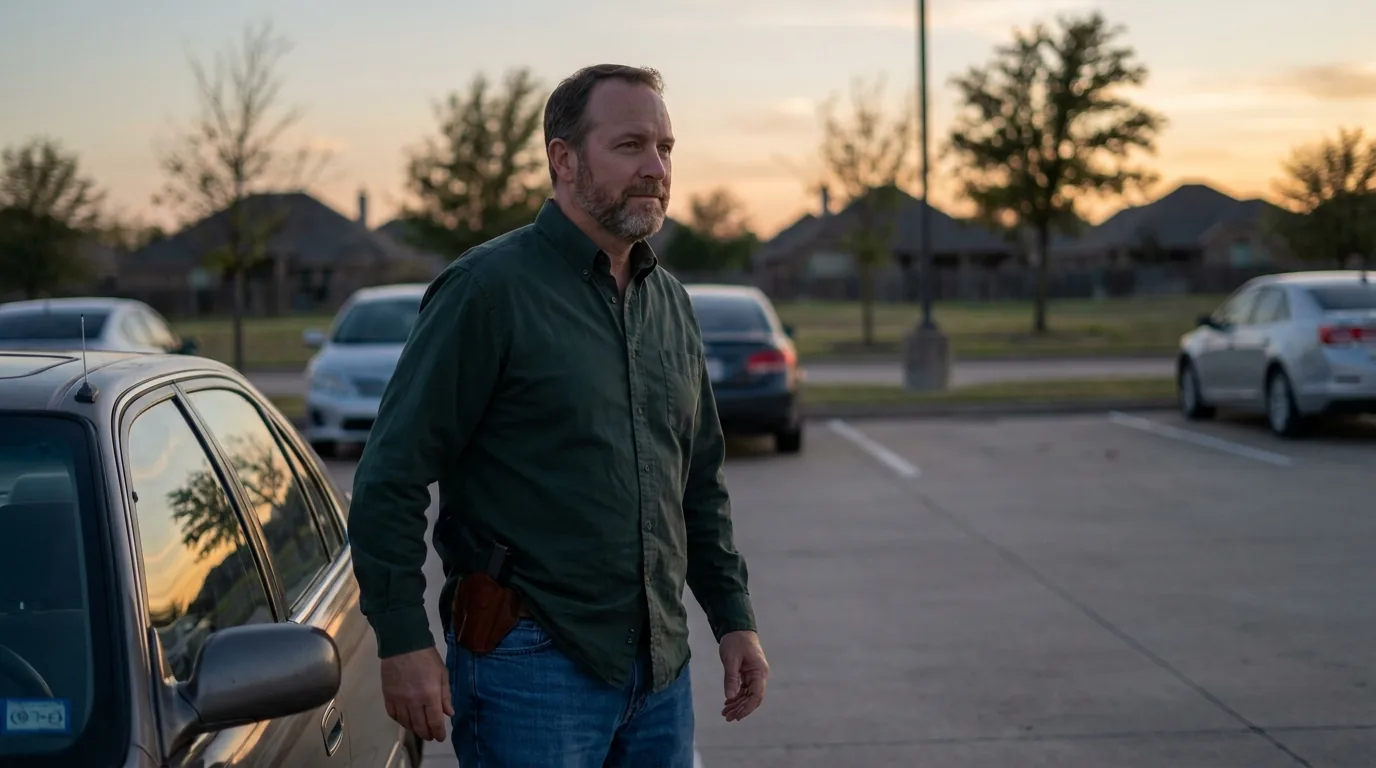
Castle doctrine is the legal principle that your home (and in many states your vehicle and place of business) carries an inside layer of protection where the duty to retreat does not apply and where the law often presumes that an unlawful, forcible entry creates a reasonable fear of serious harm. Practically, that means an intruder who breaks into your occupied home at night does not require the same step-by-step AOJ analysis a confrontation in a parking lot would. The presumption is rebuttable, and it does not authorize shooting someone you find leaving with your television. It governs the moment of forcible, unlawful entry into an occupied dwelling.
Stand Your Ground vs Duty to Retreat
Outside the home, states split on whether you must try to avoid the fight before defending yourself.
- Stand-your-ground states (the majority, roughly 38) impose no duty to retreat anywhere you are lawfully present, so long as the AOJ standard is met.
- Duty-to-retreat states (about a dozen, including New York, New Jersey, Massachusetts, Connecticut, Maryland, and Hawaii) require you to retreat in public if you can do so with complete safety before resorting to deadly force. The home exception (castle doctrine) usually still applies.
The Johns Hopkins Center for Gun Violence Solutions notes that stand-your-ground laws have been associated with measurable increases in homicide in some studies, and that the legal expansion of self-defense doctrine remains a live policy debate (Johns Hopkins, 2024). Whatever your view of the policy, the legal point is simple: know which side of the line your state sits on, and re-check before you travel.
Defense of Others
Most states allow you to use force in defense of a third person on the same terms you could use it in your own defense, judged from the perspective of the person being defended. Two recent cases illustrate the stakes. An Oklahoma high school principal was shot while tackling a former student armed with handguns, an intervention that almost certainly saved students’ lives but came at severe personal cost (The Guardian, 2026). At Aetna’s Connecticut headquarters, security personnel physically tackled a man who entered the lobby armed with an AR-style pistol, ending what could have been a mass-casualty event (New York Post, 2026). Neither responder fired, but both made split-second defense-of-others decisions that the law will judge on the same AOJ standard. The risk for a CCW holder is the “wrong end of the stick” problem: you arrive mid-incident, misread who the aggressor is, and intervene against the lawful defender. Verify before you act, and remember you are not legally required to intervene.
Defense of Property
Almost no state authorizes deadly force purely to protect property. Texas is the famous outlier with a narrow nighttime theft provision, and even there the application is fact-bound and contested. The general rule is that property is replaceable and human life is not. You can use reasonable, non-deadly force to prevent a theft or trespass. You generally cannot shoot someone who is running away with your laptop.
Brandishing, Lawful Display, and Warning Shots
Most CCW holders never fire a shot, but a meaningful number draw or display a firearm. The legal line between lawful defensive display and the crime of brandishing (or improper exhibition, menacing, aggravated assault, depending on the jurisdiction) is whether the AOJ elements were present at the moment of the draw. Producing a firearm to deter an articulable threat is generally lawful. Producing one to win an argument, intimidate a driver, or “send a message” is a felony in most states.
Warning shots are a category error. They are treated as deadly force in nearly every jurisdiction (you fired a bullet) without the corresponding legal justification (you did not have an immediate target). Several states explicitly prohibit them, and even where the statute is silent, prosecutors charge them as reckless endangerment or worse. The training rule is simple: if the situation does not justify shooting the threat, it does not justify shooting the air.
Disparity of Force
The AOJ standard does not require the attacker to be armed with a weapon identical to yours. Disparity of force is the doctrine that recognizes when an unarmed attacker can nonetheless present a deadly threat: multiple attackers against one defender, a much larger or stronger attacker, a trained fighter against an untrained defender, a young attacker against an elderly or disabled defender, or an attacker who already has you on the ground. The defender’s job is to articulate why a reasonable person would have perceived deadly jeopardy from someone who, on paper, was unarmed.
The Post-Shooting Protocol
What you do in the first five minutes after a defensive shooting can matter as much as the shooting itself. The standard protocol taught in serious CCW programs:
- Make the scene safe. Stop the threat, scan for additional threats, holster or secure the firearm if it is safe to do so.
- Call 911 first. Identify yourself as the victim of a crime, give the location, request police and EMS, and stay on the line only long enough to communicate the essentials.
- Render aid if you safely can. This is both ethically right and legally protective.
- Comply visibly when officers arrive. Hands empty and visible, follow commands, expect to be handcuffed and disarmed regardless of fault.
- Invoke counsel before giving any statement beyond identifying basic facts. A short, calm sentence such as “I will fully cooperate after I speak with my attorney” preserves your rights without sounding evasive. Detailed statements made under adrenaline are routinely inaccurate, and inaccuracies become impeachment material.
- Preserve evidence. Do not touch shell casings, do not reposition anything, do not retrieve your firearm from where officers placed it.
State Law Variation: The One Constant
The single most dangerous assumption a CCW holder can make is that the rules are the same across state lines. The North Carolina legislature spent the 2026 session debating SB50, a bill that would have eliminated the state’s pistol purchase permit and concealed carry permit requirements, with override votes contested even after a gubernatorial veto (ABC11, 2026; NC Newsline, 2026). Nebraska’s largest city has been actively revising police policy to address officer confusion about the state’s own gun laws (KETV, 2025). And the standard reciprocity reference Handgunlaw.us shows just how often state statutes shift mid-year (Handgunlaw.us, 2026). The implication for use of force is the same as for permit law: verify locally, every time, before you travel. For the broader patchwork of state permit rules see our state laws and training requirements guide, and for federal statutes that sit above all of this see our federal firearms law reference.
Use of force law is unforgiving terrain. The trainers and attorneys who specialize in it earn their fees the day you need them. Build the foundation in a quality in-person course (start with our first concealed carry course guide if you have not yet enrolled), carry the right tools for the job you have prepared for (picking that first pistol matters), and read the CCW class FAQ before you walk in. The decision to carry is a commitment to know the law as well as the firearm.
Further reading (sources)
- ABC11 Raleigh-Durham on the North Carolina SB50 concealed carry override fight
- NC Newsline for the campaign to preserve North Carolina’s concealed weapons permit law
- The Guardian with the Oklahoma principal shot while tackling an armed ex-student
- New York Post on the Aetna headquarters AR-pistol intervention
- NBC Los Angeles for the armed suspect detained near Trump National Golf Course
- Johns Hopkins Center for Gun Violence Solutions on the regulation and consequences of public firearm carry
- Everytown Research for the policy analysis of concealed carry mandates
- KETV with Omaha police updating policy amid confusion over Nebraska gun laws
- Handgunlaw.us on state-by-state firearm law updates and reciprocity
- Shaw Local for a state-level look at Illinois concealed carry regulations