Gun-Free School Zones Act: What CCW Holders Must Know About the 1,000-Foot Federal Rule
Published on September 7, 2026
On April 16, 2026, a 38-year-old Independence man walked into the office of Sunny Pointe Elementary School in Blue Springs, Missouri, with a handgun loaded with fifteen rounds in his waistband. Officers detained him there, and Jackson County charged him with a felony count of unlawful use of a weapon. Bond was set at $75,000, cash only. Nothing about that case was an honest mistake: the woman who called police had been in a prior relationship with him, had two previous restraining orders against him, and told officers he had threatened to shoot her and take their son.
But the case surfaces a question that ordinary permit holders get wrong more often than almost any other point of carry law. That charge was filed under Missouri state law, not federal law. Sitting quietly on top of it is a separate federal statute that draws a 1,000-foot circle around every K-12 school in the country, and the exception carriers assume protects them is narrower than they think.
The Statute Nobody Reads Until It Matters
The Gun-Free School Zones Act lives at 18 U.S.C. 922(q)(2)(A). It makes it a federal crime to knowingly possess a firearm at a place you know, or have reasonable cause to believe, is a school zone.
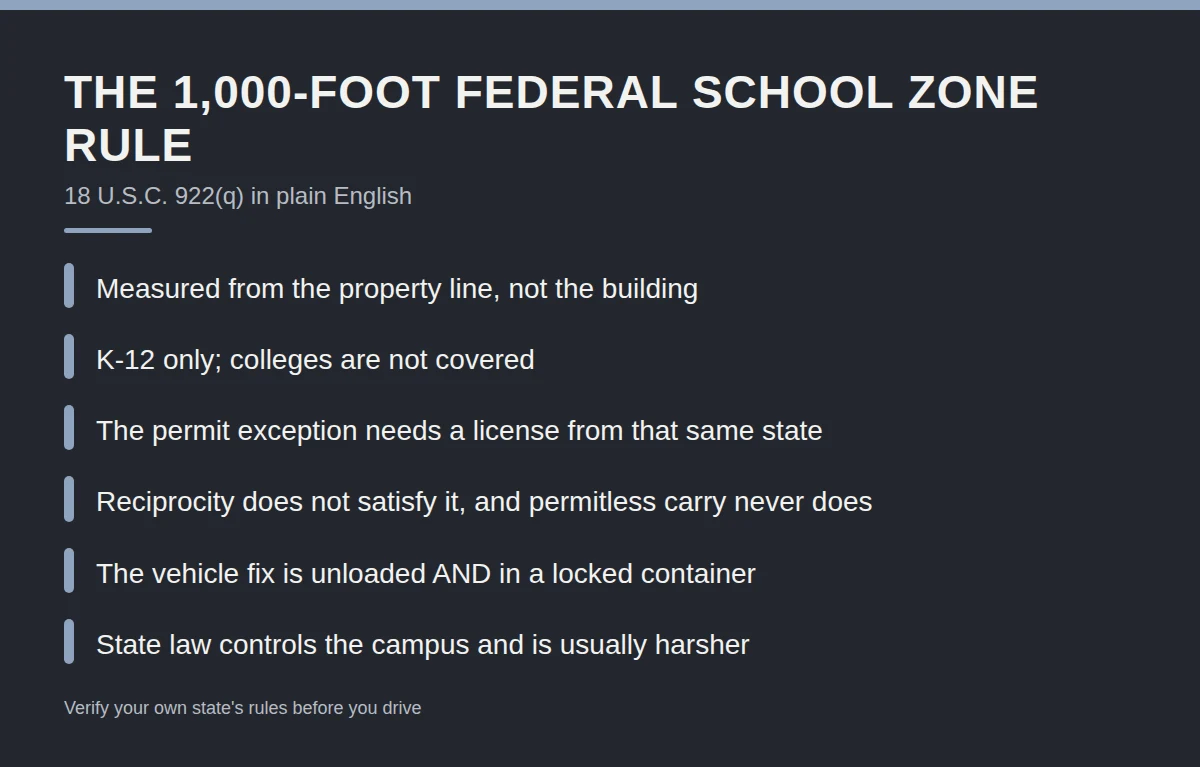
Two definitions do the heavy lifting. Under 18 U.S.C. 921(a)(26), a “school zone” means in or on the grounds of a public, parochial, or private school, or within a distance of 1,000 feet from the grounds of one. Under 921(a)(27), a “school” is one that provides elementary or secondary education as determined under state law. That last clause quietly excludes colleges and universities, which have their own separate patchwork of state rules.
Three details about that 1,000 feet catch people out.
It runs from the property line, not the building. A school with athletic fields and a bus loop pushes its zone hundreds of feet farther out than the schoolhouse suggests.
It is a radius, not a frontage. A circle with a 1,000-foot radius encloses roughly 72 acres on its own, and because the zone is measured outward from the grounds in every direction, the actual footprint is larger than that. In an older residential grid, that is three or four blocks in each direction.
It does not stop at the curb. Public sidewalks, streets, bus stops, and the parking lots of neighboring businesses all fall inside the zone if the geometry puts them there.
The penalty sits at 18 U.S.C. 924(a)(4): a fine, up to five years in prison, or both. Any prison term imposed under that paragraph cannot run concurrently with another sentence, which means it stacks. One oddity works in a defendant’s favor: despite the five-year exposure, the statute says a 922(q) violation “shall be deemed to be a misdemeanor” for the purpose of any other law, so a conviction does not automatically trigger the lifetime federal firearms ban that a felony would.
The Permit Exception, and the Trap Inside It
Most carriers know there is a permit exception. Very few have read what it actually requires.
Exception 922(q)(2)(B)(ii) applies where the person is licensed to possess the firearm by the state in which the school zone is located, or a political subdivision of that state, and where the law of that state requires law enforcement authorities to verify the applicant is qualified to receive the license before issuing it.
Read that twice, because it contains the single most misunderstood sentence in concealed carry law.
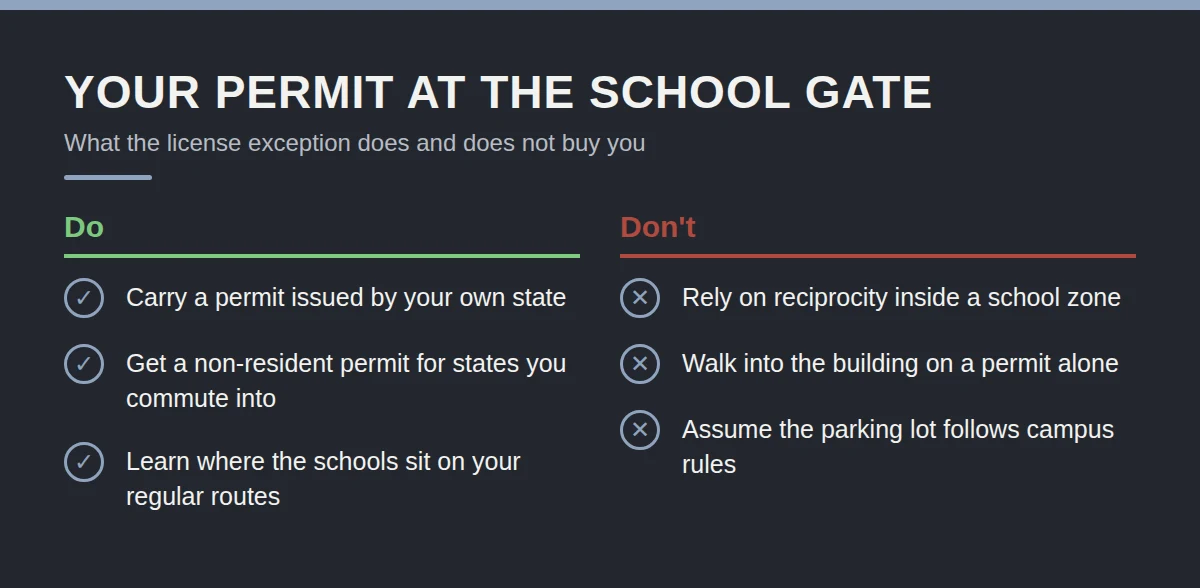
The license must come from the state where the school physically sits. Not a state that honors your permit. Not a state you have a reciprocity agreement with. The issuing state. Your Ohio permit may be perfectly valid for carry purposes when you drive into Kentucky, but it does nothing for you under the federal school zone statute the moment you pass a Kentucky elementary school, because Kentucky did not issue it. The ATF has confirmed this reading, and it is the reason the exception is sometimes called the reciprocity trap. Our state travel atlas covers how permits do and do not travel; this is the one place where the reciprocity map is simply irrelevant.
A non-resident permit from that state does work. This is the practical fix almost nobody uses. If you live in Tennessee and commute into Georgia five days a week, a Georgia non-resident license, where available, satisfies the federal exception on Georgia roads in a way your Tennessee permit never will. The statute cares about who issued the paper, not where you sleep.

Permitless carry does not satisfy it at all. There is no license and no verification step, so there is nothing for the exception to attach to. A resident of a permitless state carrying lawfully under state law, with no permit in his wallet, is inside the federal prohibition every time he drives past a middle school. This is one of the sharper arguments for getting the optional permit anyway, alongside the training and reciprocity reasons we have covered before.
The exception is not theoretical. In United States v. Tait (2000), the Eleventh Circuit overturned a school zone conviction precisely because the defendant held a license issued by the state where the zone was located.
The Other Exceptions Most Carriers Never Read
Section 922(q)(2)(B) lists seven exceptions in total. Four of them matter to ordinary carriers.
Private property not part of school grounds. Your house, your yard, your driveway, and a private business or its lot are outside the prohibition even when they sit inside the 1,000-foot ring. A public sidewalk in front of your house is not private property, which is a distinction that matters if you carry on a dog walk.
Unloaded and in a locked container. The vehicle exception requires the firearm to be unloaded and in a locked container, or in a locked firearms rack on a motor vehicle. Both conditions, not either. This is far stricter than most state vehicle-carry laws, which routinely permit a loaded handgun in a console or a mounted holster. Complying with your state’s car rules tells you nothing about whether you have satisfied this one, a gap worth reading alongside our full guide to carrying in your vehicle.
School-approved programs and contracts with the school. A firearm possessed for a program the school has approved, or under a contract between the school and you or your employer, is exempt. This is the hook that armed school staff programs hang on, covered in depth in our article on teacher and staff carry in K-12 schools.
Law enforcement acting in an official capacity. Straightforward, and it does not extend to retired officers relying on state law alone.
One more subsection deserves a mention. Section 922(q)(4) says nothing in the federal provision preempts a state or local government from enacting its own gun-free school zone law. The federal rule is a floor, never a ceiling.
Drop-Off and Pickup: Where This Actually Bites
At a school on a weekday morning, three separate bodies of law are stacked on top of each other, and they answer different questions.
The federal statute governs the 1,000-foot ring. The state statute governs the campus itself and is almost always the harsher of the two. District policy governs employees and visitors and can cost you a job or a trespass warning without any criminal charge at all.
Missouri, the state in the Blue Springs case, shows how differently the layers behave.
Under RSMo 571.030.1(10), carrying a firearm into any school, onto any school bus, or onto the premises of any function sponsored or sanctioned by school officials is unlawful use of a weapon. It is a class A misdemeanor if the firearm is unloaded and a class E felony if it is loaded. That is the charge in the Blue Springs case, and note that it turns on the gun crossing the threshold, not on the man’s intent or his permit status.
Under RSMo 571.107, a concealed carry permit does not authorize carry into a school facility without consent from the district. But that same section carries a provision worth memorizing: possession of a firearm in a vehicle on the premises of an elementary or secondary school is not a criminal offense so long as the firearm is not removed from the vehicle or brandished while the vehicle is on the premises. And a permit holder who simply enters a place the permit does not reach faces a citation ladder rather than a charge: up to $100 for a first offense, up to $200 and a one-year suspension for a second within six months, up to $500 and revocation with three years of ineligibility for a third.
Put those together and the practical shape of the risk becomes clear. In Missouri, the permit changes your exposure substantially inside the car and changes it almost not at all once you step out and walk to the door. Most states follow a version of that pattern, though the specifics move at every state line, which is why the state-by-state overview is worth checking before you assume yours matches.
Watch the edges, too. That Missouri statute reaches school-sponsored functions, which sweeps in field trips, away games, and a rented banquet hall on awards night, none of which look like a school when you pull into the lot.
Is the Law Vulnerable? Not Yet
The Gun-Free School Zones Act has a genuinely strange legal history, and it feeds a lot of internet confidence that the statute is dead. It is not.
Congress passed the original act in 1990. In United States v. Lopez (1995), the Supreme Court struck it down 5-4, holding that possessing a gun near a school neither regulated commercial activity nor required any connection to interstate commerce. It was the first time in more than half a century the Court had cut back the Commerce Clause that way.
Congress re-enacted the statute in 1996 with a jurisdictional element bolted on, limiting it to firearms that have moved in or otherwise affect interstate or foreign commerce. Because virtually every firearm has crossed a state line at some point in its life, that element is satisfied in nearly every case. Every federal appeals court to review the amended version has upheld it, including the Eighth Circuit in United States v. Danks (1999) and the Ninth Circuit in United States v. Dorsey (2005).
The most recent test came after Bruen. On June 16, 2025, a Fifth Circuit panel unanimously rejected a Second Amendment challenge in United States v. Allam. Ahmed Allam had parked the SUV he was living in beside a Texas K-8 Catholic school for weeks, was repeatedly asked to leave, and made statements about a “mission” before police found a rifle and ammunition in the vehicle. Writing for the panel, Judge Cory Wilson traced the restriction to the 1328 Statute of Northampton and later American affray laws barring going armed to the terror of the people.
The opinion is narrower than the headlines suggested. Allam was parked forty to fifty feet from the school, so the buffer zone, as the court put it, needed to do very little work. The panel expressly declined to fix how far a buffer may stretch and offered no opinion on the statute’s constitutionality in any other context. A future challenge from someone standing 900 feet away on a public sidewalk remains genuinely open. Until somebody wins it, plan around the statute as written, and see our federal firearms law reference for how this fits with the rest of the federal framework.
A Compliance Checklist That Actually Works
Hold a permit issued by your own state, even if your state does not require one. This is the single step that resolves the federal problem at home, permanently, for every school you drive past.
Get a non-resident permit from any state you routinely commute into. It is the only thing that satisfies the exception on that state’s roads. Reciprocity will not do it.
Learn where the campuses are on your regular routes. District boundary maps are public. You are looking for the ones you did not know about, the small parochial school in a converted house, the charter campus on the second floor of an office building.
If you cannot satisfy the license exception, unload and lock. Both, in a container, before you leave home. A loaded gun in a locked glovebox does not qualify.
Never treat a permit as campus access. State law and district policy control there, they are harsher than the federal rule, and in Missouri and states like it the difference between the parking space and the front office is the difference between a citation and a felony.
Handle it in your driveway, not in the carline. Every decision here is easy to make before you leave and awkward to make with twelve cars behind you.
The Short Version
The federal school zone rule is not obscure and it is not dead. It applies to a far larger area than the campus, its permit exception turns entirely on which state issued your license, and permitless carry does not satisfy it at all. State law then sits on top and is usually stricter about the campus itself. The Blue Springs case was charged under state law by a man whose conduct nobody would defend, but the federal statute behind it reaches ordinary carriers on ordinary mornings, and most of them have never read it. Anything specific to your route, your permit, or a school zone you have already driven through belongs in front of a firearms attorney, not a forum thread.
Further reading (sources)
- KSHB 41 News on the Blue Springs elementary school handgun charge
- Cornell Legal Information Institute for the text of the federal school zone prohibition and its exceptions
- Cornell Legal Information Institute with the statutory definitions of school zone and school
- Missouri Revisor of Statutes sets out the felony penalty for carrying a loaded firearm into a school
- Missouri Revisor of Statutes on where a permit does not reach and the vehicle provision that saves the parking lot
- Duke Center for Firearms Law for the Fifth Circuit upholding the buffer zone in United States v. Allam
- The Reload covering how narrowly that panel wrote its school zone ruling
- LegalClarity explains why a reciprocity permit fails the federal exception