Defending a Stranger: The Law of Defense of Others and Why It Is Riskier Than Defending Yourself
Published on September 13, 2026
On Saturday, August 1, 2026, a man carrying an AR-style rifle walked out of the drive-thru lane at an In-N-Out Burger in Twin Falls, Idaho and opened fire. A witness stopped at the light outside told NBC News that someone else in that drive-thru line, an ordinary customer with a handgun, was shooting back, and that the gunman’s attention locked onto him. “The shooter was solely focused on him,” the witness said, and “it gave them time to leave.” An off-duty state trooper also returned fire. Police Chief Matthew Hicks said their actions helped drive the suspect away from the scene and prevented further casualties. Three people were killed and seven were injured before the gunman shot himself.
Every carrier who read that story pictured themselves in that line. Almost none of them can name the legal doctrine that would have decided what happened to them afterward.
Defense of Others Is a Borrowed Right
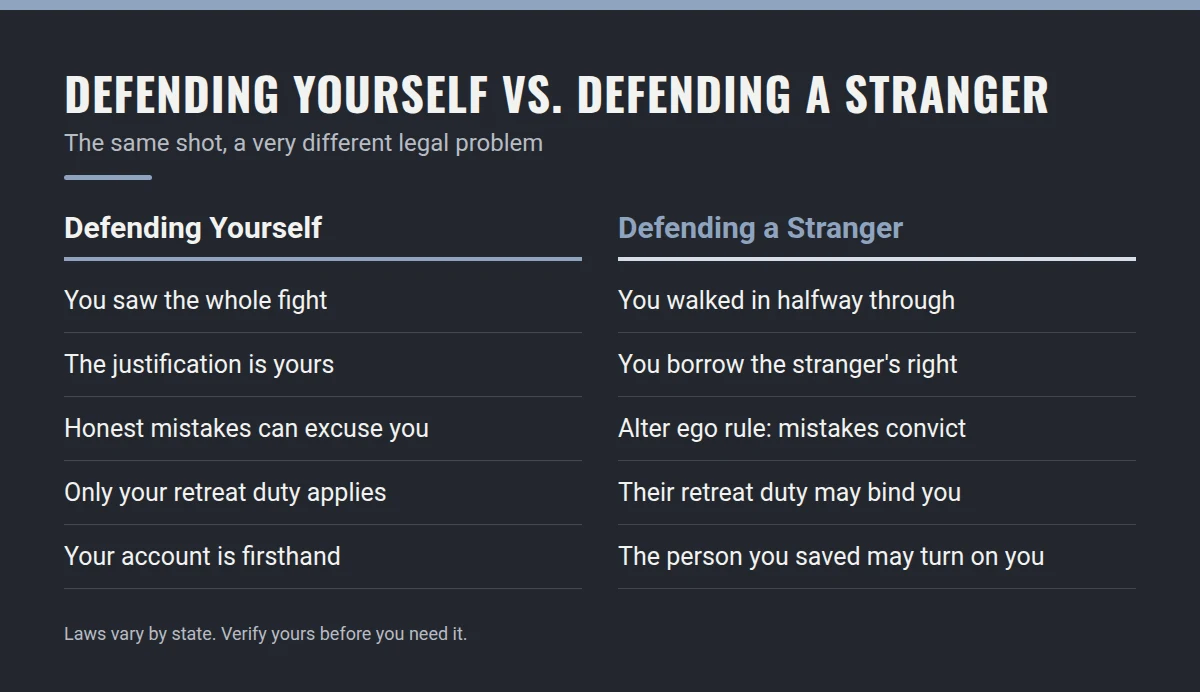
When you defend yourself, the justification belongs to you. You were present for the whole thing, you know who started it, and the facts you will testify to are facts you actually saw.
Defense of a third person works differently. Your right to act is derivative: it is built on top of someone else’s right to defend themselves, and you are joining a story that started before you got there. Two competing rules govern how much that gap costs you.
The reasonable belief standard is the modern majority approach, and the Model Penal Code states it at section 3.05: you are justified if, under the circumstances as you believe them to be, the person you are protecting would have been justified in using that force, and you believe your intervention is necessary. Texas writes it almost word for word in Penal Code section 9.33, which justifies force to protect a third person when “under the circumstances as the actor reasonably believes them to be” he could have used that force to protect himself, and he reasonably believes intervention is immediately necessary.
The alter ego rule is the older approach, and it is brutal. Under it you step into the shoes of the person you are defending and inherit their exact legal position, mistakes included. If they had no right to use force, neither did you, and it does not matter that you could not possibly have known.
The Rule That Convicted a Good Samaritan
The teaching case is People v. Young, decided by New York’s highest court in 1962. Young saw two middle-aged men beating an eighteen-year-old on a sidewalk and waded in to rescue the kid. The men were plainclothes detectives making a lawful arrest. Young’s good faith was never in question, and the appellate court below had thrown out his conviction because his mistake was honest. New York’s Court of Appeals reinstated it. Under the alter ego rule, the boy had no right to resist a lawful arrest, so Young had no right to help him resist, and a reasonable mistake bought him nothing.
Most states have since abandoned that rule. “Most” is doing real work in that sentence. The Wyoming Supreme Court only discarded it in 2021, in Smith v. State, holding it “incompatible with the Wyoming Criminal Code” because the code’s defenses are written around reasonable belief rather than imputed knowledge. That was five years ago, not fifty. A handful of jurisdictions still apply the rule or a partial version of it, and some states that use reasonable-belief language in the statute have case law and pattern jury instructions that pull in the other direction.
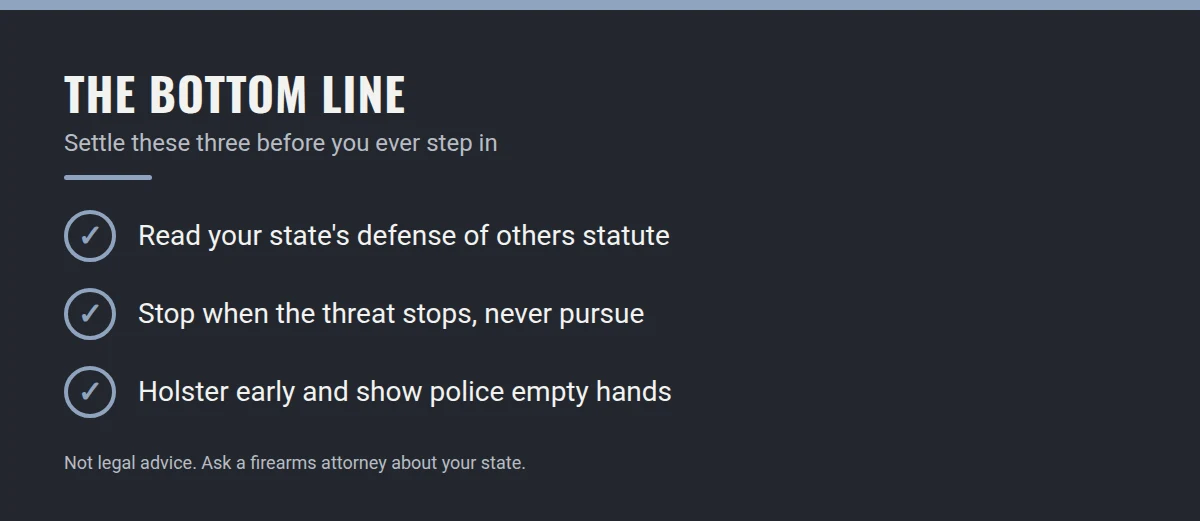
Here is the ten-minute homework, and it is worth doing tonight. Find your state’s defense-of-others provision, which usually sits one or two sections after the self-defense statute. Look for the phrase “reasonably believes.” If the statute grants you force based on what you reasonably perceived, you are in majority territory. If it conditions your right on what the third person was actually entitled to do, you are carrying the other person’s legal risk along with your own. Then check the pattern jury instruction, because that is the language a jury will actually hear. Our state law and training overview is a starting point, but the statute itself is the authority.

What You Cannot See From Across a Parking Lot
Even under the friendliest standard, your belief has to be reasonable given what was visible from where you stood. That is the whole problem, because a great deal is not visible.
You cannot see who started it. Initial-aggressor doctrine strips justification from the person who provoked the encounter, and in most states it strips it from anyone defending them too. The person losing a fight is very often the person who began it.
You cannot see what happened sixty seconds ago. The man being tackled may have just robbed the person tackling him. Mutual combat, two people who agreed to fight, produces no justified party at all in many jurisdictions.
You cannot see credentials. Plainclothes officers, off-duty officers, loss prevention staff, bail enforcement agents and hospital security all look exactly like civilians putting hands on someone. That is precisely how Young got convicted.
You cannot see who else is already working the problem. Twin Falls had two armed responders that day, a civilian and an off-duty trooper, engaging the same attacker from different positions. Neither one was labeled.
Domestic disputes deserve their own warning. They are the most common ambiguous violence a carrier will ever witness, they reverse direction without notice, and the person you intervened for will frequently testify for the other side.
Two Complications Carriers Miss
Retreat obligations travel with you. In a duty-to-retreat state, the Model Penal Code approach says you need not retreat unless you know you can secure the other person’s complete safety by doing so, and if the person you are protecting would have had a duty to retreat, you may be required to try to get them to retreat when you know it can be done in complete safety. Sorting that out in two seconds, for a stranger, is not realistic. Knowing which side of the line your state sits on before it happens is. Our use of force legal primer maps the retreat rules state by state.
Justification ends when the threat ends. Defense of others covers force that is immediately necessary to stop an attack in progress. It does not cover pursuit, and it does not cover detention. The moment the attacker disengages, runs, or drops the weapon, you are no longer defending anybody, and whatever you do next gets analyzed under citizen’s-arrest law or under nothing at all. Chasing someone across a parking lot converts a defender into a pursuer in the eyes of a jury, and it converts you into an unidentified armed man running through a crowd in the eyes of everyone else.
You Will Be the Person Holding a Gun When Police Arrive
This risk has nothing to do with doctrine and it has killed people who were legally and morally in the right.
On June 21, 2021, a gunman murdered Arvada, Colorado police officer Gordon Beesley in a public square. Johnny Hurley, an armed civilian, shot and killed the attacker. A responding officer then shot and killed Hurley, mistaking him for the shooter. No charges were filed against the officer. Arvada settled with Hurley’s family for roughly $2.8 million in 2023.
In November 2018, security guard Jemel Roberson had subdued a suspect in the parking lot of a bar outside Chicago when a responding officer shot him. Eleven days later, E.J. Bradford Jr. drew a handgun during a shooting at an Alabama mall and was killed within seconds by an officer working security there. And in San Antonio this August, police shot and killed a man after repeatedly warning him to drop a handgun. Intent is invisible. A gun in a hand is not.
The practical rules are unglamorous. Holster the gun the instant the threat stops, before sirens are audible if you can. Have empty, open, visible hands. Do not turn toward an officer while holding a firearm, and do not point at anything while explaining. Expect to be ordered to the ground, cuffed and transported even after you are believed. When you call 911, describe what you are wearing and say you are the caller, not just the armed man.

The Civil Case Is a Separate Fight
An acquittal is not the end of it, and in many ways the civil exposure is worse for a third-party defender than for someone defending their own life.
Stand-your-ground immunity statutes usually extend to defense of another, but immunity is decided on the facts, and the facts are exactly what you are weakest on. You cannot testify about how the fight started because you were not there. The person who was there has every incentive to describe it differently.
Then there are the people you did not aim at. Justification runs against the attacker. It does not run against a bystander hit by a miss, a pass-through, or a ricochet, and a negligence claim from that bystander is not answered by proving the shoot was righteous. Homeowner and umbrella policies generally exclude intentional acts, which means the family policy you assume is behind you is usually not. The person you rescued can sue you too. This is the single best argument for the legal coverage plans that carriers debate, and the argument gets stronger, not weaker, the more willing you are to act for strangers.
The Law Does Not Require You to Draw
Almost no American jurisdiction imposes a general duty to rescue. Vermont, Minnesota and Rhode Island are the narrow exceptions, and their statutes are gentler than their reputation: Minnesota’s section 604A.01 asks for reasonable assistance “to the extent that the person can do so without danger or peril to self or others,” names calling law enforcement as qualifying assistance, and makes violation a petty misdemeanor. Vermont’s carries a fine of up to $100. None of them require a firearm. A phone call satisfies every duty-to-assist statute in the country.
So the honest framing is this. Intervening for a stranger is a choice, not an obligation, and the law will not thank you for making it. Sort the choice into three buckets before you are standing in one.
A family member or known person under attack is the cleanest case: you know the history, you know who they are, and your account will hold up.
An unambiguous, ongoing attack on strangers, the Twin Falls pattern, has visible facts and an identifiable aggressor. The doctrinal risk is low. The risk of being shot by arriving police is at its highest.
An ambiguous fight between two strangers is the worst category in the book: maximum legal exposure, minimum information. This is where distance, a 911 call with a good description, moving people out of the line of fire and applying trauma care afterward do more good than a draw stroke, and none of it puts you in front of a grand jury.
Train the Decision, Not Just the Shot
Range time does not teach any of this. Force-on-force and scenario work do, and they are the reason our first-year training roadmap puts decision-making drills alongside marksmanship benchmarks. Rehearse verbal challenges, rehearse moving to cover while watching, rehearse the choice not to draw. Rehearse the mechanical failures too, because a stoppage during an intervention leaves you standing in the open with a dead pistol in front of strangers, which is one more reason to be fluent in clearing malfunctions under stress.
The Short Version
Defending yourself is judged on what happened to you. Defending a stranger is judged on a fight you walked into halfway through, sometimes under a rule that gives you no credit at all for an honest mistake. Read your state’s defense-of-others statute and its jury instruction before you ever need them, treat pursuit and detention as different legal animals entirely, assume you will be the one police point at, and carry coverage that contemplates a civil claim from someone you never aimed at. When your specific state, your specific facts, or a decision you have already made is on the table, that conversation belongs with a firearms attorney rather than a website.
Further reading (sources)
- NBC News on the bystander who pulled a Twin Falls gunman’s attention off the crowd
- NDTV with video of the armed customer who answered a rifle with a pistol
- CourtListener hosts the 1962 New York opinion that punished a good-faith rescuer
- Criminal Legal News for Wyoming discarding the alter ego rule in 2021
- Texas Public Law reproduces the reasonable-belief wording of the third-person statute
- New York State Senate publishes the justification statute that now turns on reasonable belief
- Regent University Law Review traces the origins and limits of the defense-of-others doctrine
- Colorado Public Radio covering the settlement after police killed the man who stopped an active shooter
- NPR reported the security guard shot by responding officers outside Chicago
- KENS 5 with a San Antonio man killed after repeated warnings to drop a handgun
- Minnesota Revisor of Statutes sets out the duty to assist that a phone call satisfies