Your Carry Permit Is Past the Legal Deadline: What to Do When the Issuing Office Stalls
Published on November 23, 2026
On October 14, the Justice Department opened a civil rights investigation into whether Pennsauken, New Jersey, deprives residents of their right to bear arms through “egregious and unjust delays in issuing firearm licenses.” The inquiry centers on the township police department, which handles permit applications there just as local police do across New Jersey. No findings have been announced. The Justice Department and the township both declined to comment to the Philadelphia Inquirer, and the township’s own estimate is that the whole process typically takes four to six weeks when no issues come up at the interview.
It is not the first complaint. In 2024, a township resident sued the police chief and the state attorney general, alleging that his permits to purchase a handgun, which state law says must be granted within 30 days of a completed application, had taken about 10 weeks the first time and roughly four months the most recent time. A federal judge dismissed the delay claims in 2025, citing a “lack of constitutional injury”: by then, the resident and the other applicants described in the case had all received their permits.
Most applicants will never see a federal agency take up their cause. What they have instead is a statute with a deadline in it, a paper trail they can build, and a short list of people who can move a file. This guide covers how those deadlines work, how to document a stalled application, how to escalate without burning goodwill, and when a delay becomes a legal problem worth paying a firearms attorney to solve.
Most States Put the Issuing Office on a Clock
Many states that issue carry permits on objective criteria also tell the issuing office how long it has to decide. The number of days matters less than two details applicants tend to skip: what starts the clock, and what the law says happens when it runs out. Some clocks start the day you file, some only once the office decides your application is complete, and Michigan’s starts when your fingerprints are taken. A few states give you something when the deadline passes. Most simply require a decision.
Deadlines for a new permit, from each state’s statute as of November 2026. Renewals and nonresident applications can follow different rules.
| State | Deadline | The clock starts when | What the statute adds |
|---|---|---|---|
| Minnesota | 30 days | The sheriff receives the application packet | Silence past 30 days “constitutes issuance of the permit to carry” |
| Washington | 30 days (up to 60 without a Washington ID or 90 days’ residence) | The application is filed | The office may not refuse completed applications during business hours |
| Michigan | 45 days | Classifiable fingerprints are taken | The fingerprint receipt serves as a license, carried with state ID |
| Virginia | 45 days | The clerk receives the completed application | The clerk certifies the application as a 90-day de facto permit |
| Pennsylvania | 45 days | The sheriff receives the application | A refusal must be in writing, with specific reasons, by certified mail |
| Oregon | 45 days | The application is made | With no decision, you may seek court review |
| Texas | 60 days | Completed materials reach the state’s regional designee | Or a written notice explaining the delay, with an estimate |
| Florida | 90 days | The state receives the required items | Up to 45 more days to resolve an incomplete record, then it must issue if you are otherwise eligible |
| Illinois | 90 days | The State Police receive a completed application | The State Police must confirm electronically whether your file is complete |
| New Jersey | 90 days, plus up to 30 with written reasons | Filing, once the chief deems the application complete | With no decision, it is “deemed to have been approved” |
| California | 120 days, or 30 days after the state background report if later | The office receives the completed application | A 90-day deadline for the first decision on disqualification |
| New York | Six months | The application is presented | Longer only with written notice of the reasons, for good cause |
New Jersey shows why the fine print matters. The 90 days count only once the chief deems your application complete, the chief can add 30 days by sending you a written explanation, and the statute lets an applicant agree in writing to even more time. Nothing obliges you to sign, so know what you are giving up before you do. The state’s permit to purchase a handgun is a separate document, one that every New Jersey handgun purchase requires, with its own deadline: 30 days for residents and 45 for nonresidents. That is the deadline the Pennsauken lawsuit was about.
If your state is not in the table, find its carry license statute and look for the words “within” and “days,” or ask the issuing office which section it works under. The statute is the yardstick. An office’s website often describes its typical pace instead.
Read the Fallback Clause Before You Rely on It
Four of these states treat a missed deadline as something close to a permit, and each comes with conditions.
- Michigan puts the remedy in your hand. If the county clerk issues neither a license nor a notice of disqualification within 45 days of your classifiable fingerprints, your fingerprint receipt “serves as a concealed pistol license” when carried with your state-issued driver’s license or ID, until the clerk acts. Michigan also treats an application as withdrawn if you do not get fingerprinted within 45 days of filing, so the clock runs on you too.
- Virginia has the clerk certify your application as a de facto permit and send it to you within five business days after the 45 days expire. It lasts 90 days and counts as a valid permit when presented with government-issued photo ID, until the court issues your five-year permit or finds you disqualified.
- Minnesota treats the sheriff’s silence as issuance and requires the sheriff to promptly mail you the laminated permit card, unless the sheriff has suspended the process over a pending criminal charge. The same statute requires permit holders to have the permit card and a photo ID in immediate possession while carrying, so treat the clause as leverage to get the card, not as a substitute for it.
- New Jersey deems an untouched application approved, which is a legal status rather than a card in your wallet. Carrying a handgun without a permit is a second-degree crime there, so get a New Jersey firearms attorney’s advice before relying on a deemed approval, and use it to press for the permit itself.
Oregon takes a different route: if no decision arrives within 45 days, you may ask the circuit court to review it, as our Oregon license guide explains. The other statutes in the table set a deadline but, in the sections we reviewed, offer no stand-in permit. Texas at least requires a written notice explaining why the department cannot decide, along with an estimate of how much longer it needs. New York allows a delay past six months only with written notice of the reasons, and our New York permit guide shows how far New York City has run past that line.
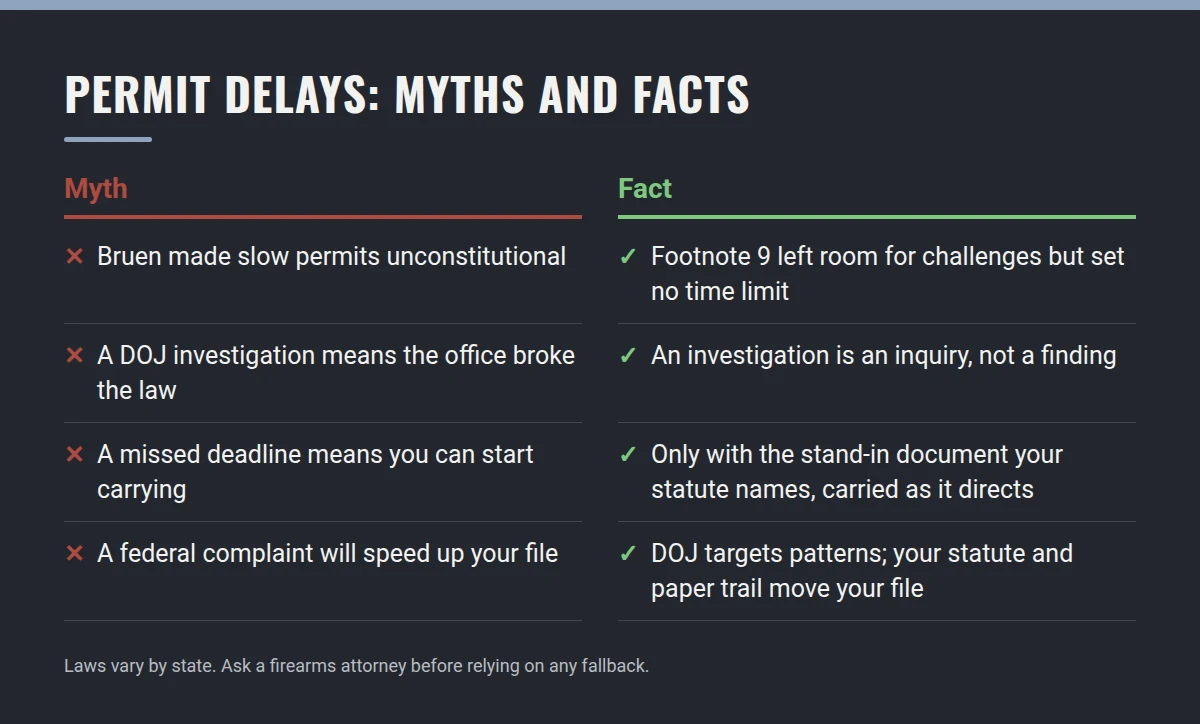
The rule for every state: rely on an interim document only in the exact form the statute describes, carried with the identification it names. If you are unsure whether you are covered, do not carry until you are.
Build the Paper Trail Before You Need It
You cannot show that a deadline was missed without proof of when it started. From the day you apply:
- Keep the dated receipt. Virginia’s clerk writes the receipt date on the application itself, and Michigan’s fingerprint receipt shows the date and time. Save every confirmation email and screenshot every status page.
- Get the completion date in writing. Where the clock starts with a complete application, as in New Jersey, Virginia, Illinois, Texas, Florida, and California, ask the office to confirm in writing that your file is complete and on what date. Illinois must tell you electronically. Elsewhere, ask.
- Meet your own deadlines. Answer any request for missing items quickly and in writing, and note the date you did. New Jersey’s online system, as the Inquirer described it for Pennsauken applicants, requires you to pay the fees and get fingerprinted within 90 days of submitting.
- Log every contact. Write down the date, the time, the name of the person you spoke with, and what they said. A log kept at the time is far more persuasive later than memory.
- Calendar the deadline from the right starting point, with a reminder a week ahead.

Escalate Politely, One Rung at a Time
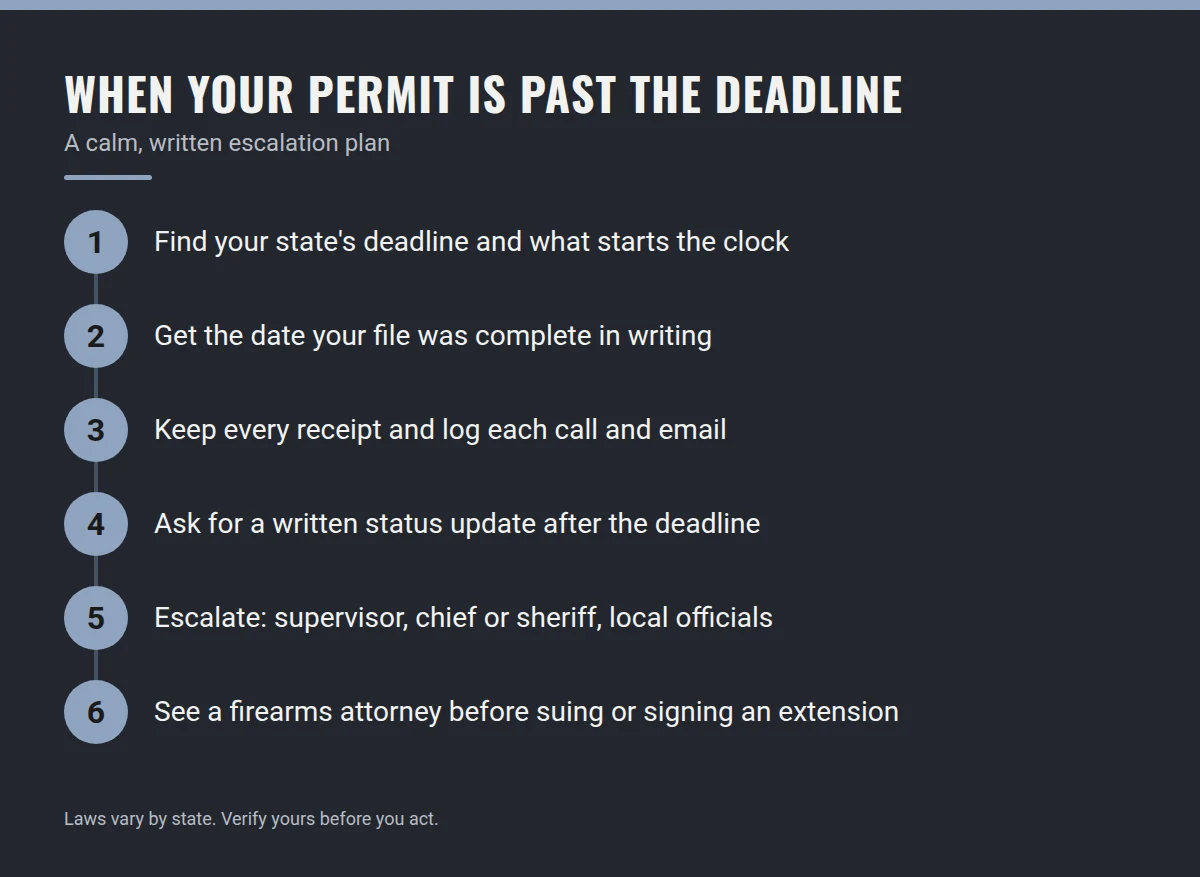
The person who answers the permit line probably did not set the office’s staffing, and a courteous applicant with a clear paper trail usually gets further than an angry one. Climb in this order, and put each request in writing.
- Ask the permit unit for a status update on the first business day after the deadline. Keep it short: your name, your application date, the statute section and its deadline, and four questions. Is my application complete? What stage is it in? Is anything outstanding from me? When should I expect a decision?
- Find out which agency is holding it. Many applications pass through a state records check and an FBI fingerprint check, and statutes often allow for that. California’s deadline moves to 30 days after the state’s background report when that comes later, and Florida allows extra time to resolve a record with no final disposition. If your file is waiting on another agency, the local clerk cannot fix it, but that agency’s firearms unit might.
- Write to the supervisor, then the chief or sheriff. Attach your log and your earlier request, and ask for a decision date in writing.
- Contact the officials who fund the office. Backlogs are often a staffing problem. When Los Angeles County cut its waits, the Justice Department credited the sheriff with devoting “substantial additional resources, including new processing software and additional personnel.” City councils, township committees, county commissioners, and your state legislator’s constituent office all have a say in those budgets.
- File a federal complaint if you see a pattern. The Civil Rights Division’s Second Amendment Section asks anyone who believes their right to keep and bear arms is being infringed to submit a complaint through its website. The section enforces the federal police pattern-or-practice law, so expect a complaint to add to a record rather than move your own file.
When a Delay Becomes a Legal Problem
Call a firearms attorney in your state when:
- The deadline has passed, you have asked in writing at least twice, and no one will give you a reason or a date.
- The office keeps calling your application incomplete over items the statute does not require.
- You are asked to sign an extension or a waiver.
- Your state offers a fallback and you want to know whether you can rely on it.
- You are thinking about suing.

A lawyer’s first move is often a letter citing the statute. If that fails, the usual state-court tool is a petition for a writ of mandamus, which the Legal Information Institute defines as “an order from a court to an inferior government official ordering the government official to properly fulfill their official duties or correct an abuse of discretion.” Federal courts cannot issue mandamus to state officers, so that petition belongs in state court.
The federal route is a civil rights suit under 42 U.S.C. § 1983, which lets a person sue an official who, acting under state authority, deprives them of a constitutional right, and § 1988 lets a court, in its discretion, award the winning side a reasonable attorney’s fee. Timing is the catch. In the Pennsauken lawsuit, the judge found no constitutional injury because the applicants had their permits by the time the claims were decided. A lawyer can tell you whether your facts, and your state’s courts, make either route worth the cost.
What Bruen Actually Said About Wait Times
The Justice Department’s position rests on one footnote. In New York State Rifle & Pistol Association v. Bruen, the 2022 decision that struck down New York’s proper-cause requirement, the Supreme Court said nothing in its analysis should suggest that the 43 shall-issue states’ licensing systems are unconstitutional. Then it added a caution: “because any permitting scheme can be put toward abusive ends, we do not rule out constitutional challenges to shall-issue regimes where, for example, lengthy wait times in processing license applications or exorbitant fees deny ordinary citizens their right to public carry.”
That sentence leaves a door open, but it does not say how long is too long. The Justice Department reads it more broadly, stating flatly in the Pennsauken announcement that “it is a violation of the Second Amendment for government officials to delay issuing permits to purchase or carry firearms.” That is the government’s position in an investigation, not a court’s ruling.
Its Los Angeles case ended without a ruling. In September 2025, the department sued the Los Angeles County Sheriff’s Department, alleging that of 3,982 applications for new licenses received from January 2024 through March 2025, the sheriff approved two, and that applicants waited an average of 281 days just for processing to begin, against California’s 90-day deadline for the first decision. The two sides agreed to settle in August 2026, with the Justice Department saying the sheriff had “drastically cut those waiting times and is now in compliance with statutory deadlines.” For how the courts are handling the rest of Bruen, see our guide to Second Amendment case law.
The practical upshot: your state’s statute is the measuring stick, and footnote 9 is the backstop for when the statute has no teeth or the office ignores it.
While You Wait
Until the permit, or your state’s stand-in document, is in your hand, carry only where your state’s law already allows it without one. If you live in a permitless carry state and meet its requirements, you may already be able to carry in your home state; there, the permit mostly matters for travel and for the exceptions that still require one, as our guide to what a permit still buys in a permitless state explains. Either way, the wait is a good stretch for dry practice and range time.
Renewals sit in the same queues: just over half of the roughly 8,400 applications in the Los Angeles data were renewals. File as early as your state allows, because an expired license is expired unless your state’s law says otherwise. Oregon, for one, keeps a license valid for up to 45 days after you apply for renewal, if you applied before it expired, have proof of the application, and have not been denied.
The Bottom Line
Know your state’s deadline and what starts it, get the completion date in writing, keep a log, and escalate in writing one rung at a time. Rely on a missed-deadline remedy only in the exact form your statute describes. A federal investigation like Pennsauken’s may change how a department works, but it will not move your file this week; your statute and your paper trail will. Laws and procedures change, so confirm the details with your issuing office, and talk to a firearms attorney in your state before suing, signing an extension, or carrying on anything other than an issued permit or the stand-in document your statute names.
Further reading (sources)
- U.S. Department of Justice on its investigation of Pennsauken’s permit delays and its settlement with the Los Angeles County Sheriff’s Department
- The Philadelphia Inquirer with the township’s processing estimate and the dismissal of the 2024 delay claims
- Benton v. Platkin, the 2024 complaint by a Pennsauken applicant over purchase permit delays
- United States v. Los Angeles County Sheriff’s Department for the federal complaint, with the application data and California’s deadlines
- Legal Information Institute on the Bruen opinion and its footnote 9, the writ of mandamus, 42 U.S.C. § 1983, and attorney’s fees under § 1988
- Minnesota Revisor of Statutes for section 624.714, with the 30-day rule and the permit card requirement
- Washington State Legislature with RCW 9.41.070 on concealed pistol license timing
- Michigan Legislature on MCL 28.425b and the receipt that serves as a license
- Code of Virginia for section 18.2-308.05 and the de facto permit
- Pennsylvania General Assembly with 18 Pa.C.S. 6109 and the sheriff’s 45 days
- Oregon Legislature on ORS chapter 166: the 45-day deadline, court review, and renewals
- Texas Legislature for Government Code section 411.177 and its 60-day deadline
- Florida Legislature with section 790.06 on the 90-day deadline and record extensions
- Illinois General Assembly on 430 ILCS 66/10 and the 90-day deadline
- New Jersey Legislature for P.L. 2022, c.131, with the deemed approval rule and the purchase permit deadline (archived)
- New York State Senate with Penal Law 400.00 and its six-month rule