When Your Doctor Asks About Guns: Firearm Risk Screening and What It Means for a Permit Holder
Published on September 20, 2026

You are in an emergency department at eleven at night for a kid’s broken wrist, or a kidney stone, or a hand you put through a window frame. Somewhere between triage and discharge, a nurse looks up from a screen and asks whether anyone in your house has been threatened with a gun. For a lot of permit holders, that question lands like an accusation, and the instinct is to shut the conversation down.
The Tool Behind the Question
That instinct is understandable and mostly misplaced, but it deserves a real answer rather than reassurance. Some of those questions come from a specific, validated instrument, and in 2026 that instrument got considerably more evidence behind it.
The screen in question is the SaFETy score, a four-item, ten-point tool built to estimate a young adult’s risk of being involved in interpersonal firearm violence over the following year. The acronym covers what it asks about: Serious fighting, Friend weapon carrying, community Environment, and firearm Threats. The original version was developed from a study of youths presenting to an urban level 1 emergency department and published in Annals of Internal Medicine in 2017, where the authors noted it could be administered in one to two minutes.
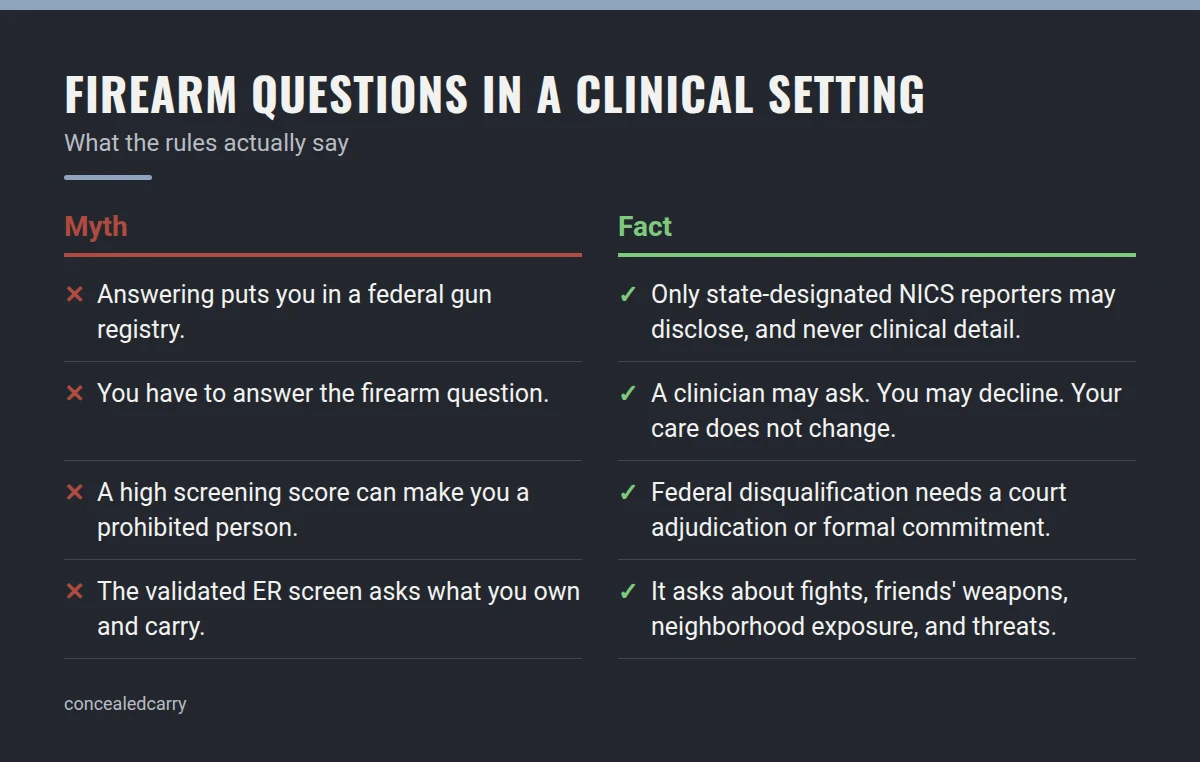
Read that item list again, because it is the single most important thing in this article. The score does not ask whether you own a firearm. It does not ask how many, what kind, whether you carry, or whether you hold a permit. It asks how often you have been in a serious physical fight, whether your friends carry weapons, how much gunfire and violence you have been exposed to in your neighborhood, and whether someone has threatened you with a gun. Those are questions about the environment a patient lives in, not about the contents of a gun safe.
The new work is a multisite external validation, funded by the Centers for Disease Control and Prevention and published in Annals. Researchers enrolled 1,506 adults aged 18 to 24 who came to one of four level 1 emergency departments across three cities for any reason at all, then followed them for a year. Among those whose twelve-month outcome could be established, the pattern was steep: a baseline score of 0 was followed by firearm violence in 1.8 percent of cases, a score of 1 to 5 in 12.1 percent, and a score of 6 or higher in 25.0 percent. The area under the ROC curve was 0.78.
The authors also tried to beat the score using a full set of covariates, including demographics, substance misuse, and screens for anxiety, depression, and post-traumatic stress. That much larger and more intrusive battery did not reproduce the gradient or explain where the score’s predictive power came from. Four questions did work that a wall of them could not. The paper is candid about its limits too: outcomes were mostly self-reported, and the highest-risk participants were the likeliest to go missing from follow-up.
Two things follow for a permit holder. First, if you are over 24, this particular screen was not built for you and is unlikely to be what you are being asked. Second, even at the top band, three quarters of the people scoring 6 or higher had no firearm violence in the following year. This is a population risk gradient, not a verdict on an individual, and no responsible clinician treats it as one.
Why a Clinician Brings It Up at All
Emergency medicine is where firearm injury physically arrives, and injury prevention has always been part of the job. Nobody objects when a pediatrician asks about pool fencing, bike helmets, or whether the cleaning products are up high. Lethal means counseling sits in the same tradition: the point is to put time and distance between a person in crisis and a fast, irreversible method.

What has changed recently is the demand for evidence. A parallel line of research makes the point neatly. A nationwide case-control study underway with National Institutes of Health funding is testing 27 school safety tactics, everything from metal detectors to arming staff, against a census of schools that experienced intentional gunfire on campus during school hours since 2015, matched against control schools drawn from the Department of Education’s national database. The reason the study is necessary is embarrassing: American schools adopted most of these measures with almost no controlled evidence that they work.
That is a standard gun owners should want applied everywhere, including to the questions asked in an exam room. An instrument that has been externally validated across four hospitals is a different animal from a question somebody added to an intake form because it felt responsible. Asking which one you are looking at is a fair question, and it is the same skepticism we apply to school-zone policy for armed staff.
What Actually Goes in the Record, and What Cannot Leave It
Here is the part that drives the anxiety, so here is the law rather than the folklore.
Your answers go into your medical record, where they are protected health information under HIPAA like everything else in the chart. There is no federal firearm registry fed by doctors’ notes, and the regulation is unusually specific about why not. The HIPAA rule that permits reporting to the National Instant Criminal Background Check System, 45 CFR 164.512(k)(7), applies only to state agencies or entities formally designated to report to NICS and to the courts, boards, and commissions that make the underlying adjudications. It covers limited demographic identifying information and expressly does not permit disclosure of diagnostic or clinical information. An emergency physician treating your kidney stone is not a designated NICS reporting entity, and the intake screen is not an adjudication.

The federal prohibitor people are actually afraid of is 18 USC 922(g)(4), which disqualifies anyone adjudicated as a mental defective or committed to a mental institution. The implementing definition in 27 CFR 478.11 requires a determination by a court, board, commission, or other lawful authority, and the commitment definition specifically excludes a person in a mental institution for observation and a voluntary admission. Talking to a doctor is not that. Checking into treatment on your own initiative is not that either. The line federal law draws is a formal legal proceeding, not a conversation. The same is true of the other silent federal disqualifiers, which trip up far more permit holders through prescriptions and cannabis than through anything said in an exam room, and the full list sits in our federal firearms law reference.
The Exception That Is Real
Now the honest part. One HIPAA exception has teeth, and pretending otherwise would be doing you no favors.
Under 45 CFR 164.512(j), a provider may disclose protected health information when they have a good-faith belief it is necessary to prevent or lessen a serious and imminent threat to health or safety, and the disclosure goes to someone reasonably able to prevent or lessen that threat. The Department of Health and Human Services has been clear that HIPAA permits this rather than requiring it, though many states layer their own duty-to-warn obligations on top.
In a growing set of jurisdictions, a clinician can also go further. Colorado, Connecticut, the District of Columbia, Hawaii, Maryland, Massachusetts, Michigan, New York, and the US Virgin Islands allow clinicians to petition a court directly for an extreme risk protection order. In states without that authority, a clinician can still hand information to a family member or a law enforcement officer who does have standing to file.
Notice what triggers all of this. Not ownership. Not a permit. Not a high score on an intake screen. A specific, credible, imminent threat, which is the same threshold that has applied to therapists for half a century.
The Gag-Law Fight and Where It Landed
Florida tried to legislate the question out of existence. Its 2011 Firearm Owners’ Privacy Act, known widely as Docs versus Glocks, barred physicians from asking about firearm ownership, recording the answers, and harassing patients about it. On February 16, 2017, the Eleventh Circuit sitting en banc struck down the inquiry, record-keeping, and anti-harassment provisions as content-based restrictions on physician speech that could not survive First Amendment scrutiny. It left standing the provision barring doctors from discriminating against patients who own guns, reading that one as regulating conduct rather than speech.
The outcome is a workable balance, and the asymmetry inside it is the answer to most of the anxiety. Your doctor has a constitutional right to ask. You have no obligation whatsoever to answer. Nobody can hold your care hostage to the response.
Other states drew the line differently and still have statutes on the books. Missouri’s section 571.012, in force since 2014, says no licensed health care professional may be required to ask about firearm access, to document it, or to notify any government entity of a patient’s identity based solely on firearm ownership. It bars electronic record systems from requiring the field before a chart can be completed, and it restricts disclosure of firearm information except by court order, in response to a threat to health or safety, as part of a mental health referral, or with the patient’s express consent on a separate document dealing only with firearms. It preserves the clinician’s ability to ask when it is medically indicated.
A word of caution on reading any of this as settled. One circuit’s ruling binds one circuit, statutes in other states are unaffected, and litigation moves slowly. That is the same trap we walk through in our piece on how a court win can leave a law fully in force.
Answering Without Creating a Records Problem
Practical guidance, in the order it tends to matter.

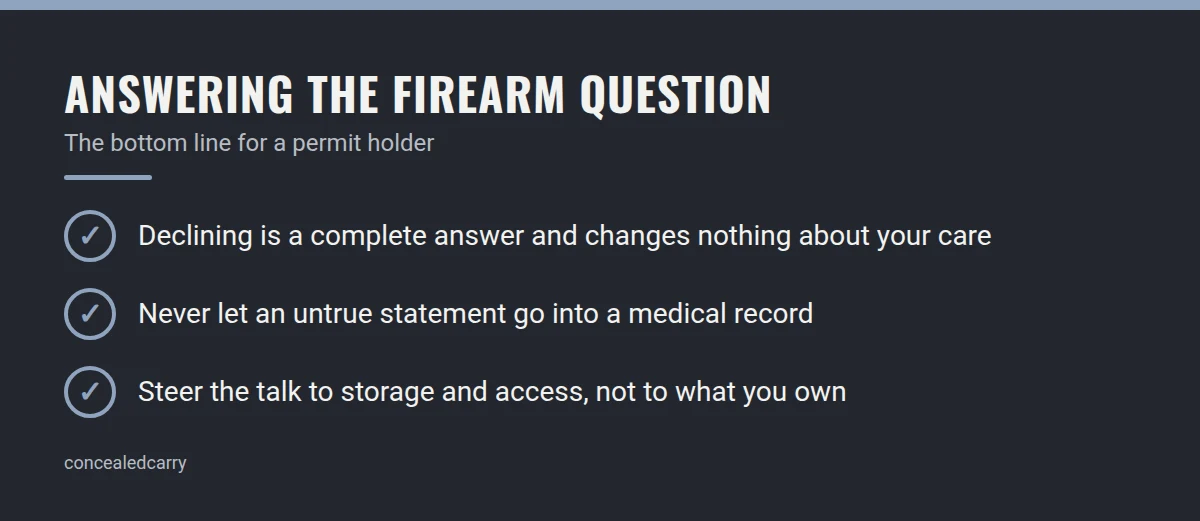
- You can decline. “I would rather not discuss that” is a complete answer. It is not a red flag, it does not go in your chart as refusal to cooperate, and it does not change your treatment.
- Do not escalate. Declining calmly costs nothing. A lecture delivered to a nurse at 2am is the kind of thing that does end up in a note.
- If you answer, answer honestly. An untrue statement in a medical record is far worse than a blank space, and it can follow you into any later proceeding.
- Steer to storage, which is the useful conversation. If there is a teenager in the house, a person in crisis, or a relative with dementia, access is the live question and you probably already know it. That conversation is worth having with somebody.
- Say so if you are in crisis. The federal prohibitor requires a court adjudication or a formal commitment, and voluntary treatment is expressly excluded. Worrying about the paperwork is the wrong thing to be afraid of in that moment.
- Read anything you sign. A blanket records release is not the same as answering a question out loud, and in states like Missouri the separate firearms-consent document exists precisely so it cannot be buried in a stack.
- Ask where the answer goes. “Does that go in my chart, and who can see it?” is a reasonable question and any decent clinician will answer it.
- Get a lawyer if it has already gone sideways. A records subpoena, a permit denial, or an ERPO petition is firearms-attorney territory, not something to handle from a waiting room. The same goes for how your state’s application treats mental health history, which varies as widely as everything else in state permit and training law.
The screen is not looking for you. It is looking for a 20-year-old who has been in three fights this year and was held at gunpoint in March, and it turns out four questions find him better than a psychological battery does. A permit holder who has sat through a real class already thinks in terms of risk, access, and storage. That is the vocabulary the clinician is reaching for, and you speak it better than most patients in the building.
Further reading (sources)
- Annals of Internal Medicine on the multisite validation of the SaFETy score across four emergency departments
- Goldstick and colleagues for the original development of the four-item SaFETy score
- PLOS One with the protocol for a nationwide controlled study of K-12 school firearm safety tactics
- Cornell Legal Information Institute on the HIPAA exceptions covering serious threats and NICS reporting
- Cornell Legal Information Institute for how federal regulation defines commitment and adjudication
- US Department of Health and Human Services explaining when a provider may disclose information about a dangerous patient
- Eleventh Circuit Court of Appeals and its en banc opinion striking down Florida’s physician inquiry ban
- Missouri Revisor of Statutes for the state limits on documenting a patient’s firearm ownership
- National ERPO Resource Center on which states let clinicians petition the court directly