Raising Kids Around Guns: Age-Appropriate Safety Talks, First Range Trips, and Youth Shooting Sports
Published on September 29, 2026
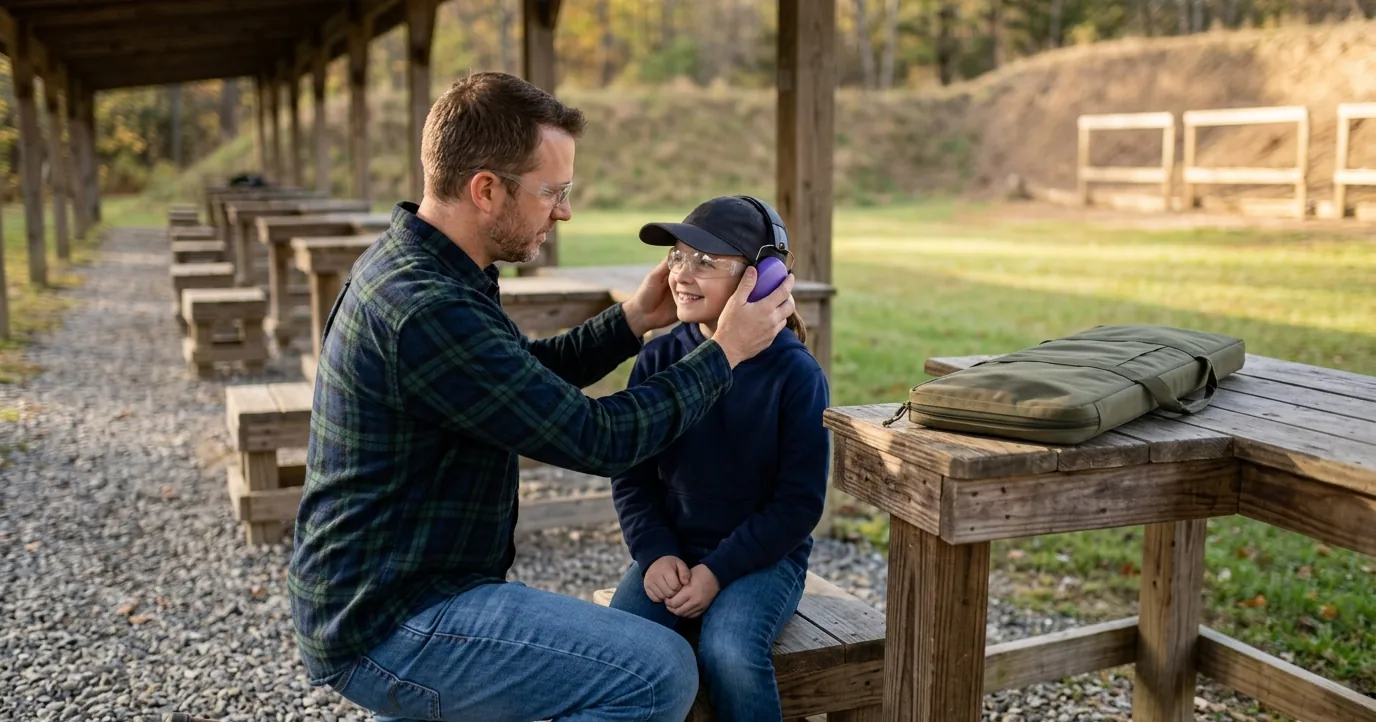
If you carry, your children are growing up around a gun whether or not anyone talks about it. Sooner or later they notice the safe in the closet and ask what is inside, whether they can hold it, and why their best friend’s parents don’t have one. Most advice written for parents treats the child as a hazard to be locked out: buy the safe, hide the key, change the subject.
Locked storage matters more than anything in this article, and nothing here replaces it. But children can also be taught, and the research on how to teach them is better than most parents realize. Here is what to teach at each age, what the evidence says about the classic safety message, and how to handle range trips, youth leagues and other people’s homes.
What a Child Can Understand at Each Age
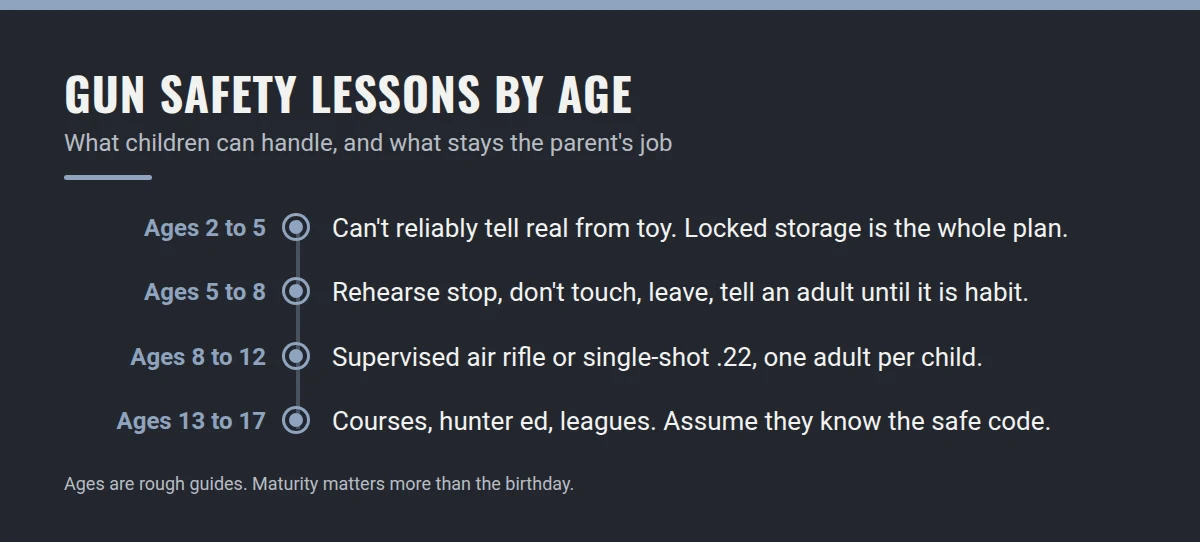
Fit the lesson to the child in front of you. These ranges are rough, and maturity matters more than the birthday.
Toddlers and preschoolers, roughly 2 to 5. Young children cannot reliably tell a real gun from a toy or hold a rule against a strong impulse. Even older children miss the first part: in a well-known Emory University study, about half the boys aged 8 to 12 who found a real handgun in a playroom thought it was a toy or were unsure. Start the vocabulary (“that is a real gun, and real guns are for grown-ups”), but at this age the safety plan is entirely yours. Every gun is on your body in a holster or locked away. There is no third place.
Early grade school, roughly 5 to 8. Children this age can learn a short rule and, more usefully, practice it until it becomes habit. The four-step programs below are built for them.
Older kids and tweens, roughly 8 to 12. Many are ready for supervised, hands-on learning: the basic safety rules, why it matters where a muzzle points, and a first shot with an air rifle or a single-shot .22 with an adult at their elbow. 4-H shooting sports clubs generally take members from age 8.
Teenagers, 13 to 17. Teens can handle formal courses, hunter education and real responsibility on the range. They also know where the key is. Plan your storage as if they have watched you open the safe, because they probably have.
Stop, Don’t Touch, Tell an Adult: What the Research Shows
The best-known version of the message comes from the NRA’s Eddie Eagle GunSafe program, aimed at preschool through fourth grade: stop, don’t touch, run away, tell a grown-up. Researchers have tested it and similar programs closely, and the results cut both ways.
Where it works. In a randomized study at North Dakota State University, both the Eddie Eagle materials and a behavioral skills program taught children aged 6 and 7 to recite the rule. Good instruction changes behavior too. In a 2023 randomized trial at Ohio State, published in JAMA Pediatrics, children aged 8 to 12 watched either a one-minute gun safety video or a car safety video at home. A week later they played in a lab room where two disabled handguns sat in a file cabinet drawer. Among the children who found a gun, the gun-video group touched it less often (39 percent against 67 percent), pulled the trigger far less (9 percent against 30 percent), and were three times as likely to tell an adult (34 percent against 11 percent). Children who had taken a firearm safety course, or who lived with guns at home, also behaved more safely.
Where it fails. Even in the winning group, two in five children touched the gun and only a third told an adult. In the 2001 Emory study, 30 of 64 boys handled a real pistol they found in a drawer, and 16 pulled the trigger hard enough to fire it. More than 90 percent of the boys who handled it said they had received some gun safety instruction, and parents’ estimates of their son’s interest in guns did not predict who would touch it.
A 2019 systematic review by Rutgers researchers concluded that school and community gun safety programs do not make children less likely to handle a gun they find unsupervised. A 2003 study found boys more likely to touch a forbidden gun than other forbidden objects, a sign that guns carry a pull a warning does not cancel.
What works better. Behavioral skills training: instruction, modeling, rehearsal and feedback, then practice in a realistic setting. In the North Dakota study, children trained this way were significantly more likely than the Eddie Eagle group to perform the steps in role plays and surprise real-world checks, and one on-the-spot practice session helped both groups. In a small follow-up from the same team, parents delivered the training at home, and it worked for three of four children. At home:
- Explain the four steps in plain words.
- Model them: “find” a toy gun under the couch, say “stop,” keep your hands at your sides, leave the room and tell the other parent.
- Rehearse until your child can run the sequence out loud in any room of the house.
- Give feedback at once, praising what went right and rerunning what was missed.
- Check quietly now and then with a toy gun left where your child will find it. If they pick it up, skip the scolding and rehearse again. Never use a real gun for this, loaded or not.
Training lowers the odds; it does not remove them. The rule is the backup. Locked storage is the plan.
Answering Curiosity So the Gun Stops Being Forbidden Fruit
Curiosity is already at work. In a survey at a rural Alabama family practice clinic, children under 10 in gun-owning homes were nearly as likely as older children to say they knew where the gun was kept (73 percent against 79 percent), and 36 percent in both groups said they had handled one. Nearly four in ten parents who believed their child did not know the storage spot were contradicted by the child, whether or not the parents locked their guns or had talked about safety.
The Eddie Eagle program’s own advice to parents is that removing the mystery leaves a child far less curious and more likely to follow the rules. In practice:
- Answer questions when they come, briefly and honestly: “It is a tool for protecting our family. It can hurt or kill someone in an instant, so only trained grown-ups handle it.”
- Say yes to a supervised look, on your terms: at the safe, after you have unloaded it, locked the action open and moved the ammunition to another room. Keep a handgun in your own hands, muzzle in a safe direction, while you name the parts and let your child look closely, because federal law limits when anyone under 18 may hold one, even at home. Then it goes back in the safe.
- Make the rule about asking. “You can see it any time you ask. You never touch it without me.” A child who can get a look by asking has little reason to go looking alone.
- Talk back to the screen. In the Ohio State trial, more exposure to age-inappropriate movies went with more unsafe handling. When a movie character waves a pistol around, point out everything they did wrong.
No trial has shown that demystifying guns makes children safer on its own, and the forbidden-gun study shows the pull is real. Open conversation shrinks the allure; it does not switch it off.
Your Carry Gun Is Part of the Lesson
A carrying parent has a problem most gun owners do not: the gun moves around the house with you, and children hug, climb and grab.
- On your body, it stays holstered in a rigid holster that covers the trigger guard, worn on a belt. Our holster guide covers positions and retention. A gun in a purse goes wherever the purse goes, including the back of a kitchen chair.
- Off your body, it goes straight into a quick-access safe, not a nightstand drawer or a high shelf. Coming home, showering and bedtime are the moments that need a fixed routine.
- It never comes out to answer a question. Drawing in the kitchen because a child asked undoes everything above, and children copy what they see far more than what they hear.
Running a Child’s First Range Session
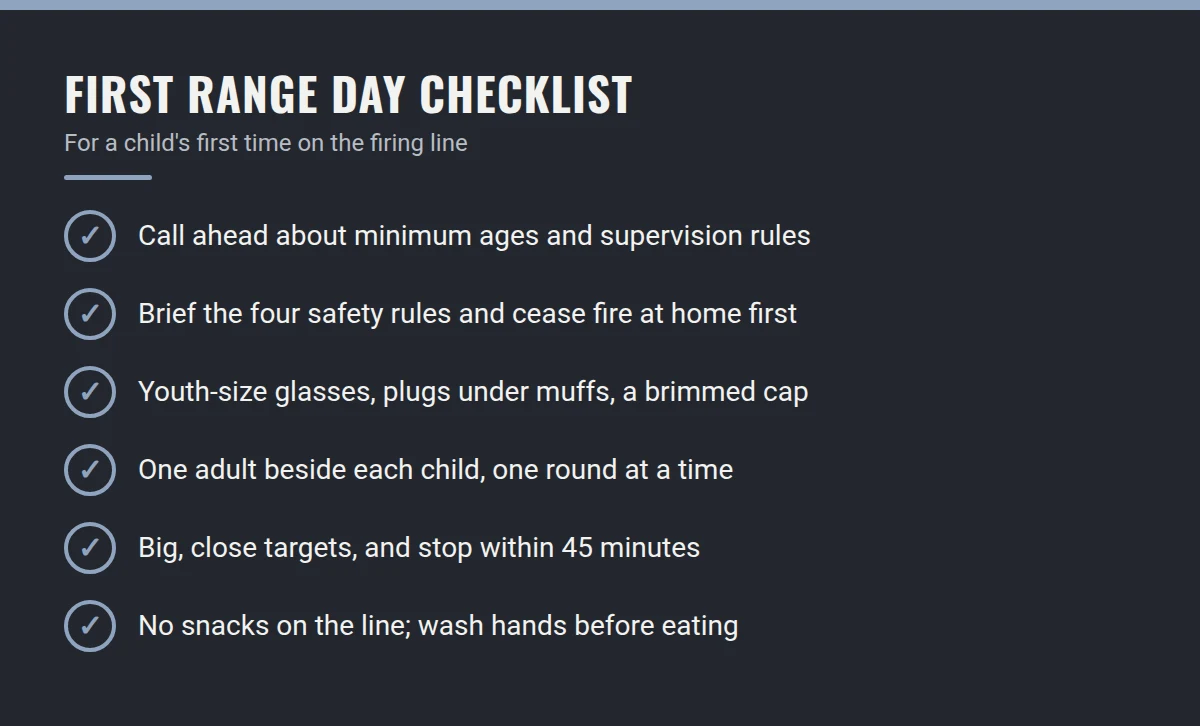
Not everyone agrees children should shoot. The American Academy of Pediatrics advises against letting a child take a turn, arguing that no amount of instruction makes a child capable of handling a lethal weapon. Youth programs such as 4-H take the opposite view and put children on the line under certified instructors. If you decide your child is ready, borrow the programs’ structure. The test is not a birthday but whether your child follows instructions with several steps, stops instantly when told, and keeps the rules at home. Then:
- Call ahead, because ranges set their own minimum ages and supervision rules. An outdoor range on a quiet weekday morning beats an indoor bay beside a stranger’s large-caliber pistol.
- Brief at home the day before. In kid words: every gun is loaded until a grown-up proves it is not; the muzzle points downrange; your finger stays straight until you are ready to shoot; know what is behind your target. And when anyone says “cease fire,” you stop, set the gun down pointed downrange and step back.
- Fit the gear: youth-size safety glasses, earplugs under earmuffs, a brimmed cap and a crew neck. Our guide to your first trip to the gun range covers protection and range commands in more depth.
- One adult per child, beside them the whole time. The child shoots from a rest, such as a sandbag on a bench, and the adult hands over one round at a time.
- Use big, close targets that show hits. A paper plate that catches every shot builds more confidence than a bullseye that swallows the misses.
- Keep it to thirty or forty-five minutes, and stop while your child still wants more. If the noise frightens them, come back another day with an air rifle.
- Treat lead as part of the lesson. A review of 36 studies of shooters’ blood lead named children among the recreational shooters at special risk. No snacks on the line, no gathering brass by hand, wash hands and faces before anyone eats, and change clothes at home.
Choosing a Starter .22, or Starting With an Air Rifle
Choose a first gun for control, not excitement.
- Consider an air rifle first. It is far quieter and cheaper to shoot than a rimfire, and 4-H commonly starts children on one: New York opens air rifle at 9 but holds rifle, shotgun and muzzleloader until 12. The same rules apply, and lead pellets still mean washing hands.
- For a first .22, a single-shot bolt action is the classic choice. One round goes in, one round is fired, and you always know whether it is loaded. A manual safety and, on some youth rifles, a separate cocking step add deliberate pauses.
- Fit beats features. Youth rifles have shorter stocks, so the butt sits in the shoulder while the trigger finger reaches naturally. A rifle that is too long gets held out at arm’s length. Start with the rifle’s own sights.
- Save semiautomatics and handguns for later. A magazine-fed gun makes it harder to tell at a glance whether it is loaded, and a short handgun barrel sweeps across people with a small turn of the wrist. Federal law also generally bars anyone under 18 from possessing a handgun. The exceptions for target practice, hunting and safety courses require a parent’s prior written consent, which the child must carry, and states can add rules of their own (our federal firearms law guide covers the wider picture). New York 4-H, for one, holds pistol until 14.
- It is your rifle, whatever the gift tag says. Dealers cannot sell any gun to a buyer under 18, so you buy it, and it lives in your safe. Calling it her rifle is fine. Storing it in her closet is not.
Youth Shooting Sports: Where the Real Coaching Is
Most kids take correction better from a coach than from a parent. Youth programs supply trained instructors, a safety culture enforced by other adults, and peers who treat safe handling as the price of admission.
4-H Shooting Sports runs through county extension offices and adds disciplines as children grow. Illinois opens archery and air rifle at 8, smallbore rifle, shotgun and air pistol at 10, and .22 pistol at 12, and each local program is led by a coordinator who must be at least 21 and complete a state certification workshop. New York instructors pass criminal background and reference checks. In Mississippi, members compete at county, district and state level, and only the top four in each discipline reach nationals, held this year in Grand Island, Nebraska. A Mississippi member who began shooting sports at eight placed third overall there in June after more than 300 hours of practice. The sport felt like a default at first, he said, before it became his own, and he now helps teach other members about safety.
Scholastic programs. The Scholastic Shooting Sports Foundation, a 501(c)(3) charity, runs the Scholastic Clay Target Program (trap, skeet and sporting clays) and the Scholastic Action Shooting Program (action pistol and rimfire rifle). Teams form around schools and communities, and adult coaches use the sport to teach sportsmanship, responsibility and teamwork.
Other on-ramps include Junior ROTC marksmanship teams, scouting shooting programs and state hunter education. Hunter education is worth taking even for a teen who never hunts, because it teaches safe handling where no range officer is watching.
Whichever you choose, look for certified instructors, youth-size equipment, a low ratio of shooters to coaches and a culture where safe handling is the status symbol. Sit in on a session first.
Teenagers: More Skill, Different Risks
A teen who came up through a league may soon outshoot you. The risks change shape, though.
- Storage has to stop a teenager, not a toddler. A lock that defeats a curious four-year-old will not stop a sixteen-year-old who has watched you open it. Avoid birthdays and obvious codes, change the combination now and then, and keep keys on your person. League experience does not make unsupervised access acceptable.
- A crisis changes everything. The AAP notes that suicidal thoughts in teens are often impulsive and acted on quickly, and that a loaded gun within reach makes those actions far more likely to be fatal. If your teen is going through a hard stretch (depression, a breakup, trouble at school or with substances), move the guns out of the house for a while, to a trusted relative or a storage service, following your state’s transfer rules. If you are worried about your child’s safety right now, call or text 988.
The Question to Ask Before a Playdate
You control your home, not the homes your children visit. The American Academy of Pediatrics says more than a third of unintentional shootings of children happen in the homes of friends, neighbors or relatives, and it suggests adding one question to the list parents already ask about pets, allergies and supervision: is there an unlocked gun in your house?
Carrying parents are the best-placed people to ask, because nobody mistakes the question for politics. Lead with your own practice: “We keep our guns locked up. Before the kids get together, how do you store yours?” Most gun owners will answer plainly. If the answer is vague, skip the argument and host at your house.
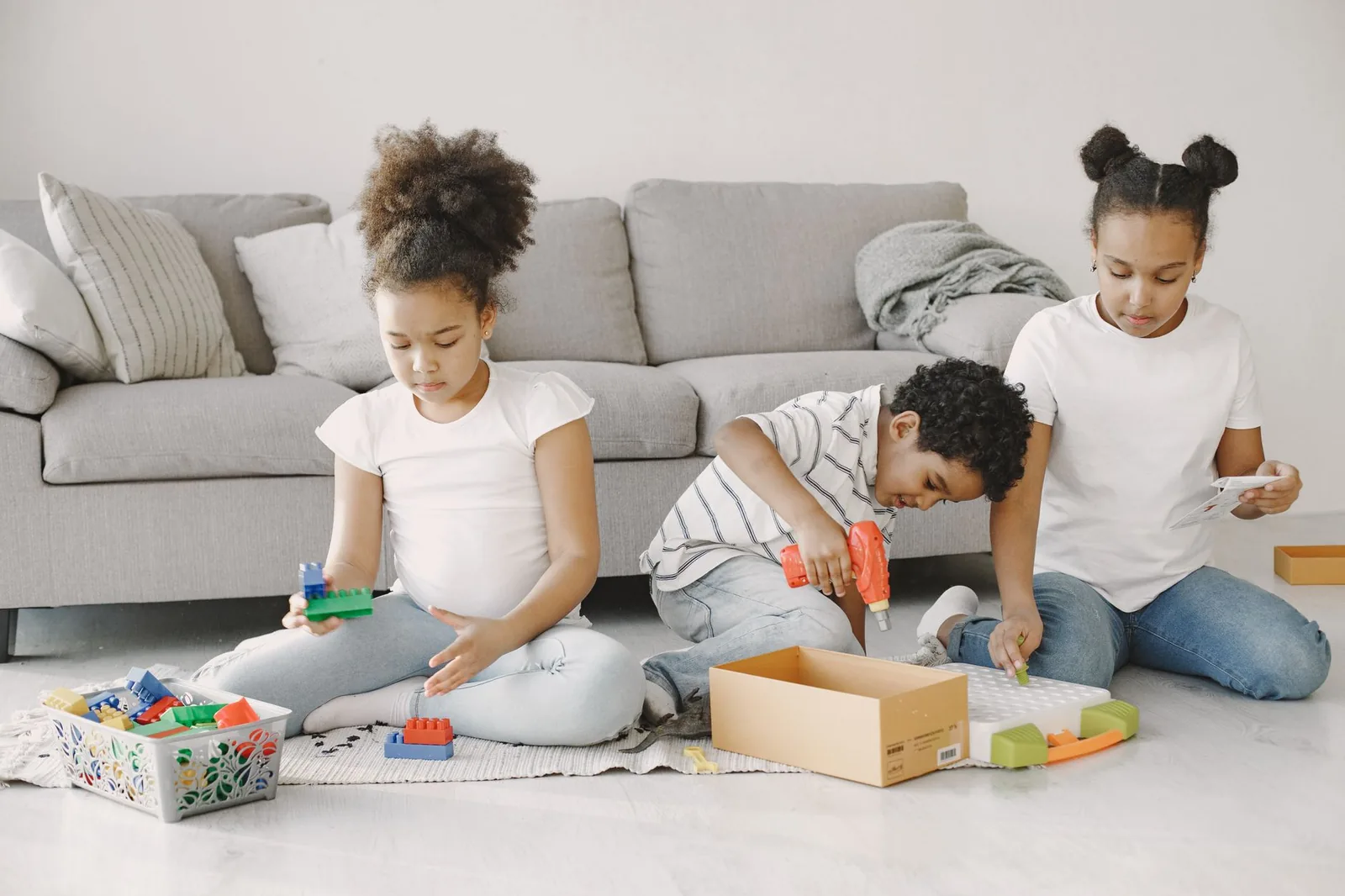
Then prepare your child for the day nobody asked. The four steps apply at a friend’s house, including when the friend is the one holding the gun. Agree on a code phrase they can text or say on the phone that means “come get me now,” so they can leave without losing face, and promise they will never be in trouble for using it.
Return the courtesy: tell visiting parents how you store your guns before they ask, and keep your carry gun holstered on your body or locked in the safe while their kids are over. Your pediatrician may ask you the same question; our guide to when your doctor asks about guns explains why clinicians raise it.
The Short Version
Teach the rule, rehearse it until it is habit, answer questions on your terms, and give an interested child real coaching when they are ready. Then lock up anyway, because every study above says a well-taught child will still sometimes touch a gun they find. Laws on minors, supervision and storage vary widely by state, so check yours and ask a firearms attorney about anything unusual. And put your child, and yourself, in front of a certified instructor in person.
Further reading (sources)
- Kjærvik and Bushman on how a one-minute safety video changed what children did around real handguns
- Jackman and colleagues for what boys aged 8 to 12 did when they found a real handgun
- Gatheridge and colleagues comparing Eddie Eagle with behavioral skills training in children aged 6 and 7
- Gross and colleagues on parents delivering gun safety skills training at home
- Holly and colleagues with a systematic review of school and community gun safety programs
- Hardy on why boys reach for a forbidden gun more than other forbidden objects
- Baxley and Miller for how often children contradict their parents about household guns
- Laidlaw and colleagues on lead exposure at firing ranges and the shooters at special risk
- NRA Eddie Eagle GunSafe Program with the four steps and its guidance for parents
- American Academy of Pediatrics on where children’s unintentional shootings happen and the question to ask other parents
- Illinois 4-H for shooting sports age limits by discipline and coordinator certification
- New York State 4-H with its discipline age ladder and instructor screening
- Scholastic Shooting Sports Foundation on its clay target and action shooting programs for school-age shooters
- Picayune Item about a Mississippi 4-H member’s road to a national podium
- Legal Information Institute for the federal juvenile handgun rule and its written consent exceptions